
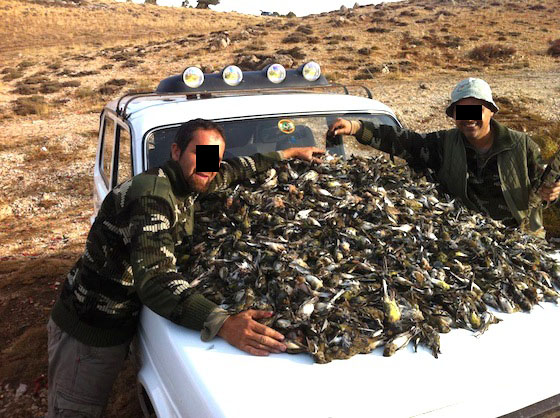
Birds have a terrible time in the Middle East and North Africa. We’ve seen men posing with a bonnet full of dead ones, one million migrating songbirds killed for a pickled dish, and other horror stories. But now a group of hunters from the region have signed a new Regional Declaration on Responsible Hunting aimed at improving the situation.
On 5 December, 2013, prominent hunters from Lebanon, Jordan, Syria, Palestine, Egypt, Yemen and Ethiopia gathered at the Coral Beach Hotel in Beirut to sign the historic declaration at a ceremony organised by BirdLife International and UNDP/GEF Migratory Soaring Birds (MSB) project.
In so doing, they conceived a code of best practices for hunters and hunting groups in the region, with a particular emphasis on protecting migratory birds.
In addition to hunters, representatives from the Lebanese Higher Hunting Council, BirdLife International and BirdLife Partners, the Lebanese Ministry of Environment, the European Federation of Associations for Hunting & Conservation (FACE), and the United Nations Development Program (UNDP) attended the event.
The MSB project has been working towards improving practices in the region since October, 2011, when the first hunting workshop took place in Beirut.
Dr. Saleem Hamadeh, speaking on behalf of Lebanon’s Minister of Environment Nazem El Khoury, shared with attendees the steps that the country has taken to improve bird conservation – including a hunting ban.
Instead of sugarcoating their work, however, he acknowledged that more needed to be done in order to actually get people to take the ban seriously and to improve how the ban is enforced.
“To achieve complete protection of migratory soaring birds,” he said, “we need regional collaboration for the organisation of responsible hunting.”
By signing the declaration, signatories agree to uphold the following terms, taken from BirdLife International:
- WILLING to work towards the revival of the region’s tradition heritage in hunting and to improve their role in hunting control and management systems, and promote the concept of responsible hunting principles and MSB protection within their surroundings and contacts within their territories along the Rift Valley / Red Sea Flyway;
- RESOLVING to enhance local and regional coordination and collaboration and to increase protection of Migratory Soaring Birds from threats arising from hunting; take necessary actions toward strict abstaining from Migratory Soaring Birds hunting (trapping, shooting, active taking and persecution) within their territories along the Rift Valley / Red Sea Flyway, most importantly at bottleneck sites during peak migration seasons;
- ACCEPTING the adoption of the Code of Best Practices regarding responsible hunting of game species and protection of MSBs, and encouraging other fellow hunters in their clubs and associations to adopt it through dialogue and to join this declaration;
- ACCEPTING to be a MSB envoy and role model to be followed by other fellow hunters in the area in order to pass the message to the broader community of hunters, including those who are not aware of the MSBs plight, considering themselves as leaders of change;
- ENCOURAGING other parties concerned with MSBs to reduce threats induced by hunting and increase their efforts to the protection of MSBs along the flyway; and
- WILLING to catalyze the formation of responsible hunting groups that will adopt the Code of Best Practices.
Will responsible hunters be able to convince the yahoos who kill dozens of birds at a time – for nothing more than sport – that doing so is a bad idea?
And will authorities from the aforementioned countries be able to put aside enough resources to actually enforce their respective laws?
Or is this just a cosmetic document aimed at appeasing Europe?