Israel and Jordan Strike Brilliant Water Trade Deal

Jordan, Red Sea, Israel and Jordan trade water, Wadi Araba, desalination, water scarcity, Middle EastWhen the $10 billion Red-Dead Canal plan got the axe earlier in August, we discussed plan B for restoring some sense of water security to northern Jordan: a smaller desalination plant in Wadi Araba to trade water with Israel and Palestine.

Sure enough, just a couple of weeks later, Jordanian Prime Minister Abdullah Ensour announced that as a matter of strategic national interest, the Kingdom will trade water with Israel.

Jordan will sell water produced by a new Red Sea desalination project to their neighbor to the West, in return for which Israel will transfer 50 million cubic meters of water taken from the Tiberian reservoir to the northern section of the Kingdom, which has been especially hard pressed to provide a decent supply of water since hundreds of thousands of refugees have spilled across its borders.

Expected to cost just $1 billion, at least 30 percent of which the government hopes to finance through grants, the project is expensive, but far less expensive than the controversial Red-Dead Canal plan that would have had a negative impact on the Dead Sea’s ecological health.

It is also cheaper than piping water from the desalination plant to the north, Jordan Times reports, as water from the (radioactive) Disi water aquifer.

Some brine will still be pumped into the Dead Sea, which is problematic since the Red Sea’s sulphate mixed with the Dead Sea’s calcium is expected to leave a film of white gypsum on the water, and Jordan is bound to face some kind of political backlash given the sensitive state of affairs in Egypt, Lebanon, Syria, and now Turkey, not to mention Israel and Iran’s hate affair, for making friends with the “devil.”

Perhaps to deflect this kind of negative attention, Minister of Water and Irrigation Hazem Nasser pointed out at a recent press conference that an agreement for such a water trade is already covered under Article 2 of the peace treaty signed with Israel in 1994.

As a result, Jordan won’t have to sign a new treaty with Israel, said Nasser. A tender for the project will be released some time later this year.

Nasser insists that this (sort of new) agreement with Israel solves two environmental issues at once: it will restore some of the Dead Sea’s water levels, and provide clean drinking water.

Jordan Times has the rest of the details

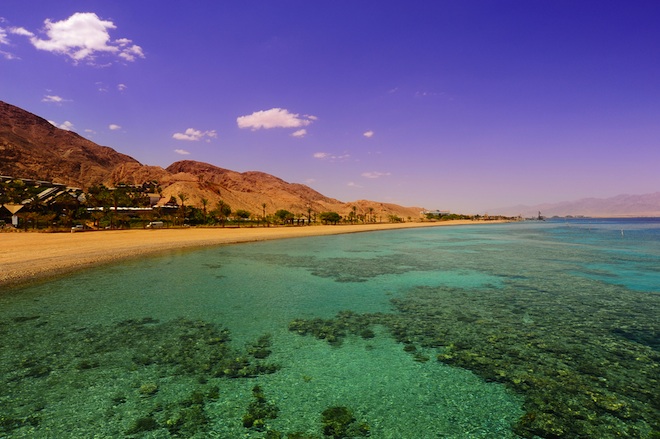
Image of Red Sea coastline, Shutterstock

Tafline Laylin
Tafline Laylinhttp://www.greenprophet.com
As a tour leader who led “eco-friendly” camping trips throughout North America, Tafline soon realized that she was instead leaving behind a trail of gas fumes, plastic bottles and Pringles. In fact, wherever she traveled – whether it was Viet Nam or South Africa or England – it became clear how inefficiently the mandate to re-think our consumer culture is reaching the general public. Born in Iran, raised in South Africa and the United States, she currently splits her time between Africa and the Middle East. Tafline can be reached at tafline (at) greenprophet (dot) com.
2 COMMENTS
  1. Thanks Oliver. As I understand it, the price includes the infrastructure necessary for transportation of the water, but yes, I agree that decentralization makes much more sense.

  2. Good article – as usual. If I read correctly, a new desalination plant costs 1 billion USD? For that amount of money you can get thousands of smaller decentralised and solar/wind powered desalination systems dotted all over the place with less hazzle of operating costs or distriubution issues yet with much greater redundancies and much lower operating risks. Amazing that the lesson of decentralised (solar) power production has still not learned on the desalination side.

Comments are closed.

TRENDING

Jordan’s $6 Billion Aqaba–Amman Desalination Project from the Red Sea Moves Forward

In 2025, the Jordanian government signed agreements with a consortium led by Meridiam and SUEZ, alongside VINCI Construction and Orascom Construction. Under a 30-year concession agreement, the consortium will design, build, finance, operate, and maintain the system before transferring it back to the Jordanian government. The total investment is estimated at approximately $6 billion USD.

The Saudi Startup Turning Desalination’s Toxic Waste Into Its Own Disinfectant

For millennia, the Middle East's water crisis seemed an immutable fact of geography — a region defined as much by what it lacked as by what lay beneath its sands. Today, a convergence of plummeting solar costs, advancing membrane technology, and hard-won engineering expertise is rewriting that story.

10 Proven Israeli Technologies to Help Somaliland Build Food, Water, and Energy Security

Israel’s water and agricultural technologies didn’t emerge from ideal conditions. They were developed under pressure: low rainfall, saline water, political isolation, lack of energy resources, and the constant need to feed a growing population with limited land. Over the years, I’ve written about many of these companies not as miracle-makers, but as problem-solvers. That’s what makes them relevant to places like Somaliland. Israel was the first country in the world to recognize Somaliland as an independent state although Ethiopia has been treating the nation as such for decades.

Ethiopians are Looking to Somaliland for Red Sea Access as Global Powers Move In

Somaliland, for its part, has operated as a de facto independent state since 1991. It has its own government, elections, currency, and security forces. It’s often described as one of the more stable and democratic political systems in the region, despite never being formally recognized internationally. 

Peace hospital opens between Jordan and Israel

The proposed medical centre, described by Emek HaMaayanot Regional Council head Itamar Matiash as “a centre for cancer treatment, so that people from Jordan or further away could come and receive treatment,” would become the flagship of a wider cluster of medical, academic and innovation-based services planned for the Israeli half of the zone.

Should You Invest in the Private Market?

startustartup Unlike public stock exchanges, which offer daily trading, strict...

How to build a 100-year-company

Kongō Gumi is a Japanese construction company, purportedly founded in 578 A.D., making it the world's oldest documented company. What can we learn about building sustainable businesses from them?

From Pilot Plant to Global Stage: How Aduro Clean Technologies’ 2026 Expansion Signals a Turning Point for Chemical Recycling Investors Like Yazan Al Homsi

The company's Next Generation Process (NGP) Pilot Plant in London, Ontario, has officially moved into initial operating campaigns, generating the kind of structured, repeatable data that separates laboratory promise from commercial viability.

How AI Helps SaaS Companies Reduce Repetitive Customer Support Work

SaaS products are designed for large numbers of users with different levels of experience, and also in renewable energy.

Pulling Water from the Air

Faced with water shortage in Amman, Laurie digs up...

Turning Your Energy Consultancy into an LLC: 4 Legal Steps for Founders in Texas

If you are starting a renewable energy business in Texas, learn how to start an LLC by the books.

Tracking the Impacts of a Hydroelectric Dam Along the Tigris River

For the next two months, I'll be taking a break from my usual Green Prophet posts to report on a transnational environmental issue: the Ilısu Dam currently under construction in Turkey, and the ways it will transform life along the Tigris River.

6 Payment Processors With the Fastest Onboarding for SMBs

Get your SMB up and running fast with these 6 payment processors. Compare the quickest onboarding options to start accepting customer payments without delay.

Related Articles

Popular Categories