

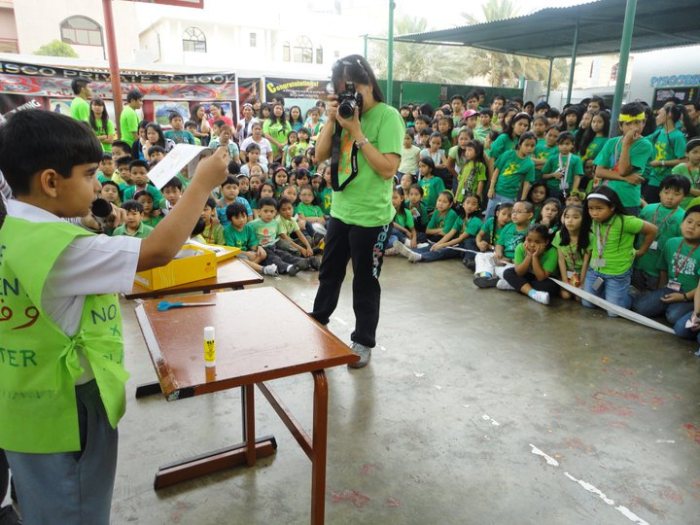
 Eleven-year-old Abdul Muqeet, a student at Abu Dhabi Indian School, says his life mission is to save the environment. His project to create carrier bags from discarded newspapers earned him the nickname Paper Bag Boy, which in turn got him a 2011 Abu Dhabi Environment Award. This pre-teen dynamo is energizing friends and strangers to work together to create a greener world.
[youtube]http://youtu.be/qWW7tuNaV3w[/youtube]
He spent World Environment Day at nearby Khalidiyah Mall with a team of green-minded friends, encouraging shoppers to buy locally grown produce, reduce food waste and recycle leftovers. His campaign reflected the day’s broader theme, Think.Eat.Save.
“Together we can change the situation,” said Muqeet, “If everyone does their part and helps spread this year’s message we will be able to save a lot of food and avoid wastage, which can then be used for those people who are dying of hunger. We should also understand why we should consume more locally produced food.”
The UN Food and Agriculture Organization estimates 1.3 billion tons of food is wasted worldwide every year.
Fifteen-year-old Athira (last name withheld) took a different tack towards saving the environment. Fifty classmates from the Emirates Future International Academy dressed as chefs and marched at Khalidiyah and Al Wahda malls to promote a campaign against food waste. They carried placards painted with “Save. Do not waste food”, “Think Organic”, and “Eat locally produced organic vegetables” in Arabic and English.
“I feel that the environment is getting degraded and people are polluting it,” she said, “We should care for our future generations when they are going to grow up because each minute babies are born, and each second we are polluting the environment more and more. Today is a step towards saving it.”
The campaign was organized by social-responsibility group Nahtam, the UN Environmental Program, the Zayed Higher Organization for Humanitarian Care, Abu Dhabi Municipality and LuLu Hypermarkets. The little chefs also aimed to educate emiratis on the importance of an organic lifestyle.
“Chemicals in food affect our health and environment and people are not well aware of it,” George Itty, chief executive of Nahtam told The National. “Organic is beneficial and it’s still in the initial stages in the UAE, so it needs a lot of work.”
Malls across Abu Dhabi will set up greenhouses to grow a dozen healthy veggies including tomatoes, lettuce and cucumbers. “We want to educate the people that it’s possible to grow food here,” said Itty. “Bringing food from abroad means a lot of carbon footprint with transportation, so it has to be organic and locally produced.”
“We need to make people more aware of how to save food and improve our environment.” Isabelle Le Bon, co-founder of Nahtam, said she hoped the children would become ambassadors. “If each child does what is written on their apron, it will make a big difference,” she said. “So when you next go shopping, think before you buy something because if it’s available from here, buy it local.”
Image of Abdul Muqeet by ecoMENA



hats off to this young activist
Thanks for spreading awareness and hats off to this young activist
The real question is: How many children will he and the other boys father when they grow up? Safely recycle 100% AND peacefully reduce the human population with family planning programs. Then, with no pollution and fewer people there will be plenty of resources for everyone.