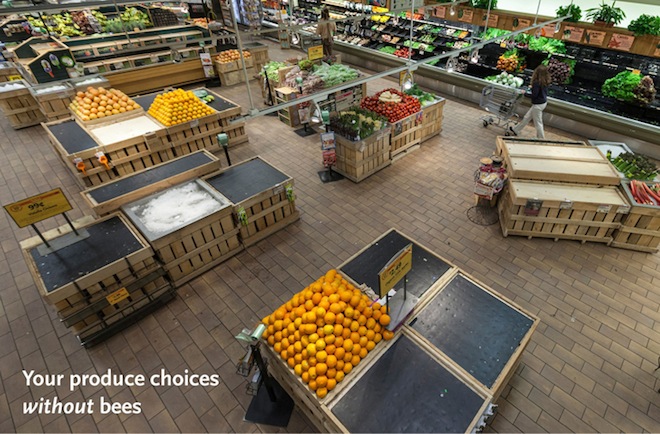
A Food Market Without Bees (Whole Foods Photo)

WHOLE FOODS MARKET PRODUCE DEPARTMENTA corporate natural foods store in the United States has captured a photograph of what their shelves would look like if bee populations completely collapse. Whole Foods teamed up with the Xerces Society, a wildlife conservation group, to illustrate just how important bees are to our food supply in the hopes of raising greater awareness.
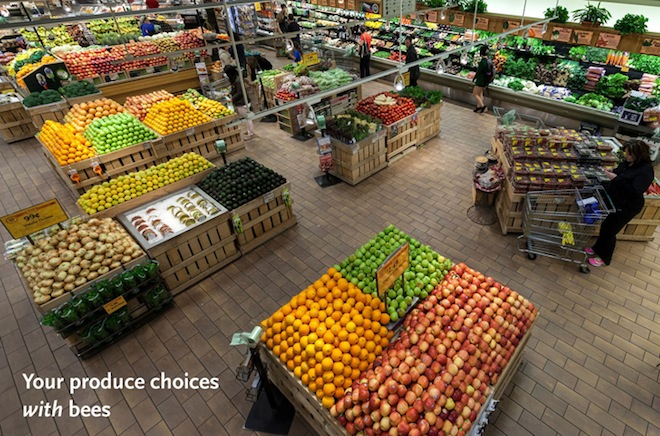
WHOLE FOODS MARKET PRODUCE DEPARTMENT

At the end of 2006, beekeepers and other agriculturalists began to notice that in certain bee colonies, adult males would disappear, leaving the queen and the remaining hive alone.

Called Colony Collapse Disorder (CCD), this phenomenon has spread around the world, putting global bee populations in serious peril.

The causes for CCD are not yet 100 percent certain, but an increasing number of reports show that neonicotinoids present in certain pesticides may be toxic to pollinators.

“…recent research suggests that neonicotinoids may make honey bees more susceptible to parasites and pathogens, including the intestinal parasite Nosema, which has been implicated as one causative factor in CCD,” writes the Xerces Society.

The European Union recently voted to ban pesticides containing neonicotinoids, but the United States, in bed with companies like Bayer that manufacture the pesticides, continues to permit their sale.

Like most things in nature, bees don’t operate in a vacuum, and nor do we.

Whole Foods claims that one in every three bites of food is pollinated by bees. That’s 100 crops in the United States alone, including apples, onions, avocados, carrots, mangoes, lemons, limes, honeydew, cantaloupe, zucchini, summer squash, eggplant, cucumbers, celery, green onions, cauliflower, leeks, bok choy, kale, broccoli, broccoli rabe, and mustard greens.

Whole Foods is donating 10 cents for every pound of summer squash sold between June 12 and June 25 to raise funds for Share the Buzz – a new initiative designed to get more people interested in restoring bee populations.

Hardly anybody seems to be talking about neonicotinoids in North Africa and the Middle East, where controlling their sale and distribution will be significantly more difficult – especially if products previously slated for the US and EU are “dumped” in Asia.

But there are a small handful of beekeepers throughout the region – from Israel to Lebanon and Turkey – who continue to create safe habitat for bees.

Our future depends on it.

Visit Xerces Society for a complete list of products deemed harmful to bees and other pollinators and join Share the Buzz to learn what you can do to help.

Image via PRNewsFoto/Whole Foods Market
Tafline Laylin
Tafline Laylinhttp://www.greenprophet.com
As a tour leader who led “eco-friendly” camping trips throughout North America, Tafline soon realized that she was instead leaving behind a trail of gas fumes, plastic bottles and Pringles. In fact, wherever she traveled – whether it was Viet Nam or South Africa or England – it became clear how inefficiently the mandate to re-think our consumer culture is reaching the general public. Born in Iran, raised in South Africa and the United States, she currently splits her time between Africa and the Middle East. Tafline can be reached at tafline (at) greenprophet (dot) com.
5 COMMENTS
  1. You can take the citrus produce away from the 1st photo as well. Bees pollinate citrus trees and also make excellent honey from orange and other citrus blossoms.

LEAVE A REPLY

Please enter your comment!
Please enter your name here

TRENDING

Sustainability That Sells: How Profit and Purpose Come Together in the Hive

Whether you are a commercial grower, hobbyist beekeeper or retail equipment supplier, this system opens a new income stream with minimal environmental impact.

💩 Who Has the Healthiest Donor Poo? Maybe You Do.

If you’re young, active, eat whole foods, and haven’t taken antibiotics recently, chances are your gut community is robust — and possibly valuable. Stool donors can receive compensation and, more importantly, contribute to the next generation of microbiome-based medicine. 

Honey gummies from the Land of Milk and Honey

A new gummy made with honey.

Bees for Peace in Israel uses biodynamic beekeeping to sweeten hearts

Israel is a global hotspot for plant and animal diversity. Bees as pollinators are crucial, biodynamic beekeeping, which sees the hive as one organism, growing in practice.

The bees of Azerbaijan go hightech

A feature on who is leading beekeeping and honey production in Azerbaijan.

Qatar’s climate hypocrisy rides the London Underground

Qatar remains a master of doublethink—burning gas by the megaton while selling “sustainability” to a world desperate for clean air. Wake up from your slumber people.

How Quality of Hire Shapes Modern Recruitment

A 2024 survey by Deloitte found that 76% of talent leaders now consider long-term retention and workforce contribution among their most important hiring success metrics—far surpassing time-to-fill or cost-per-hire. As the expectations for new hires deepen, companies must also confront the inherent challenges in redefining and accurately measuring hiring quality.

8 Team-Building Exercises to Start the Week Off 

Team building to change the world! The best renewable energy companies are ones that function.

Thank you, LinkedIn — and what your Jobs on the Rise report means for sustainable careers

While “green jobs” aren’t always labeled as such, many of the fastest-growing roles are directly enabling the energy transition, climate resilience, and lower-carbon systems: Number one on their list is Artificial Intelligence engineers. But what does that mean? Vibe coding Claude? 

Somali pirates steal oil tankers

The pirates often stage their heists out of Somalia, a lawless country, with a weak central government that is grappling with a violent Islamist insurgency. Using speedboats that swarm the targets, the machine-gun-toting pirates take control of merchant ships and then hold the vessels, crew and cargo for ransom.

Leopoldo Alejandro Betancourt López Turned Ocean Plastic Into Profitable Sunglasses

Few fashion accessories carry the environmental burden of sunglasses. Most frames are constructed from petroleum-based plastics and acrylic polymers that linger in landfills for centuries, shedding microplastics into soil and waterways long after they've been discarded. Leopoldo Alejandro Betancourt López, president of the Spanish eyewear brand Hawkers, saw this problem differently than most industry executives.

Why Dr. Tony Jacob Sees Texas Business Egos as Warning Signs

Everything's bigger in Texas. Except business egos.  Dr. Tony Jacob figured...

Israel and America Sign Renewable Energy Cooperation Deal

Other announcements made at the conference include the Timna Renewable Energy Park, which will be a center for R&D, and the AORA Solar Thermal Module at Kibbutz Samar, the world's first commercial hybrid solar gas-turbine power plant that is already nearing completion. Solel Solar Systems announced it was beginning construction of a 50 MW solar field in Lebrija, Spain, and Brightsource Energy made a pre-conference announcement that it had inked the world's largest solar deal to date with Southern California Edison (SCE).

Related Articles

Popular Categories