Why the 400ppm CO2 Milestone is so Important

climate change, global warming, carbon dioxide emissions, highest level of CO2 in human history, environment, news Charles David Keeling began recording CO2 levels at Hawaii’s Mauna Loa Observatory in 1958, back when concentrations hovered at around 315 parts per million. Five decades later and that number has soared to 400ppm and his son told Yale Environment 360 we’re unlikely to stop it from rising any time soon. Director of the Scripps CO2 Program in California, which is designed to make climate change science accessible to the lay person, Ralph Keeling said that the number 400 is a milestone mostly because it’s a nice round number that people can grasp.

“So this is really a moment for human awareness,” he said, “just like passing a 50th birthday.”

“This is a point to think about where we are in the course of the rise of carbon dioxide. It feels a little bit like we’re moving into another era, in that somehow between 350 and 400 parts per million feels like a certain kind of range of CO2, and now we’re moving into a different range.”

He said that in order to keep levels from surpassing 400ppm, we would have to reduce fossil fuel consumption by up to 60 percent, right now, something that is essentially not going to happen.

Not only would it be virtually impossible to get the whole planet behind the idea, it would be financially crippling.

As a result, we are on track to reach 450ppm in the next 20 to 25 years and further exponential escalations thereafter.

Keeling estimates that the earth’s CO2 concentration last reached 400ppm between two and four million years ago during the mid-Pliocene era.

Combining methane and other heat-trapping gases with CO2 emissions, Keeling told Yale Environment 360 that we are probably going to double pre-industrial levels of greenhouse gas concentrations by the middle of this century.

Reluctant to present himself as a problem solver, Keeling suggests that adopting more fossil fuels and eliminating unrealistically low energy prices might take us one step closer to averting the worst.

:: The Guardian

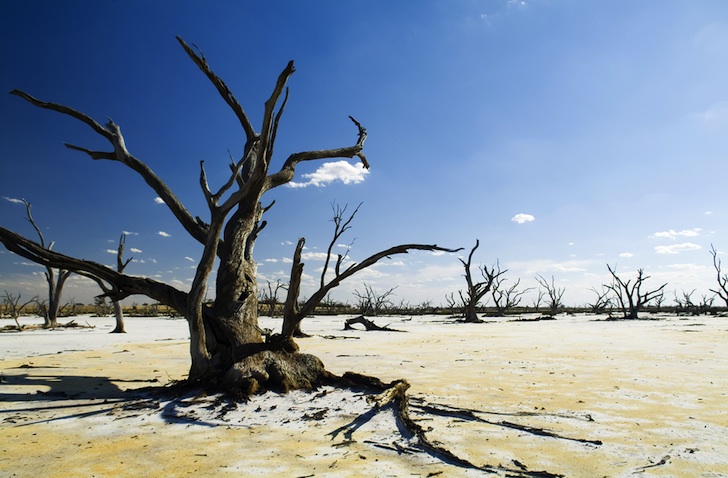
Image of dead tree trunks, Shutterstock

Tafline Laylin
Tafline Laylinhttp://www.greenprophet.com
As a tour leader who led “eco-friendly” camping trips throughout North America, Tafline soon realized that she was instead leaving behind a trail of gas fumes, plastic bottles and Pringles. In fact, wherever she traveled – whether it was Viet Nam or South Africa or England – it became clear how inefficiently the mandate to re-think our consumer culture is reaching the general public. Born in Iran, raised in South Africa and the United States, she currently splits her time between Africa and the Middle East. Tafline can be reached at tafline (at) greenprophet (dot) com.
1 COMMENT
  1. The answer is:
    1. Safely recycle 100% of all human-generated waste materials.
    3. Peacefully reduce the human population with family planning programs.
    Tragically, we humans are addicted to economic growth and the power of money.
    But I will continue trying to warn people even though they won’t listen. I cannot
    abandon the people and beautiful things I love.

LEAVE A REPLY

Please enter your comment!
Please enter your name here

TRENDING

Huge Fish Nursery Discovered Under Freezing Arctic Seas

In 2019, an underwater robot camera exploring the seabed...

Remilk makes cloned milk so cows don’t need to suffer and it’s hormone-free

This week, Israel’s precision-fermentation milk from Remilk is finally appearing on supermarket shelves. Staff members have been posting photos in Hebrew, smiling, tasting, and clearly enjoying the moment — not because it’s science fiction, but because it tastes like the real thing.

The US leaves 66 United Nations organizations to “put America first”

The world needs a reset and to restart well intentioned cooperation projects from start. Because right now the UN and EU projects look like software built on code from the 80s, rickety, patched, slow to adapt, and prone to crashing under the weight of outdated assumptions.

Turkey named as climate change COP31 home in 2026

Murat Kurum as President-Designate of COP31

Ancient air trapped in Canadian salt bubbles foretells climate future

Opening these samples is like cracking open air that existed long before dinosaurs, before forests, before animals of any kind. As lead researcher Justin Park put it: “It’s an incredible feeling to crack open a sample of air that’s a billion years older than the dinosaurs.”

Qatar’s climate hypocrisy rides the London Underground

Qatar remains a master of doublethink—burning gas by the megaton while selling “sustainability” to a world desperate for clean air. Wake up from your slumber people.

How Quality of Hire Shapes Modern Recruitment

A 2024 survey by Deloitte found that 76% of talent leaders now consider long-term retention and workforce contribution among their most important hiring success metrics—far surpassing time-to-fill or cost-per-hire. As the expectations for new hires deepen, companies must also confront the inherent challenges in redefining and accurately measuring hiring quality.

8 Team-Building Exercises to Start the Week Off 

Team building to change the world! The best renewable energy companies are ones that function.

Thank you, LinkedIn — and what your Jobs on the Rise report means for sustainable careers

While “green jobs” aren’t always labeled as such, many of the fastest-growing roles are directly enabling the energy transition, climate resilience, and lower-carbon systems: Number one on their list is Artificial Intelligence engineers. But what does that mean? Vibe coding Claude? 

Somali pirates steal oil tankers

The pirates often stage their heists out of Somalia, a lawless country, with a weak central government that is grappling with a violent Islamist insurgency. Using speedboats that swarm the targets, the machine-gun-toting pirates take control of merchant ships and then hold the vessels, crew and cargo for ransom.

Leopoldo Alejandro Betancourt López Turned Ocean Plastic Into Profitable Sunglasses

Few fashion accessories carry the environmental burden of sunglasses. Most frames are constructed from petroleum-based plastics and acrylic polymers that linger in landfills for centuries, shedding microplastics into soil and waterways long after they've been discarded. Leopoldo Alejandro Betancourt López, president of the Spanish eyewear brand Hawkers, saw this problem differently than most industry executives.

Why Dr. Tony Jacob Sees Texas Business Egos as Warning Signs

Everything's bigger in Texas. Except business egos.  Dr. Tony Jacob figured...

Israel and America Sign Renewable Energy Cooperation Deal

Other announcements made at the conference include the Timna Renewable Energy Park, which will be a center for R&D, and the AORA Solar Thermal Module at Kibbutz Samar, the world's first commercial hybrid solar gas-turbine power plant that is already nearing completion. Solel Solar Systems announced it was beginning construction of a 50 MW solar field in Lebrija, Spain, and Brightsource Energy made a pre-conference announcement that it had inked the world's largest solar deal to date with Southern California Edison (SCE).

Related Articles

Popular Categories