

 Middle East city heads want to make their cities more sustainable.
The Middle East and North Africa (MENA) region is 60 percent urbanized compared to the global average of 52 percent and is home to one of the world’s most rapidly expanding populations. By 2030, a 45 percent increase of MENA’s urban population will add another 106 million people to urban centres. Countries like Egypt, Iraq, Yemen, Kuwait, and Djibouti will see their urban population doubling over the next 20 years.
In Rabat last month I attended a series of fascinating exchanges among several Mayors and ministers of urban and local administration from Morocco, Tunisia, Jordan, Lebanon, Egypt, Yemen, and the Palestinian Territories. This initiative, supported by the Arab Urban Development Institute, the World Bank and the Center for Mediterranean Integration, was designed to connect MENA city leaders to urban leaders and experts from around the world so that they could explore urban opportunities and share growth management approaches.
Services and manufacturing activities constitute up to 90 percent of the region’s GDP and being hosted in urban centers, there’s no doubt MENA’s cities are its main engines of growth. However – and there was lots of talk about this during the conference – for the past decade, city mayors in the region have been facing three major challenges.
Firstly, a significant lack of resources and capacity at the local level, MENA cities have the lowest share of local government expenditures in the world, for example only 3 percent in Jordan, 5 percent in Tunisia, or 17 percent in Morocco. This is partly the result of a legacy of highly centralized planning and decision-making processes, coupled with limited institutional capacity at the local level.
The second challenge is the large percentage of young people in urban populations: more than 140 million youth are 15-29 year’s old. Youth unemployment ranges from 20 to 40 percent, twice the world average, and about 50 million jobs are needed by 2020 to fully absorb the young people coming into the labor market, mostly in cities of course.The third challenge is that in several countries in the region, mayors still oversee only solid waste, drainage and electric lighting.
In sum, all of this means it is quite difficult for mayors to be fully responsive to citizens’ requests, and if no action is taken, cities could become bottlenecks rather than engines of growth.
To play their vital role in a country’s socioeconomic development, cities need to be well-governed, empowered, and sustainably managed. Growth and job creation cannot be created or sustained if Arab cities continue to under-invest in infrastructure, as was the case during the last decade. This underinvestment has resulted in power blackouts, unreliable and expensive ICT services, congested roads and poor mass transit systems, intermittent and unclean water supply, air pollution, raw sewage effluents, and garbage piling up on public land. Over time this compromises the attractiveness of cities and undermines the private sector’s performance.
The good news is that more and more governments in the region are supporting city-level accountability to citizens. For instance, Tunisia, Yemen and Morocco are moving down the path of decentralization, recognizing that improvements in the quality of life for citizens in a highly urbanized region must come from cities themselves and cannot continue to be addressed solely at the national level. So the burning questions among local and national decision-makers now are these: how to enhance public participation at the local level? How to ensure urban investments are sustainable? How to provide incentives to local governments to perform better? This is a very good sign.
And this is not only a question of providing more financing at the local level. It is also a question of enhancing accountability of cities to both citizens and the national level. Both aspects, financing and governance, are inextricably linked. Our conference discussions made it very clear that a city without good governance and accountability will have difficulty mobilizing tax revenue from its citizens and funds from the national level. And without this support how can city managers respond to the real needs of citizens?
But what we heard in Rabat was governments increasing their focus on integrated local development, starting to explore new, decentralized institutional models, with more empowerment but also accountability at the local level. These are exciting developments that will reposition MENA’s cities, home to 60 percent of MENA citizens after all, at the core of the development agenda.
“This blog was originally posted on Voices & Views: Middle East & North Africa and this reposting does not publicly represent or imply that The World Bank is participating in, or has sponsored, approved or endorsed the views of the Green Prophet.”
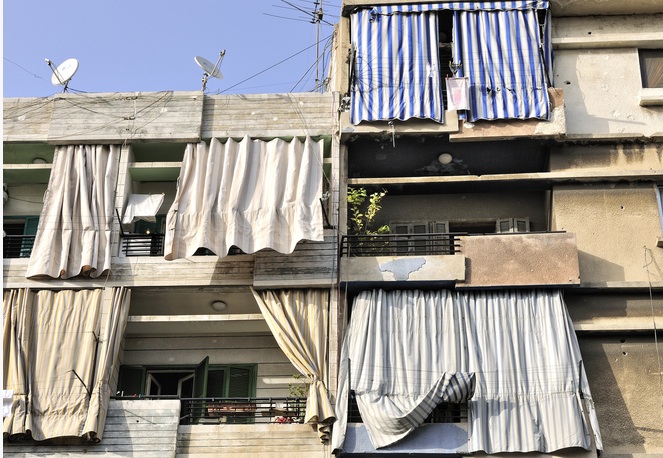
Image of typical building with curtains on balconies in Bourj Hammoud, Armenian district, Beirut, Lebanon, Middle East via Shutterstock



If the MENA Mayors really put their heads together and think clearly they will realize they must not allow city populations to double, or else they will suffer environmental collapse. Instead, they need to promote family planning education to reduce overpopulated humanity to live in peace and balance with this biosphere we call planet Earth. Everyone needs to ask this question: How many people can the Earth support?