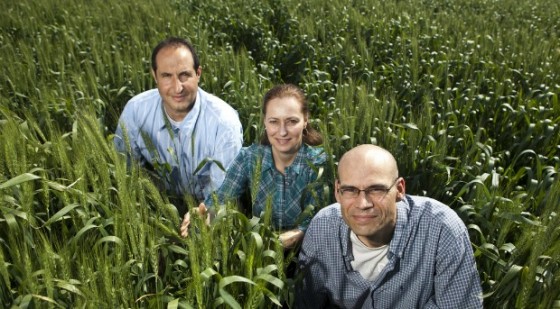

Jacob Karni Is Israel’s Solar Star

jacob karni israel solar energyI interview one of Israel’s main solar energy entrepreneurs and researchers, Jacob Karni.

Israeli solar energy pioneer Prof. Jacob Karni was born just two years after Israel became a state, in 1950. Already back then, the country’s leaders were tangibly aware that Israel needed to develop its human resources in order to build a country that was severely lacking in energy and water. Unlike some kids who have their goals set early, Karni didn’t know he would be an engineer, let alone work with the sun. He grew up in the Polish Zionist Kibbutz Beit Alpha in northern Israel, where he slept in a children’s house like all kibbutz kids back then, and his mom before him. He went on to become an officer in a tank unit and served in the 1973 Yom Kippur War.

Falling in love with an American Jewish woman in 1974 sent him packing to Minneapolis for about 10 years. When he and his wife returned to Israel in the mid-Eighties, he had four children and three degrees in engineering from the University of Minnesota – the last one a PhD in mechanical engineering.

His specialty was heat transfer and thermodynamics: “A professor in my department, my colleague and adviser Prof. Ed Fletcher in the US, was a pioneer in high-temperature solar thermal chemistry and he introduced me to what I am working on now,” says Karni.

Unlike many Israeli researchers who choose either a career in academia or a life of entrepreneurialism, Karni has found a happy balance between the two.

Although he has one of the brightest solar energy careers in Israel, he avoids the spotlight and prefers to call himself “a lab rat.”

Through his two-and-a-half decades of work at the world-renowned Weizmann Institute of Science in Rehovot, Karni and his lab team have laid the foundations of three promising solar energy technologies — two to the point of having commercial breakthroughs.

Like a parent to solar startups

Karni’s played a leading role in planting the stark yellow “tulip” of AORA, found in Israel’s Negev Desert and now also in Spain. The company has built the world’s first solar hybrid power plant, comprising 30 heliostat solar reflectors. Karni’s work is also behind the technology that collects solar energy from the back-to-the-future parabolic mirror collectors of HelioFocus.

In these two companies, he says, “I am like in a parent position after the kids have grown up. I talk with them regularly to discuss issues informally. But we keep in close touch.”

And now Karni has invested his research into NewCO2Fuels, which aims to make brown coal and power plants greener by using power from the sun to produce hydrogen fuel more cheaply, efficiently and safely while solving storage and transportation issues.
“Our work now focuses on creating fuels from sunlight, water and carbon dioxide that comes out of smokestacks. We are trying to do what trees do very well when they convert sunlight, CO2 and water into building materials,” he tells ISRAEL21c.

Each company has about a decade of R&D behind it.

“I start with an idea and we keep developing it until we figure out why it doesn’t work, to find fundamental flaws and then drop it or find out what’s wrong and fix it. We get to the point where an idea works and where they have the potential to make the process of converting sunlight to electricity or fuel efficient, with the potential for the costs to be low.”

Unlike efficiencies in the solar photovoltaic market hovering at around 15 percent, Karni aims for his solar technologies to be about 30% efficient at converting the sun’s photons into electricity.

Without high efficiencies there is no market for solar, he says. It needs to be at the same cost, or less than traditional polluting fuels, in order for the masses to adopt it.

“The sun is the only solution I can see, the only one,” he stresses.

Karni joins other Israeli solar energy engineer pioneers such as Zvi Tabor, Levi Yissar, Prof. David Faiman and Prof. Avi Kribus.

“In my work I am looking for an absolute solution and it is not the easiest thing to do,” he says. “Solar energy is challenging, perhaps the most challenging of all the renewable energy solutions, but it is really the only one that offers the best solution. Some will argue that position for nuclear, but being in the Middle East we don’t like solving one problem to create another. If you use nuclear, it might solve a temporary energy problem, but it opens a Pandora’s box of other problems.

“I don’t have a magic wand to make it work, though I am trying,” Karni concludes.

This story is reprinted from ISRAEL21c– www.israel21c.org

Karin Kloosterman
Karin Kloostermanhttp://www.greenprophet.com
Karin Kloosterman is an award-winning journalist, innovation strategist, and founder of Green Prophet, one of the Middle East’s pioneering sustainability platforms. She has ranked in the Top 10 of Verizon innovation competitions, participated in NASA-linked challenges, and spoken worldwide on climate, food security, and future resilience. With an IoT technology patent, features in Canada’s National Post, and leadership inside teams building next-generation agricultural and planetary systems — including Mars-farming concepts — Karin operates at the intersection of storytelling, science, and systems change. She doesn’t report on the future – she helps design it. Reach out directly to [email protected]

LEAVE A REPLY

Please enter your comment!
Please enter your name here

TRENDING

Astro uses AI to help procure land for renewable energy

For oil-rich, environmentally vigilant Gulf states, Astro isn’t just another startup story. It is a blueprint for accelerating an energy transition that is now existential, not optional.

Earth building with Dead Sea salt bricks

Researchers develop a brick made largely from recycled Dead Sea salt—offering a potential alternative to carbon-intensive cement.

Farm To Table Israel Connects People To The Land

Farm To Table Israel is transforming the traditional dining experience into a hands-on journey.

How Renewable Energy is Revolutionizing the Way We Power Our World

Solar has become the star of the transition thanks to modular hardware and straightforward installation. It fits dense cities and remote towns alike. Many companies are turning to rooftop arrays and carport systems - and exploring commercial solar installation as a practical way to lock in future savings.

Leading Through a Dual-Energy Transition: Balancing Decarbonisation with Energy Security

Experience in one area of the energy industry isn't enough to guarantee readiness across all the others. That's where a structured program like an MBA in energy can come in. Today's advanced curricula explore energy economics, finance, policy, and strategic management alongside the technical subjects. And when pursuing an energy MBA online, professionals can skill up and retrain without having to step out of the labor market -- an important perk at a time when skilled professionals are already in short supply.

Qatar’s climate hypocrisy rides the London Underground

Qatar remains a master of doublethink—burning gas by the megaton while selling “sustainability” to a world desperate for clean air. Wake up from your slumber people.

How Quality of Hire Shapes Modern Recruitment

A 2024 survey by Deloitte found that 76% of talent leaders now consider long-term retention and workforce contribution among their most important hiring success metrics—far surpassing time-to-fill or cost-per-hire. As the expectations for new hires deepen, companies must also confront the inherent challenges in redefining and accurately measuring hiring quality.

8 Team-Building Exercises to Start the Week Off 

Team building to change the world! The best renewable energy companies are ones that function.

Thank you, LinkedIn — and what your Jobs on the Rise report means for sustainable careers

While “green jobs” aren’t always labeled as such, many of the fastest-growing roles are directly enabling the energy transition, climate resilience, and lower-carbon systems: Number one on their list is Artificial Intelligence engineers. But what does that mean? Vibe coding Claude? 

Somali pirates steal oil tankers

The pirates often stage their heists out of Somalia, a lawless country, with a weak central government that is grappling with a violent Islamist insurgency. Using speedboats that swarm the targets, the machine-gun-toting pirates take control of merchant ships and then hold the vessels, crew and cargo for ransom.

Leopoldo Alejandro Betancourt López Turned Ocean Plastic Into Profitable Sunglasses

Few fashion accessories carry the environmental burden of sunglasses. Most frames are constructed from petroleum-based plastics and acrylic polymers that linger in landfills for centuries, shedding microplastics into soil and waterways long after they've been discarded. Leopoldo Alejandro Betancourt López, president of the Spanish eyewear brand Hawkers, saw this problem differently than most industry executives.

Why Dr. Tony Jacob Sees Texas Business Egos as Warning Signs

Everything's bigger in Texas. Except business egos.  Dr. Tony Jacob figured...

Israel and America Sign Renewable Energy Cooperation Deal

Other announcements made at the conference include the Timna Renewable Energy Park, which will be a center for R&D, and the AORA Solar Thermal Module at Kibbutz Samar, the world's first commercial hybrid solar gas-turbine power plant that is already nearing completion. Solel Solar Systems announced it was beginning construction of a 50 MW solar field in Lebrija, Spain, and Brightsource Energy made a pre-conference announcement that it had inked the world's largest solar deal to date with Southern California Edison (SCE).

Related Articles

Popular Categories