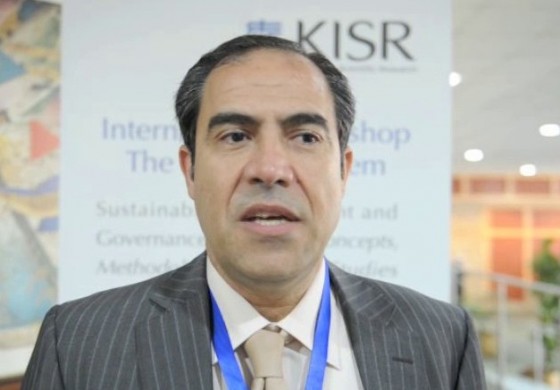
 Walid Saleh speaks to Green Prophet about sustainability in the Middle East
From Sudan to Saudi Arabia, Hima – an ancient Arabian conservation concept – has helped keep the peace. Now it is hoped a new interpretation of the conservation principle will help protect the region’s dwindling resources by tapping into cultural norms and histories, then radically updating them for a world struggling with climate change. I spoke to Walid Saleh, MENA Regional Programme at the United Nations University-Institute for Water, Environment, and Health, about his work at the HIMA Global Initiative and the opportunities and constraints they are facing.
Green Prophet:What are the benefits of the new formulated interpretation of HIMA compared to the traditional concept?
Walid Saleh: The traditional Hima system was practiced as land management, and unfortunately this is the image that comes to mind when Hima is mentioned. Moreover, the traditional Hima system was a practice with no written set of principles, nor any written laws or governance framework. Recently, the IUCN has recognized Hima as a system that can be classified under any of the 6 protected areas categories. This, in my belief, fails to recognise Hima as a sustainable development system that is routed in the Islamic environmental laws.
What we are aiming to establish is HIMA as a standalone sustainable development initiative that has a well defined legal frame work, socio-economic framework, governance system, and a road-map for implementation. We believe that the HIMA can address most of the challenges that humanity faces today and in future generations. The HIMA system is currently being documented as a complete sustainable development initiative and efforts are underway to register it under the UN Commission for Sustainable Development.
GreenProphet: What is the ‘Human Integrated Management Approach’ or HIMA?
Walid Saleh: The new HIMA vision is based on social and economic justice and environmental integrity. To achieve this, the following governing principles are needed to achieve human wellbeing :
- The Ethical principles which include the Hima development vision and describe the aims and objectives and the ethical dimension of Hima governance system
- Environmental sustainability principles are based on reverence to natural resources and no harm (fassad)
- Institutional principles recognise (a) the role of the State in providing basic needs; (b) the role of the voluntary sector to contribute to socio-economic and non-material development of the community and (c) the devolution of Hima management within the local community.
- Good governance principles provide a framework for the adequate management of the natural resources in Hima zones including conflict resolution mechanisms.
What are some of the lessons you have learnt and taken on board from the traditional concept of Hima?
As I mentioned earlier, Hima was traditionally practiced with a mix of traditional knowledge and Islamic principles. As such, it helped establish social harmony in various communities. For example in Darfur, Hima as a range land management system was practiced before Sudan secured its dependence in the 1960s.
Hima kept peace and social harmony among all the different tribes of Darfur. It is only after the Hima system was abolished in the sixties that problems in Darfur arose.
These are some of the lessons we had in mind when developing the HIMA Global Initiative. Other lessons stems from the fact that the Hima system managed to give the people of Arabia, with their harsh environment, a sustainable living. However, to meet the challenges of today and the needs for the future generation, a well-defined sustainable development approach is needed. This is were we are coming from. HIMA can address this need and we intend to apply the system, in pilot projects in the MENA region as a first step, for the next five years to have enough data for validation purposes before it is promoted globally.
Could you tell us a little bit about how you got involved in the HIMA project?
My strong interest in the Hima was born as result of my involvement in the WANA forums where HRH Prince El Hassan Bin Talal kept asking the question “What is the Role of Hima in This Issue…?” HRH insistence on asking the same question while debating different issues created a strong interest in me to explore Hima in depth.
After studying the Hima constitution (Al Wathiqa) that the Prophet Muhammed (Peace Be Upon Him) established for Al madina Al Monawara, I came up with the Hima Global Initiative: The Role of Hima as a Community-based Natural Resources Management System for Peace-building. I’m currently leading the technical committee for the Global Hima Initiative launched last May 2012.
Since most of today’s conflicts usually are about sharing the natural resources, the Hima Global Initiative aims to:
- Promote the Hima constitutional principles, as model, to propose solutions to areas of conflict, such as Abyei, Darfur, and the Western Sahara;
- Build confidence among parties in conflict by promoting social justice, equalities, social responsibilities, and the rule of law;
- Celebrate societal diversity, ethical values & customs, and rights for ethnic and religious minorities;
- Promote unity based on human needs & human rights;
- Promote peace, freedom of religion, respect of each other’s values, and acceptance.
What are some of the major opportunities and also constraints facing the HIMA concept that were highlighted in the recent December workshop?
There are political challenges such as lack of political will, government mistrust of citizens (and vice versa), legal empowerment of people and lack of awareness which all represent challenges. Other challenges are related to weak civil society organizations, the lack of space for them to function and the need to develop this space and capacity build.
There is also a need for better communications to convince the necessary people yet university training does not encourage community-sensitive approaches but teaches us to dictate and prescribe. However, some political developments – e.g. regionalization can be a driving force in the HIMA implementation.
There is also a real need to develop a blueprint that is adaptable to different situations and create an understanding that HIMA is not only about going back to the old – it is about blending the old with the new.
What are the aims of the upcoming implementation workshop?
The Phase II “KISR workshop” is an initiative to strengthen policy dialogue on adopting the Hima for sustainable development at all levels. The main objective of the workshop is to help put forward an efficient action plan on the Hima legal framework, socio-economic and governance system based on “Islamic Ecological Principles and Law”. The framework will serve as valuable guide and reference for all those interested in sustainable utilization of natural resources and Hima-based protected area management for the wellbeing of present and future generations.
For more on HIMA go to:
HIMA – A Traditional Arabian Conservation Concept Modernised
Great Examples Of ‘Hima’ Or Protected Areas In The Middle East
Hima: The Middle East’s Tradition of Environmental Protection