

Laurie escaped from the Trade Towers 11 years ago and as a building expert looks critically at standards in the Middle East.
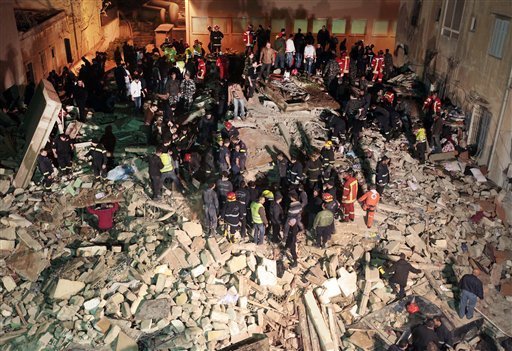
Building codes ensure that a properly constructed building will safely stand up to predictable wear and tear. Codes specify fire-resistant performance for materials and prescribe safe exiting requirements for occupants. But what guides human behavior in a building emergency? How would you make out in a crisis? In short, would you make it out? This question takes on new urgency in the Middle East: Last July, firefighters battled a blaze that erupted in Manama, Bahrain’s capital city, destroying hundreds of shops in the popular Isla Town Market. Over 500 stalls were destroyed in the five hours it took to bring the blaze under control. In May, fire engulfed Doha’s Villaggio Mall, killing 19 people. A 5-story apartment building collapsed in Beirut in January, killing another nineteen (see above photo).
I confess a strong personal bias on this topic, being one of fortunate thousands who walked away from the biggest building collapse in history. I trekked down the stairs of One World Trade Center with architects and engineers from my office (several who actually built the place 30 years earlier) and we building “professionals” barely knew how to exit.
Consider that in Sharjah last April a 25-story apartment block turned into a towering inferno, leaving 125 families homeless. A senior police official said the fire began on the first floor and then spread quickly due to the weather and wind speed. He blamed flammable materials in the building’s exterior for accelerating the burn.
Afterwards, Geze Middle East Managing Director Charles Constantin told ConstructionWeekOnline, “Safe buildings can help save lives.”
Gee, do you think?
User safety in buildings is a critically underexplored area in the Middle East
Consider egress from a modern building as a flowchart. There are a zillion potential decision points in your path – are you prepped to deal with the choices?
We get a safety drill every time we buckle in on a flight. Could you channel your inner flight attendant and describe how to safely exit your home, your office, the room you sleep in on a holiday? Trust me, it’s worth some thought.
Do you know how to use an emergency fire extinguisher or firehose? There’s more to it than turning a valve: a firehouse will explode if the hose isn’t first unfurled, rendering it useless to kill a flame. A volunteer fireman in our escape crowd knew what to do, otherwise it’s a fair bet I’d not be typing this sentence.
What if heat or building movement causes doorways to warp and rack and jam? Got a clue how else to make an exit? Decades in the building trade and it didn’t occur to me I could punch through a simple sheetrock wall with my ball point pen. It didn’t occur to a lot of other people either, with catastrophic results.
How would McGyver escape a stopped elevator? Do you recall school kid lessons to “drop and crawl” beneath the smoke cloud, to touch the door panel before opening to gauge the heat on the other side? Do you break the windows in a room filling with smoke, or not? The list goes on and on. A zillion decision points: the most important aspect of any building is how users get out.
It’s critical for architects and facility managers to communicate site-specific safety information if occupants are to have best prospects of leaving the premises alive.
Human health and safety are inextricably linked to the environment. The three are often lumped together in governmental and corporate Health, Safety and Environment (HSE) units, responsible to set legislation and policy relative to building construction, and ongoing operations and maintenance. HSE advances are welcome, but as important is equipping building users with practical information on how to navigate and operate the facility in a variety of emergency conditions.
Within the design/build industry, how are we ensuring that that our buildings are secure, functional, stable and durable? More critically, are we fulfilling our obligations to the wider public in caring for their safety?
Designers and builders must learn from recent disasters in order to future-proof our projects. But it’s up to all of us to ask questions, to become expert “operators” within the spaces we live and work. Demand frequent safety sessions with your employer and become friends with your corporate safety plan. Map out an evacuation plan for your home, and risk nerdiness by taking your family through drills. The idea is not to fan fear, but rather to raise consciousness. Life saving consciousness about the theaters where we act out our lives.
Next up, how to tackle the environmental aspects of a building as it dies.
Image of Beirut building collapse via The State