Share Beirut is TED-style Creativity Conference for Lebanon

Lebanese illustartor and webcomic Maya ZankoulLebanese illustartor Maya Zankoul “draws” against issues that range from pollution, electricity cuts, real estate pricing, to politics in Lebanon. She will be one of the guest speakers at SHARE Beirut.

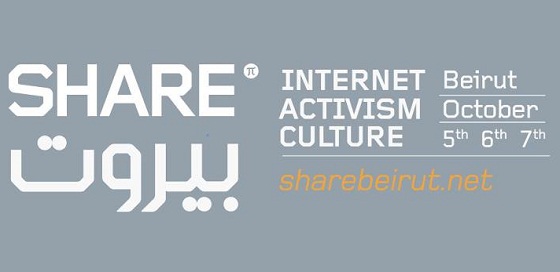
In October there will be a free three day conference in Beirut which will look at “digital” rights in the MENA and promote creativity. Similar to the concept of TEDx (see the TEDx Jaffa conference), a platform where people can share innovative knowledge or “ideas worth spreading,” SHARE Beirut is a hybrid event that brings together hundreds of passionate people, forward-thinkers, cultural creatives, activists and artists from the Middle East and around the world to share ideas on how to levarege on the digital media.

For three days starting on October 5, SHARE Beirut will become a huge opportunity for the Middle East North Africa (MENA) region to promote an understanding of open, decentralized and accessible forms of communication, exchange and creation. The event is coordinated by the Share Foundation, a nonprofit organization dedicated to protecting the rights of Internet citizens and promoting free access and exchange of knowledge and information.

My guess is that this will be a very successful event.

SHARE has cleverly picked up on the emerging trend of “digital empowerment” in the MENA where many believe that what fuelled the Arab Spring was the internet and social media.  But although the internet may have initiated, sustained and encouraged a viral revolution, there is now an “Arab Spring online backlash” where recent legislation in the MENA is looking to censor and control what type of information can be “shared” on the net. In Iraq for example a recent bill on “information-technology crimes” includes mandatory life sentences for using the internet to “compromise” the “unity” of the state or promote “ideas which are disruptive to public order”.

Prior to the Arab spring five of the top ten most internet censored countries were from the Arab world: Saudi Arabia, Syria, Yemen, Tunisia and Egypt. After the Arab Spring, the future of internet censorship in the region is looking precarious, hopefully SHARE Beirut can help promote digital freedom.

At the conference, sixty lectures and workshops will be delivered by leading international bloggers and artists who will educate the audience on new forms of activism by using advanced technologies to create, influence and affect. Workshops and discussions will explore the fight for digital and human rights, free access to information flow , transparency and privacy.

The aim is to set new standards that will prevent any kind of oppression, censorship and surveillance for future generations in the MENA, as well as understanding the positive values the internet has to offer and the need to protect it as an open and free territory for all.
SHARE Beirut, digital activism, Arab Spring, creative activism

The program is inviting.

From Sami Ben Gharbia an exiled Tunisian human rights campaigner and blogger, to Ammar Abu Shady the Egyptian production director of Qabila TV, a “media incubator that engages in crowdsourcing innitiatives” to Vida Rizk founder of Aflamnah a kickstarter-like crowdfunding platform for creative projects in the Arab World  to Maya Zankoul a Lebanese illustrator that “draws” against some of the daily hassles and inefficiencies found in Lebanon.

There are too many great minds to mention, but this event will definitely push forward the outspoken and creative boundaries of the MENA region.

If you are interested in attending this FREE conference, register as soon as you can before the 28th of September.

Images via SHARE


Linda Pappagallo
Linda Pappagallohttps://www.greenprophet.com/
Linda's love for nature started when at the age of eight she discovered, with her dog, a magical river in the valley of a mountainous region in Lebanon. For four years Linda and her dog explored along the river, until one day she saw construction scrapers pushing rock boulders down the valley to make way for new construction sites. The rubble came crashing into the river destroying her little paradise, and her pathetic reaction was to shout at the mechanic monsters. Of course that was not enough to stop the destructive processes. As she continued to observe severe environmental degradation across the different places she lived in the Middle East and Africa, these terrible images remained impressed in her mind. However, environmental issues where not her first love. Her initial academic and career choices veered towards sustainable economic development, with particular interest in savings led microfinance schemes. Nevertheless, through experience, she soon realized a seemingly obvious but undervalued concept. While humans can somewhat defend themselves from the greed of other humans, nature cannot. Also nature, the environment, is the main “system” that humans depend on, not economics. These conclusions changed her path and she is now studying a Masters in International Affairs with a concentration in Energy and the Environment in New York. Her interests lie on ecosystems management: that is how to preserve the integrity of an Ecosystem while allowing for sustainable economic development, in particular in the Middle East and Africa.

LEAVE A REPLY

Please enter your comment!
Please enter your name here

TRENDING

Listening to Water: Tarek Atoui’s Next Work for Tate Modern

Born in Beirut, Lebanon in 1980 and now living in Paris, Atoui has spent years building instruments that don’t sit comfortably in concert halls. Many of them involve water, glass, and ceramics — materials that react to sound instead of simply producing it.

Lebanon reporting fellowship for truth-tellers

Lebanon’s environmental crisis is not abstract. It is shaped by war, neglect, corruption, and silence. Rivers carry untreated sewage and industrial waste into the Mediterranean. Dynamite fishing shatters fragile marine ecosystems along the coast. In many areas, Hezbollah’s military presence and decades of instability have made environmental accountability nearly impossible. What flows into the sea is not only pollution — it is politics, poverty, and unresolved war. And yet, these stories are rarely told with depth, care, or courage. Silat Wassel’s Environmental Justice Journalism Fellowship is opening space for exactly that. They are looking for a few brave souls. 

Slow food market Souk el Tayeb in Lebanon celebrates food and Eid El Barbara

What makes Souk El Tayeb in Lebanon remarkable is not only its insistence on local, seasonal produce, but its belief that dignity and sustainability must go hand in hand. Farmers are paid fairly. Villages are uplifted. Traditional recipes are kept alive not as nostalgia but as knowledge systems: real food is carbon-light, waste-free, and is adapted to the land.

The Pope visits Lebanon and the site of the deadly Beirut blast

“Lebanon, stand up,” he added. “Be a home of justice and fraternity! Be a prophetic sign of peace for the whole of the Levant!”

Dead shark on beach injured by fishing nets

  A dead shark that washed ashore this week at...

Qatar’s climate hypocrisy rides the London Underground

Qatar remains a master of doublethink—burning gas by the megaton while selling “sustainability” to a world desperate for clean air. Wake up from your slumber people.

How Quality of Hire Shapes Modern Recruitment

A 2024 survey by Deloitte found that 76% of talent leaders now consider long-term retention and workforce contribution among their most important hiring success metrics—far surpassing time-to-fill or cost-per-hire. As the expectations for new hires deepen, companies must also confront the inherent challenges in redefining and accurately measuring hiring quality.

8 Team-Building Exercises to Start the Week Off 

Team building to change the world! The best renewable energy companies are ones that function.

Thank you, LinkedIn — and what your Jobs on the Rise report means for sustainable careers

While “green jobs” aren’t always labeled as such, many of the fastest-growing roles are directly enabling the energy transition, climate resilience, and lower-carbon systems: Number one on their list is Artificial Intelligence engineers. But what does that mean? Vibe coding Claude? 

Somali pirates steal oil tankers

The pirates often stage their heists out of Somalia, a lawless country, with a weak central government that is grappling with a violent Islamist insurgency. Using speedboats that swarm the targets, the machine-gun-toting pirates take control of merchant ships and then hold the vessels, crew and cargo for ransom.

Leopoldo Alejandro Betancourt López Turned Ocean Plastic Into Profitable Sunglasses

Few fashion accessories carry the environmental burden of sunglasses. Most frames are constructed from petroleum-based plastics and acrylic polymers that linger in landfills for centuries, shedding microplastics into soil and waterways long after they've been discarded. Leopoldo Alejandro Betancourt López, president of the Spanish eyewear brand Hawkers, saw this problem differently than most industry executives.

Why Dr. Tony Jacob Sees Texas Business Egos as Warning Signs

Everything's bigger in Texas. Except business egos.  Dr. Tony Jacob figured...

Israel and America Sign Renewable Energy Cooperation Deal

Other announcements made at the conference include the Timna Renewable Energy Park, which will be a center for R&D, and the AORA Solar Thermal Module at Kibbutz Samar, the world's first commercial hybrid solar gas-turbine power plant that is already nearing completion. Solel Solar Systems announced it was beginning construction of a 50 MW solar field in Lebrija, Spain, and Brightsource Energy made a pre-conference announcement that it had inked the world's largest solar deal to date with Southern California Edison (SCE).

Related Articles

Popular Categories