
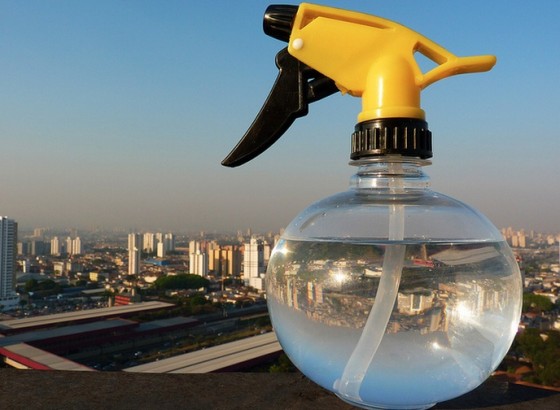

 Faced with water shortage in Amman, Laurie digs up some alternative solutions for generating more water.
No water in my house last week in Amman, Jordan and I’m mildly freaked: I’d just taken delivery on some giant bottles for our water cooler, and I was up to speed on laundry. But no water means no cleaning. Not much cooking happening either. And let’s not talk on the toilet issue.
Residential cut-offs are commonplace in Amman, but for me it’s a first. I’m unnerved. Not so much by the apartment’s micro-drought (I’d cope for a few days, no 127 Days crisis looms). I’m edgy because my First-World-Barbie belief that tells me when I turn a knob, clear water will pour forth –– is seriously flawed.
I’ve never experienced an instance when household water failed to act on my command. I make it cold or hot, get it flowing in forceful jets or delicate sprays. Seems I have a bit of a Moses complex when it comes to controlling water, but when it comes to accessing clean stuff when needed, shouldn’t we all?
Set aside that divining rod. Unlace your rain dance shoes. Purified drinking water can now be directly produced from the humidity in the atmosphere. This isn’t pipe dream, Rube Goldberg contraptions not required. Unlimited, pure drinking water can be pulled from the air for an investment of less than $2,000 bucks.
An eight-mile swath of free floating moisture encases the globe; an untapped resource for us to stick a straw into. Atmospheric water trumps the amount of liquid in the oceans. Compared to ground sources, water extracted directly from the air is relatively clean.
EcoloBlue Atmospheric Water Generators (AWGs) are now available in Jordan. The device produces unlimited drinking water by extracting humidity out of the air, then condensing it to water. The sky-water is stored in the system’s main storage tank, where it runs through an hourly 12-step filtration process to remove chemicals and particulates.
When water’s consumed from the machine, it refills itself automatically. It comes in three versions (one makes sparkling water) that work with any power source, including solar, wind and gas powered generators, rendering the hydration system both sustainable and portable.
They’re also being marketed as an antidote to plastic water bottles (eliminating demand for both grab-and-go mini bottles and the larger refills for water coolers) and as a safe alternative for everyone tethered to dodgy municipal water lines. AWGs can be easily “plugged in” to existing plumbing, allowing its filtration system to clean tap water of harmful chemicals, and common pollutants such as arsenic, trace prescription drugs, bacteria and human hormones.
Gizmos like this can cut demand on municipal water usage by 90 percent.
Water harvesting systems that are self-sustaining, energy efficient and eliminate plastic bottles are a marvelous reality, but they don’t let us off the ethical hook of unsustainable consumption patterns.
Water shortfalls are rampant in the Middle East. The 2011 Green Economy in a Changing Arab World Report released by the Arab Forum for Environment and Development states, “An annual per capita water share below 1,000 cubic meters poses a significant constraint to economic development, health and well-being; below 500 cubic meters, and water scarcity becomes a threat to life.”
Green Prophet reported that the Jordan-Arab region could face severe water crisis in the next three years, when annual per capita water share may fall to less than 500 cubic meters, leaving us with less than one tenth of the average world citizen’s share of the wet stuff:. Over 45 million people in Arab nations lack access to clean water. It’s unlikely they’ll be rushing to buy AWGs, unless, as with clean cookstoves, prices to produce and deliver the units becomes economically sensible.
Let’s get active on water use reduction; it’s easy to do.
Look at your water consumption. See your patterns of usage: don’t judge, just view them. Become aware of your daily waltz through the wet stuff. Next, pick a few low-hanging opportunities for conservation. The behavioral ones are simple and free.
Cut back your showers by a minute or two. Create your own grey-water recycling program: rinse veggies and fruits in a pot of water instead of a running tap, then recycle the liquid to water your plants. Sweep dusty paths and stairways instead of hosing them down. Only run clothes- and dish-washers when they’re full.
Stay out of the bathtub. Reuse your towels. Keep taps open only to as needed: don’t run faucets awaiting the perfect temperature or to create background music to your teeth brushing. And, Amman car owners: could you relax on the thrice-weekly car washes? Drop a few bucks on water conserving shower heads. Lay down some drip-irrigation tubing to keep your gardens green.
It takes 1500 liters of water to produce 1 kg of wheat, but it takes 15,000 liters to produce 1kg of beef. So skip the steak, add a few meat-free menus to your diet. Poke around the Green Prophet archives to find excellent tips on choosing food with positive water impact.
My water-scare is a wake-up call I’ll happily share with you. So what are you doing to save water?
Image of via 3336



Thank you for this info! I am the editor of Slab-City.com, a small desert community in Southern California. We are looking for solutions to obtaining water as we live Off the Grid and have no water supply except when we go to the highway visitor center and pump it into tanks, then pump it into our RV’s or campsite water supply. Fortunately, as a community, we are tolerant of each others body odors that become inevitable with limited water supply. Will look into this concept more deeply! Cheers!
JTR
As always, thank you for your comments. Would you perhaps consider a Q&A “interview” regarding the perils of over-population?
Best regards
Laurie
To Charles –
Perhaps I am reading too much Ray Bradbury these days, but I do believe water is the next battlefield.
Am especially cognisant that advances in energy (biofuels as example) have prohibitive water bills. But while (as a knitter) I could make cold weather survivable, I can’t knit my family a pitcher of water.
Watch this space – water will be the new Wild West.
Thanks for the great comment –
To Public Action Project –
Thanks for the thoughtful comments. I went back to the Arab Report cited in the article, and quote from page 24:
“As a result, the Arab world is expected to face the prospect
of severe water scarcity as early as 2015, where the per capita water share per year will be less than 500 cubic meters. This is less than one-tenth of the global average of over 6,000 cubic meters. An annual per capita water share below 1,000 cubic meters is considered to pose a significant constraint to economic development, health and wellbeing; below 500 cubic meters, water scarcity becomes a threat to life.”
I agree it’s improbable that a solitary Jordanian would drain over a thousand liters per day. I can only surmise that the statistic encompasses more than individual usage (instead, catering for water consumed by environmental controls (air conditioning), food prep, personal share of community consumption?
I will query the Arab Forum on this – your comment is too provocative to not address. Thanks again –
The planet does not have a limited supply of water. There are 3.1 quadrillion gallons of water in the atmosphere at any given time. This (atmospheric water generation) is a solution to the water crisis that is in complete harmony with the hydrological cycle. A revolutionary technology that doesn’t place additional demands on the planet. A technology that extracts pure, fresh drinking water from a resource that regenerates itself with each passing day. No depletion of vital aquifers. No plastic bottles. No wars over the future of a resource that every human is entitled to enjoy. The water is generated from a source the common person fails to see which is easy to understand because the source is largely invisible.
500 cubic meters a year is 1.3 cubic meters/day = 1300 liters a day per person which is huge. Yes, the US has 636 liters/day— We, in Jordan, have 120 liters per day.
50 liters per day is the cut off point for compromising hygiene—not 1000 liters per day.
Please correct that in your article. It is scary what you are seeing!
The growing population will always need more water, but the planet has a limited supply and it responds to ever-growing human demands with drought, wildfires, sudden storms and flash floods, trying to return to a natural balance. But we humans follow our instincts, not common sense.
Maurice – that’s phenomenal.
Our AC units are built into the walls – not possible to tap the condensate. You might want to make a How-To booklet/kit and teach everyone how to recapture this precious resource.
AC water in particular – it really works! I get between 9-12 liters per night from a 1 hp Ac unit.