New Regulations Encourage More Sustainable Fishing In Turkey

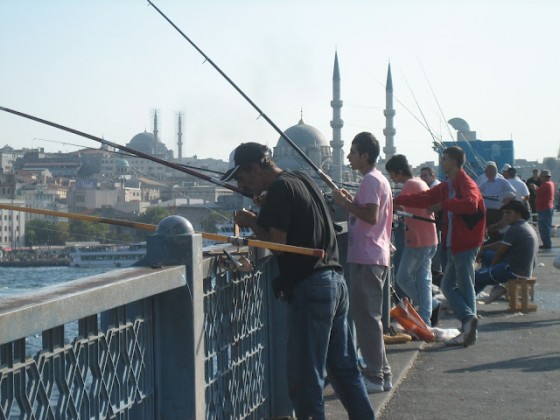
New regulations will restrict fishermen in Turkey from catching juvenile fish and using dragnets in shallow waters. But environmentalists say the laws don’t go far enough.

The new fishing season in Turkey will kick off in just a few days, on Sept. 1. In preparation, Turkey’s Ministry of Food, Agriculture and Livestock has proposed new fishing legislation, raising the length of legal catches and the depth of legal dragnet use, according to independent media center Bianet. Slowing the extinction of a species

One fish that will benefit from the new laws is the turbot, which is an endangered species, according to Greenpeace Mediterranean Oceans Campaigner  Banu Dökmecibaşı.

Under the new laws, the length of a legal turbot catch will be raised from 40 centimeters to 45. It seems like a trivial change, but those extra five centimeters will mean many more juvenile turbots stay in the water and have a chance to breed, boosting the overall population.

To further encourage prolific breeding in the species, turbot hunting will be restricted between April 15 and June 15.

The legal length of sea bream and sea bass will also be raised, from 20 to 35 centimeters and 18 to 25 centimeters, respectively.

The use of dragnets, meanwhile, will be banned around the Princes’ Islands, the Gulf of İzmit, and the Bay of Büyükçekmece, all of which are in the Marmara Sea off the southern coast of Istanbul. In areas where the nets can still be used, the depth of the water must be at least 24 meters, up from the 18-meter depth previously required by law.

If approved by the Prime Ministry, the laws will remain in effect for the next four years.

Struggle for sustainable fishing not over yet in Turkey

Greenpeace Mediterranean has been campaigning for laws against the capture of juvenile fish since 2010. Hundreds of thousands of Turks have petitioned, texted, and made phone calls to their government about the issue through Greenpeace’s efforts.

While the new regulations are certainly an improvement over their predecessors, they still lag behind the regulations recommended by Greenpeace — and followed in other parts of the world.

In European Union countries, for example, dragnet fishing is banned in waters shallower than 50 meters. And while restricting dragnet use in certain parts of the Marmara Sea is a positive step, the entire sea should be designated a conservation zone, according to Greenpeace Oceans Campaigner Dökmecibaşı.

Beyond making these laws, moreover, the government must ensure they are enforced, Dökmecibaşı told Bianet. The hunting and sale of juvenile bluefish was banned in Turkey last year, she pointed out, but the law was rarely enforced because of a lack of inspection.

In addition, Turkey has suffered from a spike in illegal fishing gangs, who occasionally turn violent when environmentalists attempt to intervene. The government has managed to cut down on the problem significantly in recent months, however, Dökmecibaşı says.

:: Bianet

Read more about conservation in Turkey:

Long-Awaited Wildlife Corridor Becoming Reality in Turkey

Environmentalist Partially Blinded By Illegal Fishermen In Istanbul

In Remotest Anatolia, Lone NGO Speaks Up On Nature’s Behalf

Julia Harte
Julia Hartehttp://www.greenprophet.com
Julia spent her childhood summers in a remote research station in the Rocky Mountains of Colorado, helping her father with a 25-year-old experiment in which he simulated global warming over a patch of alpine meadow. When not measuring plant species diversity or carbon flux in the soil, she could be found scampering around the forests and finding snowbanks to slide down. Now she is a freelance journalist living in Istanbul, where her passion for the environment intersects with her interest in Turkish politics and grassroots culture. She also writes about Turkish climate and energy policy for Solve Climate News.

LEAVE A REPLY

Please enter your comment!
Please enter your name here

TRENDING

Dead shark on beach injured by fishing nets

  A dead shark that washed ashore this week at...

The Emirates wants to help Lebanon become a sustainable winner

Can sustainable experts change the future of Lebanon for the better? The UAE is leading the way.

Fight against illegal fishing and bottom sea trawling in the Mediterranean

The FAO-based group are working with NGOs urging the adoption of measures that would allow the GFCM to tackle illegal, unreported and unregulated fishing and cases of non-compliance within its region

New High Seas treaty set by the UN to protect marine life

The Food and Agriculture Organization of the United Nations...

We need larger buffer zones around protected marine areas, finds new study.

Even protected oceans and seas are severely affected by "edge effect"

Qatar’s climate hypocrisy rides the London Underground

Qatar remains a master of doublethink—burning gas by the megaton while selling “sustainability” to a world desperate for clean air. Wake up from your slumber people.

How Quality of Hire Shapes Modern Recruitment

A 2024 survey by Deloitte found that 76% of talent leaders now consider long-term retention and workforce contribution among their most important hiring success metrics—far surpassing time-to-fill or cost-per-hire. As the expectations for new hires deepen, companies must also confront the inherent challenges in redefining and accurately measuring hiring quality.

8 Team-Building Exercises to Start the Week Off 

Team building to change the world! The best renewable energy companies are ones that function.

Thank you, LinkedIn — and what your Jobs on the Rise report means for sustainable careers

While “green jobs” aren’t always labeled as such, many of the fastest-growing roles are directly enabling the energy transition, climate resilience, and lower-carbon systems: Number one on their list is Artificial Intelligence engineers. But what does that mean? Vibe coding Claude? 

Somali pirates steal oil tankers

The pirates often stage their heists out of Somalia, a lawless country, with a weak central government that is grappling with a violent Islamist insurgency. Using speedboats that swarm the targets, the machine-gun-toting pirates take control of merchant ships and then hold the vessels, crew and cargo for ransom.

Leopoldo Alejandro Betancourt López Turned Ocean Plastic Into Profitable Sunglasses

Few fashion accessories carry the environmental burden of sunglasses. Most frames are constructed from petroleum-based plastics and acrylic polymers that linger in landfills for centuries, shedding microplastics into soil and waterways long after they've been discarded. Leopoldo Alejandro Betancourt López, president of the Spanish eyewear brand Hawkers, saw this problem differently than most industry executives.

Why Dr. Tony Jacob Sees Texas Business Egos as Warning Signs

Everything's bigger in Texas. Except business egos.  Dr. Tony Jacob figured...

Israel and America Sign Renewable Energy Cooperation Deal

Other announcements made at the conference include the Timna Renewable Energy Park, which will be a center for R&D, and the AORA Solar Thermal Module at Kibbutz Samar, the world's first commercial hybrid solar gas-turbine power plant that is already nearing completion. Solel Solar Systems announced it was beginning construction of a 50 MW solar field in Lebrija, Spain, and Brightsource Energy made a pre-conference announcement that it had inked the world's largest solar deal to date with Southern California Edison (SCE).

Related Articles

Popular Categories