Libya’s Post-Revolution Trash and Traffic Problems

traffic-trash-libya-democracy-revolution-futureClear Libyan streets of trash and traffic for a brighter and more democratic future says expert

Security concerns in Libya may be top of the political agenda, but more goodwill could be earned if socio-economic problems such as traffic and trash are tackled says Rhiannon Smith, who is an economic development expert in Libya. Post-revolution, Libya is struggling with pressing security concerns, disunity and division along religious and ethnic lines. As such, political progress away from a long authoritarian past to a more democratic future has been painfully slow. The solution is tackling problems that all Libyans face and there isn’t more that unites Libyans in despair than the traffic and trash problem.

These “are issues that could be actively addressed with minimal controversy and relatively little effort which would not only improve living standards across the country, but also lay the groundwork for the psychological transition from authoritarianism to democracy,” writes Smith in OpenDemocracy.

With petrol cheaper than mineral water and a threadbare public transport infrastructure, the streets of Libya are congested and dangerous. A hike in petrol prices and greater enforcement of traffic rules is one quick solution whilst the public infrastructure is built up. As well as cutting back the congestion, the traffic law enforcement could be the “first step towards re-establishing rule of law in post-Gaddafi Libya.”

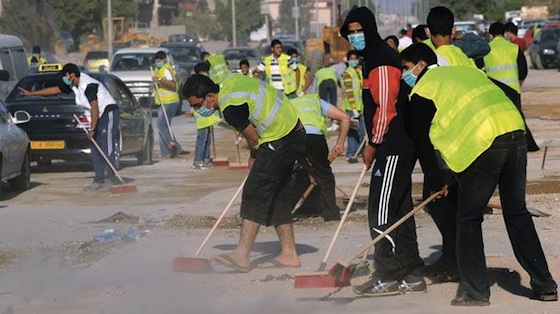
Another major issue facing Libyans is trash. On the streets, in the alleyways, in parks and schools, it’s clear that the country has a chronic litter problem. The main reason behind this is the absence of an organised, well-funded rubbish collection service and a general acceptance of littering. Smith argues that a massive overhaul is needed in the long-run but for now, a bigger workforce and modern collection vehicles would be a step in the right direction.

“Not only would the environment be cleaner and healthier, removing the litter could help kindle Libya’s fledgling tourism industry,” adds Smith. “Perhaps more importantly, cleaning the streets will show that the government is doing its job and might encourage people to consider the consequences of throwing their rubbish on the streets.”

It turns out that what’s good for the planet is also good for democracy – and there is nowhere that could benefit from more democracy and environmental action than the Arab world.

: OpenDemocracy

:: Image of Libyan children cleaning the streets via Times of Malta.

For more on Libya see:

Was The Arab Spring Good for Renewable Energy?

Libyan Artist Turns Weapons of War Into Sculptures

MENA is Changing Drastically & NASA Has The Pictures To Prove It
 

Arwa Aburawa
Arwa Aburawahttp://www.greenprophet.com
Arwa is a Muslim freelance writer who is interested in everything climate change related and how Islam can inspire more people to care for their planet and take active steps to save it while we can. She is endlessly suspicious of all politicians and their ceaseless meetings, especially as they make normal people believe that they are not part of the solution when they are the ONLY solution. Her Indian auntie is her model eco-warrier, and when Arwa is not busy helping out in the neighborhood alleyway garden, swap shopping or attempting fusion vegetarian dishes- with mixed success, she’d like to add- she can be found sipping on foraged nettle tea.
1 COMMENT
  1. Any male-dominated population anywhere in the World will continue to grow and produce more waste materials than the environment can absorb, resulting in disease and death to a growing number of people. Thus, while liberating women by giving them the right to decide if and when to concieve and birth their children, thus reducing the population, it is necessary to safely recycle 100% of trash, garbage, junk, smoke and fumes. If not we all face ecocide and extinction in our lifetime.

LEAVE A REPLY

Please enter your comment!
Please enter your name here

TRENDING

Play spogomi the garbage picking sport and win a World Cup

If the future of environmental action looks less like a lecture and more like a pickup game, that might not be a bad thing at all.

Arab agricultural land is on the brink

Across the Arab world, croplands face a perfect storm of stressors. Excessive fertilizers and pesticides erode soil ecology. Poor drainage and over-irrigation drive salinization, leaving fields crusted with salt. Rising temperatures, dwindling groundwater, and more frequent sand-and-dust storms—all amplified by climate change—compound the crisis.

Freedom Flotilla sets sail toward Gaza with Greta Thunburg on board to liberate Gaza

Inside the controversial voyage that merges climate activism, human rights, and Middle East politics. Will the Freedom Flotilla make it to Gaza?

Morocco loses half its wheat crop this year from drought

A prolonged drought in Morocco is causing serious problems...

Syrian first lady Asma al-Assad has leukemia: her video about it

London born and bred, Asma al-Assad, the first lady to the Syrian dictator Bashar al-Assad, has announced she has acute myeloid leukemia.

Qatar’s climate hypocrisy rides the London Underground

Qatar remains a master of doublethink—burning gas by the megaton while selling “sustainability” to a world desperate for clean air. Wake up from your slumber people.

How Quality of Hire Shapes Modern Recruitment

A 2024 survey by Deloitte found that 76% of talent leaders now consider long-term retention and workforce contribution among their most important hiring success metrics—far surpassing time-to-fill or cost-per-hire. As the expectations for new hires deepen, companies must also confront the inherent challenges in redefining and accurately measuring hiring quality.

8 Team-Building Exercises to Start the Week Off 

Team building to change the world! The best renewable energy companies are ones that function.

Thank you, LinkedIn — and what your Jobs on the Rise report means for sustainable careers

While “green jobs” aren’t always labeled as such, many of the fastest-growing roles are directly enabling the energy transition, climate resilience, and lower-carbon systems: Number one on their list is Artificial Intelligence engineers. But what does that mean? Vibe coding Claude? 

Somali pirates steal oil tankers

The pirates often stage their heists out of Somalia, a lawless country, with a weak central government that is grappling with a violent Islamist insurgency. Using speedboats that swarm the targets, the machine-gun-toting pirates take control of merchant ships and then hold the vessels, crew and cargo for ransom.

Leopoldo Alejandro Betancourt López Turned Ocean Plastic Into Profitable Sunglasses

Few fashion accessories carry the environmental burden of sunglasses. Most frames are constructed from petroleum-based plastics and acrylic polymers that linger in landfills for centuries, shedding microplastics into soil and waterways long after they've been discarded. Leopoldo Alejandro Betancourt López, president of the Spanish eyewear brand Hawkers, saw this problem differently than most industry executives.

Why Dr. Tony Jacob Sees Texas Business Egos as Warning Signs

Everything's bigger in Texas. Except business egos.  Dr. Tony Jacob figured...

Israel and America Sign Renewable Energy Cooperation Deal

Other announcements made at the conference include the Timna Renewable Energy Park, which will be a center for R&D, and the AORA Solar Thermal Module at Kibbutz Samar, the world's first commercial hybrid solar gas-turbine power plant that is already nearing completion. Solel Solar Systems announced it was beginning construction of a 50 MW solar field in Lebrija, Spain, and Brightsource Energy made a pre-conference announcement that it had inked the world's largest solar deal to date with Southern California Edison (SCE).

Related Articles

Popular Categories