

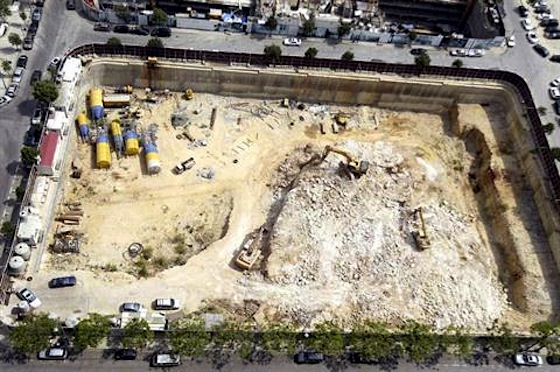
Bulldozers in Beirut tore down remains of a 2,500 year old Phoenician port on Tuesday with blessings from the Culture Minister. Eventually, three new skyscrapers will be built in its place, further blighting a once-beautiful city. The former Culture Minister Salim Wardy thwarted efforts by Venus Construction to proceed with the demolition in Mina al-Hosn and activists have engaged a year-long battle against the firm, but Gaby Layyoun ordered the port’s destruction, denying claims of its historical importance. Activists told The Daily Star that they will not rest until both Layyoun and Venus Construction stand trial for destroying the city’s cultural heritage.
The Phoenicians
The ancient Phoenicians maintained a maritime trading culture all along the Mediterranean Sea, including present-day Lebanon.
Archaeologists and maritime historians hired by the former Culture Minister compiled a scientific report that evidence suggests that the presence of dry docks dating to 500 B.C. were likely to exist in Beirut. The Directorate General of Antiquities then discovered two ancient dry docks that were used for shipbuilding and their maintenance at the site of Venus Construction’s planned $500 million development.
Based on these findings and the discovery of two large sandstones dating to the first and third centuries A.D., Wardy issued ministerial decree 25 in April, 2011 designating 1200 square meters of land owned by Venus Construction as public property of archaeological importance that should not be tampered with, according to The Daily Star.
Wiping out history for money
Venus Construction hired a team of experts who refuted the team’s report. Instead, they said, since the site is 8 meters above sea level and 230 meters from the Mediterranean Sea shore, it couldn’t have functioned as either a port or a storage facility for ancient ships.
But Layyoun revoked the decree on Tuesday saying that there is no evidence related to ships or any type of works related to maritime activity at the site. This announcement delighted Venus CEO Mohammad Kassem, who wasted no time dispatching bulldozers to the site, where 2,500 years of history was destroyed in one very shortsighted day.
Today at noon, activists are expected to gather in front of the Culture Ministry to protest the demolition following calls from the Association for the Protection of the Lebanese Heritage. Salim Wardy says that both Layyoun and Venus Construction “have committed a crime by destroying the port.”
If you’re in Beirut, please make your voices heard.
image via Mahmoud Kheir, The Daily Star
More on Archaeology in the Middle East:
Archaeologists Discover Lost Language in Turkey




This isn’t an isolated incident either. Since the revolution in Egypt an innumerable amount of archaeological dig site have been desecrated by thieves, and one site in particular has been covered over by a new mosque. It’s difficult to asses the situation from here in the States, but common opinion is, of course, to preserve historical site (no matter what value has been placed on it by local researchers) as there is likely great discoveries to be made and much more to be learned.
There are two sides to this story.
Some archeologists assure that the site has no value at all and it is not an ancient phoenician port.
see article in french: http://www.lorientlejour.com/category/%C3%80+La+Une/article/765693/Le_%3C%3C+port_phenicien_de_Beyrouth+%3E%3E_detruit_a_coups_de_pelleteuse.html
It is always important to give the two side of a story.
Agreed, but still. The Middle East is full of archeology. Often people today don’t have the right tools to understand what they are seeing. A site should never be destroyed at any cost. There are ways to bury archeology and build around it so that future archeologists will have something to work on/with. This is sustainable archeology. I can imagine that in 100 years the future archeologists would be upset about what’s happening in Beirut right now.