Poverty Group Objects to Clean Technology Fund in Morocco

Concentrated-Solar-Power

Big Solar drives a wedge between the need to abate climate change and end poverty, says The World Development Movement.

Claiming the the World Bank’s Clean Technology Fund is supposed to be used to alleviate poverty, a British group is objecting to the use of World Bank funds in Morocco to deploy a Desertec solar project in Morocco that will export power to Europe.

The Moroccan Agency for Solar Energy (MASEN) is expected to award the contract for the first phase of the 500 MW Ouarzazate solar project within weeks to one of three energy developers from outside Morocco.

MASEN intends to develop four 500 MW solar projects by 2020, which would allow it to source nearly half of its electricity from renewables, as well as become a net exporter of energy to Europe thanks to its interconnector stretching to Spain. In anticipation of becoming a renewables powerhouse, Morocco doubled the capacity of the interconnector to 400MW in 2007.

After accepting bids from 200 companies, Spain’s Abesinsa ICI  Abengoa’s industrial engineering and construction unit, Italy’s Enel SpA  and Saudi-owned ACWA Power International are in the lead to develop the project. While Abengoa has developed projects like this before, Enel has only 230 MW in solar development.

Major industrial giants like Siemens, Mitsubishi, Daewoo, Lockheed Martin and Sener were shut out.

The World Development Movement claims that using Clean Technology Fund money for the solar project would be a misuse of funds, as it claims that the program is intended partly to reduce poverty, and “to prioritise projects that tackle poverty and aid transition to a low carbon economy, instead of subsidising multinational companies.”

But the objective of the Clean Technology Fund is to invest in clean energy projects in developing nations to cut greenhouse gas emissions of the recipient country over the long term, according to WRI.

As solar projects go mainstream, they are increasingly developed by very large engineering firms. Saudi  Arabia has a $109 billion solar plan to power one third of its country, for example. This will not be developed by small companies.

According to the World Bank [PDF] the bids must support local manufacturers within a regulatory framework that requires investment locally, where bids must specify local content clauses, including technical education and R&D.

Morocco is ideally situated for hosting this giant solar project for the Desertec plan to power Europe from the Sahara, because it has the solar insolation, the strong government support and existing grid connections with ALgeria and Spain.

But another key reason that the World Bank selected Morocco for funding was the existence of a local manufacturing base with already existing industries, with the ability to supply the project from the most basic raw materials through to the final metal structures, electric and electronic equipment.

As the North African deserts becomes a hub for CSP solar power, driven by Desertec, it will increasingly develop and hone an expertise in solar project development that will add jobs as a thriving clean technology sector develops in the region.

It would be a pity if changing the emphasis to poverty reduction within the Clean Technology Fund program led to weakening its far more far-reaching good it can do in reducing greenhouse gas emissions by helping the developing world hurdle the pollutants that threaten us all, and most particularly, the poor, by developing a solar power industry supply chain in Morocco.

Related:
Morocco to Build Cars in Zero Carbon Factory
Interview: SolarReserve For the MENA Region?
Egypt to Test Unique CSP Solar/Biomass Hybrid Plant

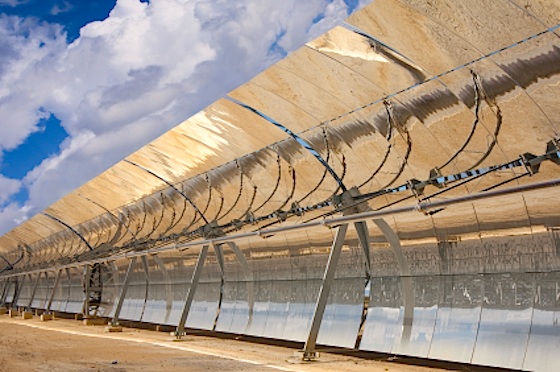
Image of solar thermal from Abengoa

1 COMMENT

LEAVE A REPLY

Please enter your comment!
Please enter your name here

TRENDING

Travel Morocco with teens at the Kasbah du Toubkal’s magical mountain retreat

Walking well-trodden mountain pathways, eating fresh local food, and learning about the transformative work embedded in the Kasbah’s approach to tourism has now been imparted to our children. We hope, in turn, these experiences will serve to inform their contributions in the world as they continue to grow. Don’t wait, Morocco is on everyone’s bucket list. Growth and change are inevitable. 

Arab agricultural land is on the brink

Across the Arab world, croplands face a perfect storm of stressors. Excessive fertilizers and pesticides erode soil ecology. Poor drainage and over-irrigation drive salinization, leaving fields crusted with salt. Rising temperatures, dwindling groundwater, and more frequent sand-and-dust storms—all amplified by climate change—compound the crisis.

Morocco loses half its wheat crop this year from drought

A prolonged drought in Morocco is causing serious problems...

Morocco pardons 5,000 cannabis farmer convicts

As a way to cut down on the illegal drug trade, Morocco decides to pardon cannabis growers making their practices legal.

The wind farms of the Middle East

In recent years, the Middle East has emerged as a significant player in renewable energy, embracing the potential of wind power to diversify its energy mix and reduce reliance on fossil fuels.

Qatar’s climate hypocrisy rides the London Underground

Qatar remains a master of doublethink—burning gas by the megaton while selling “sustainability” to a world desperate for clean air. Wake up from your slumber people.

How Quality of Hire Shapes Modern Recruitment

A 2024 survey by Deloitte found that 76% of talent leaders now consider long-term retention and workforce contribution among their most important hiring success metrics—far surpassing time-to-fill or cost-per-hire. As the expectations for new hires deepen, companies must also confront the inherent challenges in redefining and accurately measuring hiring quality.

8 Team-Building Exercises to Start the Week Off 

Team building to change the world! The best renewable energy companies are ones that function.

Thank you, LinkedIn — and what your Jobs on the Rise report means for sustainable careers

While “green jobs” aren’t always labeled as such, many of the fastest-growing roles are directly enabling the energy transition, climate resilience, and lower-carbon systems: Number one on their list is Artificial Intelligence engineers. But what does that mean? Vibe coding Claude? 

Somali pirates steal oil tankers

The pirates often stage their heists out of Somalia, a lawless country, with a weak central government that is grappling with a violent Islamist insurgency. Using speedboats that swarm the targets, the machine-gun-toting pirates take control of merchant ships and then hold the vessels, crew and cargo for ransom.

Leopoldo Alejandro Betancourt López Turned Ocean Plastic Into Profitable Sunglasses

Few fashion accessories carry the environmental burden of sunglasses. Most frames are constructed from petroleum-based plastics and acrylic polymers that linger in landfills for centuries, shedding microplastics into soil and waterways long after they've been discarded. Leopoldo Alejandro Betancourt López, president of the Spanish eyewear brand Hawkers, saw this problem differently than most industry executives.

Why Dr. Tony Jacob Sees Texas Business Egos as Warning Signs

Everything's bigger in Texas. Except business egos.  Dr. Tony Jacob figured...

Israel and America Sign Renewable Energy Cooperation Deal

Other announcements made at the conference include the Timna Renewable Energy Park, which will be a center for R&D, and the AORA Solar Thermal Module at Kibbutz Samar, the world's first commercial hybrid solar gas-turbine power plant that is already nearing completion. Solel Solar Systems announced it was beginning construction of a 50 MW solar field in Lebrija, Spain, and Brightsource Energy made a pre-conference announcement that it had inked the world's largest solar deal to date with Southern California Edison (SCE).

Related Articles

Popular Categories