


The Kingdom of Saudi Arabia’s (KSA) fast food market is expected to reach $4.5 billion in gross sales by 2015, driven by growing demand from its young, western-influenced population, higher disposable incomes, and new financing arrangements, according to a report by Euromonitor, a leading analyst of global markets.Western coffee chains are less about catching a caffeine fix than they are about providing a cozy venue to check your email or write your screenplay. Similarly, future expansion of junk food joints in the Middle East will be sold as “lifestyle destinations” that just happen to come with a side of sugar, fat and processed carbs.
Extremely limited social outlets for young Saudis mean there’s a wide market in which fast food outlets can position themselves as central points for uber-passive “recreation” and hip social gathering.
Established chains will likely spearhead growth, accounting for nearly 20 percentof Saudi foodservice transactions in the next three years. Franchise consultants report a steep increase in inquiries from firms eyeballing store openings throughout the Gulf Cooperation Council (GCC) region, which includes the Kingdom of Saudi Arabia, the United Arab Emirates, Kuwait, Bahrain, Qatar, and the Sultanate of Oman.
The surge in food chains entering the Gulf market comes as international brands seek to bolster global revenues amid increased competition in their home markets.
Last December, after their Middle East sales grew by 47.29% and hit the $2MIL mark, New Zealand’s Burger Fuel announced plans to open a dozen new stores across the region.
Tim Hortons, Canada’s largest restaurant chain, announced plans to roll out 120 stores in the GCC over the next five years. I recently counted 37 Tim Hortons’ billboards between Dubai and Abu Dhabi. Man, those Emiratis trump NYC cops in their love of doughnuts and cups of joe.
Denver-based Smashburger, which I first encountered as a pocket-friendly place to grab an après-ski bite, has signed agreements for 17 stores in Kuwait, Bahrain and Saudi Arabia. Skiers, schmiers: who doesn’t love a Classic with Cheese?
Eating out is emerging as a key entertainment option for Saudis of all ages, creating lucrative opportunities for restaurants that succeed in tailoring their concepts to local tastes. These trends are transformative, bringing convenience and standardization into people’s lives.
Stepped up consumerism encourages sedentary lifestyles.
People eat out more; consuming more quantity with less quality. Green Prophet has been reporting on the dubious ingredients in fast food offerings, and the alarming health problems among children in the Gulf. The rise of fast food contributes to rampant obesity and increased incidence of cardio-vascular disease and diabetes. Overpackaged takeout foods will exacerbate local pollution. An increasingly consumerist lifestyle can cause also impact financial health: people’s priorities change, putting instantaneous gratification ahead of household budgeting and longterm financial planning.
In Arab culture, food looms large, and is central to its world reknown hospitality. The emergence of western junk food will surely speed the demise of this regional attribute. Say “marhaba” to burgers, processed ice cream, and empty calorie baked goods, and bid “maa salama” to cultural norms such as local cuisine, dinners with extended family, and long held traditions centered on food preparation and sharing.
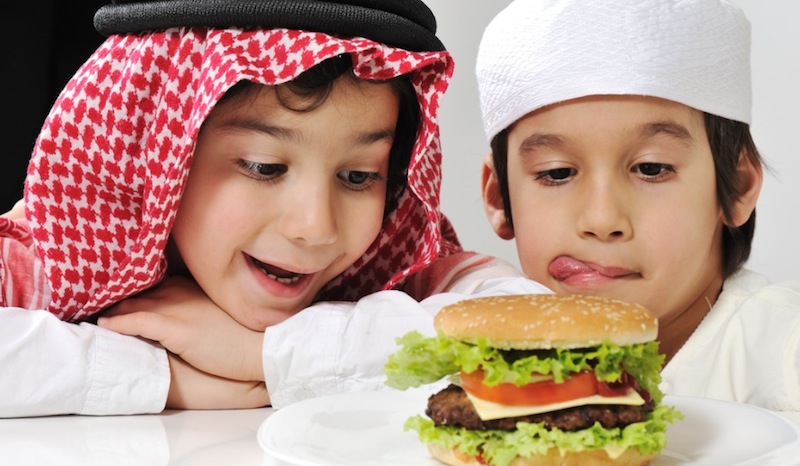
Image of kids and burgers from Shutterstock




That’s classic – I want a tube of CRUST! Where’d you buy it?
Let’s start carrying cameras to record them all – maybe do a Green Prophet contest?
Thanks for the great laugh!
oh, laurie, you have to do an article on ‘howlingly funny’ copy-cat names. my all time favorite was a tube of toothpaste. i got such a laugh out of it that i actually bought it and sent it to my family in the states. it was a ‘Crest’ copy-cat and they copied, exactly, the font and colors. well, they had to change something, right? but unfortunately they chose to swap out the ‘e’ for a ‘u’…
Crust toothpaste!
who wouldn’t want to brush their teeth with ‘Crust’?
I see pretty much the same in Jordan, Margaret. The chains are in the cities, and in the mid-sized villages there are big-name knock-offs (with howlingly funny names like Cheeseburger Prince and Captain Tucky’s Fried Chicken).
Bad thing is that lunches and parties at these places are held out as special treats – so kids love it and want it even more.
Terrible we have the same problem here in Turkey especilly with really young children and the Gift Meal Packets A lot of it I blame on the Mums( sorry) but as children get older and more tied to computer and these games then its Pizzas ..ordered over comp and delivered to home ..dont know about other countries (These remarks are tied to the Turks living in cities not rural areas)