

Think Egypt’s White Desert meeting Mont Blanc.
Three days of heavy snowfall hit downtown Amman, fat flakes screaming for clothes not found in our closets. Schools shut and offices closed. Icy roads wrought havoc on the annual Dead2Red bike and running race. Park aside historical significance, religious connotation, and cultural pride: I say this waterbody’s main value is as an organic stress-reducer for Egyptians and Jordanians, and for tourists from everywhere else drawn to its salt-encrusted shores.
Wade, float, gaze at its gorgeousness and feel your muscles go slack, your pulse settle into a kitten’s purr at the Dead Sea. So with local weather so unpredictable and a school break looming, I poked around for alternative de-stress-tinations with a warm water theme. Say hello to Pamukkale, Turkey.
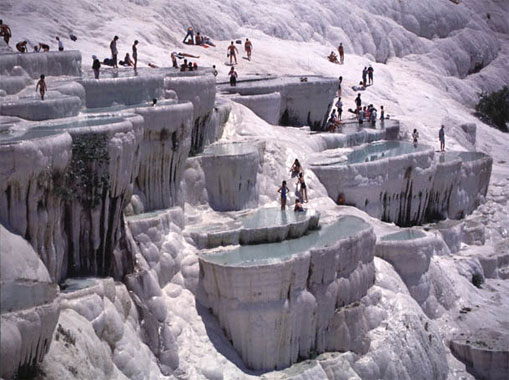
Natural relaxation’s most excellent Plan B. Pamukkale is a surreal natural hot tub growing in southwestern Turkey. It’s a series of brilliant white travertine steps, fanning across a hilltop, filled with a continual stream of heated mineral water from 17 natural hot springs. It promises to be as revivifying to the body as it is to the soul.
 For over 14,000 years, calcium carbonate (CaCO3) contained in the flowing waters has coated the outcropping in a sparkling white icing. This mineral is the main ingredient in pearls and eggshells, and it supersaturates these waters.
The water off-gasses carbon dioxide when it hits the surface, in turn depositing the CaCO3 on the pool beds. The CaCO3 solidifies over time, expanding the terraced structure. Pool temperatures vary from tepid to boiling.
People have bathed here for millennia: the water has therapeutic qualities and since antiquity has been used to treat eye and skin diseases, high blood pressure and heart disease. Unlike the Dead Sea, here you can splash with abandon, dunk your head, and open your eyes underwater.
Tourism is big business in Pamukkale, whose name means “cotton castle” in Turkish. Located about 12 miles north of the town of Denizli, it’s also home to the Byzantine/Greco-Roman city Hierapolis which was built in the 6th century BCE. The ruins cover an extensive area. Over time, as the pools enlarge, they slowly encase the archeology in a crystalline white crust.
 The site had been largely unprotected until 1988 when it was declared a World Heritage site. Previous development had caused considerable damage to both the archeological ruins and the travertine pools. Cars and motorcycles were allowed to traverse the hills and hotels were built on top of the ancient’ remains.
Vehicles are now prohibited and the intrusive hotels demolished. Restorative work continues and protections are in place.
As example, shoes are prohibited when bathing, and many areas are off-limits to foot traffic altogether.
Stark white objects in nature make for arresting visuals. Think Egypt’s White Desert, and Mont Blanc: riveting viewing, but hardly body-friendly. I’ve scraped knees on pale salt-caked boulders edging the Dead Sea, and had Dover Cliffs’ chalk fall on my head. Here’s hoping that Pamukkale proves as easy on my body as it will be on my eyes.
And please, no more freak snow in Jordan.
First and third image by www.ilostravel.con.tr ; second image by www.crainium.net


Had wonderfull time in Pamukkale. We went to Pamukkale with Danish speaking guide – the guide were awesome and so were the travel agent Amisol Travel in Denmark. We have been travelling with them the last 4 years now, and everything just went perfect. You can see more of their programs on the link here: http://www.amisol.dk/rejser/tyrkiet/
From family vacations to last-minute romantic getaways, make Orbitz your first and only stop for Pamukkale vacations. You can customize your trip with flights, hotels and activities to match your travel plans and tastes. Sweeten the pot with extra savings when you book your flight and hotel together.
Create your own Pamukkale travel plans
Build your own Pamukkale vacation itinerary. Choose a flight that matches your schedule and a hotel with the amenities you need. Book them together for extra discounts you won’t find when booking separately.
For all our Pamukkale tours visit http://www.onenationtravel.net
My boyfriend and I went to Turkey last year with the Danish travel agency Atlantis Rejser. We saw the Pamukkale on an excursion and it was an truly an incredible sight! It’s definately not the last time we go to Tyrkey with Atlantis Rejser.
You can see more beautiful photos of Pamukkale here: http://www.atlantisrejser.dk/destinationer/tyrkiet/pamukkale-bomuldsborgen/fotos/
Daily Pamukkale Tours,Guided Pamukkale Hierapolis Tours,Pamukkale Tour Packages.
http://www.tours4turkey.com/Tours/Daily_Tours_Turkey/Daily_Pamukkale_Tour.html