Rooftop Hydroponic Farms in Egypt Scrub the Air and Uplift Urban Poor

rooftop farming, egypt, maadi, hydroponic farms, soilless farming, agriculture, aquaculture, urban farming, organic farming

Urban farming in Egypt has soared. Read about Schaduf – a soilless solution taking root in Maadi.

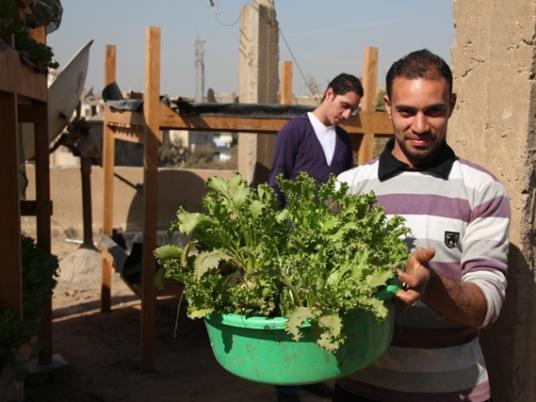
Two Egyptian brothers have received enough donations to set up three rooftop farms in Maadi – a once wealthy suburb of Cairo. Due for full installation by April, these won’t be any old farms. Sherif and Tarek Hosny have developed closed-loop, vertical hydroponic systems that use recycled water and mineral nutrient solutions to grow cheaper, healthier produce.

Designed to become a secondary source of income for poor families living in the less-privileged areas of Maadi, where many expatriates and wealthy Egyptians seek shelter from Cairo’s bustling urban center, Schaduf’s farms have great potential to scrub the neighborhood’s polluted air and give struggling families a much-need fiscal boost.

A healthy supplemental income

Sherif Hosny is an engineer who quit his job in Dubai to work on an organic farm in the United States. He told Egypt Independent that he became taken with farming  and decided to return to his home country with his new-found learning.

Through Schaduf, which name refers to a weighted pole device that is used to lift heavy buckets of water, the Hosny brothers hope to uplift families that live below the poverty line. They are well on their way to achieving this goal.

Already they have received enough donations to build three rooftop systems that cost up to $2,500 – an amount of money that poor families could never produce. Schaduf has implemented a scheme that allows them to provide the hydroponic system and training upfront, for which new part-time urban farmers should be able to pay within a year by selling their produce.

Not only does the system support a new generation of urban farmers, but the supplies used to create the systems all come from local manufacturers, which further fosters a proudly-Egyptian economy.

Supporting the local economy

Egypt Independent reports:

All of the products used from the wooden frames, the perelite (a soil conditioner), the peat moss to the tarps are locally manufactured. Schaduf has already received enough donations to set up three rooftop farms and is working with local NGOs to find families who are interested and have the appropriate amount of space.

In addition to the rooftop hydroponics farm, the Hosny brothers are testing an “aquaponic” systems that combines principles of aquaculture and hydroponics. Although they have managed to raise Tilapia fairly successfully, the fish die off during unusually cold weather, so Schaduf is testing various low-tech solutions that will maintain warmth in the rooftop fish tanks.

Critics worry that Egypt’s pollution will compromise the quality of produce grown on Maadi rooftops, but Sherif dismisses these claims.

“Trees in the neighborhood may filter out some of the pollution sediments before they reach roofs, and the plants create CO2, pulling pollution out of the air,” he told Egypt Independent, adding that if rooftop gardens “could have a big impact on Cairo air.”

:: Egypt Independent

More on urban farming solutions in Egypt:

Egyptian Organic Farm Declared Sustainability World Leader

What Urban Rooftop Gardening Could do for the Middle East
Egypt’s Urban Agriculture Movement is Growing
Tafline Laylin
Tafline Laylinhttp://www.greenprophet.com
As a tour leader who led “eco-friendly” camping trips throughout North America, Tafline soon realized that she was instead leaving behind a trail of gas fumes, plastic bottles and Pringles. In fact, wherever she traveled – whether it was Viet Nam or South Africa or England – it became clear how inefficiently the mandate to re-think our consumer culture is reaching the general public. Born in Iran, raised in South Africa and the United States, she currently splits her time between Africa and the Middle East. Tafline can be reached at tafline (at) greenprophet (dot) com.
4 COMMENTS
  1. Hydroponics simply means growing plants without soil. All required food elements for the plants are called hydroponic nutrients, which are dissolved in water and fed directly to the roots automatically. Plants form smaller roots and grow in inert grow media (i.e. gravel, sand, water or even air). If you haven’t seen it for yourself, you will be amazed.

  2. I personally think it is a great concept, Hydroponic rooftops look like a better option, with the easy availability of hydroponic nutrients. Green roofs can significantly reduce the surface run off volumes, improve air quality and rates of rainfall leaving roofs, people can grow vegetables like tomatoes, carrots and many more with the help of it thus reducing their food bills and also avoid eating contaminated vegetables that we get in the super markets. I would rather suggest going for hydroponic green rooftops rather than organic green roofs. It will not only help in getting bigger and better yields, but also the time required for the garden to sprout will be less compared to organic gardening and vegetables can be grown throughout the year.People can start off with it on a small scale using products root shooters from advancednutrients.com

    http://advancednutrients.com/hydroponics/products/root_shooters/root_shooters_product_information.php

Comments are closed.

TRENDING

Jujube, the sidr tree of medicine and magic

A magic holy sidr bath to deflect the evil eye? It needs 7 powdered sidr leaves stirred into a bucket of warm water. The hadith of the Prophet Muhammad allows to repeat healing prayers and verses from the Koran to increase the water’s potency. 5 grams, or 1 tablespoon of sidr powder equals 7 leaves.

Farm To Table Israel Connects People To The Land

Farm To Table Israel is transforming the traditional dining experience into a hands-on journey.

Iran’s holiest city about to run dry as terror chosen over water management

Iran’s second-largest city, Mashhad, is facing an acute water emergency after dam reservoirs feeding the city fell below three percent capacity, according to Iranian state and local media. Officials warn that without rainfall or improved inflows from neighboring Afghanistan, the city’s supply could soon collapse.

Regenerative circling faming with man, AI, robots and solar power

In the next wave of regenerative agriculture, the farm is no longer a grid of efficiency but a living circle—with the human spirit at its core. Instead of replacing the farmer, AI and robotics now orbit like silent companions, extending our hands rather than erasing them. A rotating robotic arm moves through the plot not as a master, but as an assistant, guided by ecological intelligence and human intuition. This is not automation for profit—it’s a return to sacred design, where technology becomes humble, circular, and in service to the soil, the grower, and the wider web of life.

Rewilding the Suburb: Lagoon Valley’s Profound Plan for Conservation Community in California–– An Interview with Developer Curt Johansen

Lagoon Valley developers have set aside a remarkable 85% of its total land for open space, trails, and protected habitats—a rare move in an era of unchecked development. This isn’t just a nod to green space; it’s a full embrace of a conservation community model, where nature isn’t a backdrop but a partner.

Turning Your Energy Consultancy into an LLC: 4 Legal Steps for Founders in Texas

If you are starting a renewable energy business in Texas, learn how to start an LLC by the books.

Tracking the Impacts of a Hydroelectric Dam Along the Tigris River

For the next two months, I'll be taking a break from my usual Green Prophet posts to report on a transnational environmental issue: the Ilısu Dam currently under construction in Turkey, and the ways it will transform life along the Tigris River.

6 Payment Processors With the Fastest Onboarding for SMBs

Get your SMB up and running fast with these 6 payment processors. Compare the quickest onboarding options to start accepting customer payments without delay.

Qatar’s climate hypocrisy rides the London Underground

Qatar remains a master of doublethink—burning gas by the megaton while selling “sustainability” to a world desperate for clean air. Wake up from your slumber people.

How Quality of Hire Shapes Modern Recruitment

A 2024 survey by Deloitte found that 76% of talent leaders now consider long-term retention and workforce contribution among their most important hiring success metrics—far surpassing time-to-fill or cost-per-hire. As the expectations for new hires deepen, companies must also confront the inherent challenges in redefining and accurately measuring hiring quality.

8 Team-Building Exercises to Start the Week Off 

Team building to change the world! The best renewable energy companies are ones that function.

Thank you, LinkedIn — and what your Jobs on the Rise report means for sustainable careers

While “green jobs” aren’t always labeled as such, many of the fastest-growing roles are directly enabling the energy transition, climate resilience, and lower-carbon systems: Number one on their list is Artificial Intelligence engineers. But what does that mean? Vibe coding Claude? 

Somali pirates steal oil tankers

The pirates often stage their heists out of Somalia, a lawless country, with a weak central government that is grappling with a violent Islamist insurgency. Using speedboats that swarm the targets, the machine-gun-toting pirates take control of merchant ships and then hold the vessels, crew and cargo for ransom.

Related Articles

Popular Categories