
Water Filter Uses Bacteria Beads to Eat Nitrates

nitrate beads, new water filter, bacteria
Low tech water filters loaded with a nitrate-munching bacterium help clean up fertilizers and feces in water waste.

Rainstorms wash away what nature can’t clean up, but this often comes at a severe environmental price. Water runoff from agricultural fertilizers, animal waste and human sewage are poisoning wells and aquifers with nitrates. These compounds cause harmful algae blooms and pose health risks for pregnant women and formula-fed newborns.

Water companies currently deal with the problem in a very basic way because getting the nitrates out by reverse osmosis is too expensive. They simply dilute the nitrate-laden water, explain professors Amos Nussinovitch and Jaap van Rijn from the Hebrew University of Jerusalem.

The two scientists have developed a novel low-tech solution to take nitrates out of water in a cost-effective, environmentally friendly and non-toxic way.

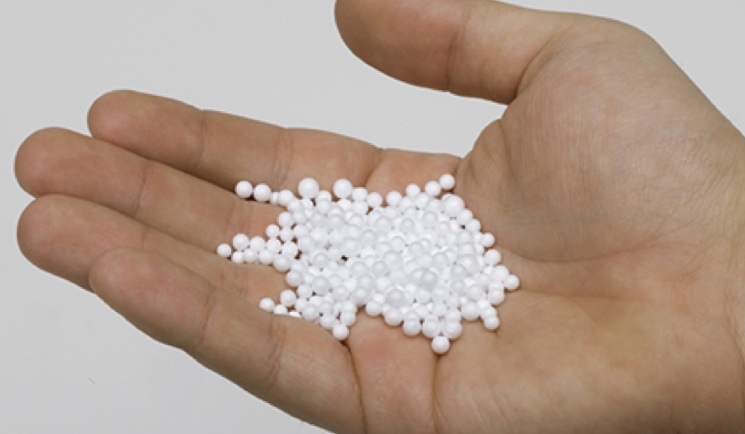
Nussinovitch, an expert in biological carriers, and van Rijn, a specialist in bacteria, paired up to develop a bio-filter composed of tiny Styrofoam-like white beads that carry nitrate-eating bacteria. When added to a water well, aquifer or aquarium, the bio-filter does its job effectively and cheaply.

Showcased at the water conference WATEC

Now in the prototype stage, the product is being tested to see how well it can work in larger bodies of water. It is being developed commercially by the technology transfer arm of Hebrew University, Yissum, and was launched at the WATEC water conference in Tel Aviv in November.

Water infrastructure companies everywhere are paying attention.

Nitrates are an increasing problem for both the developed and developing world. As our populations grow, so does the need for fertilizers, sewage reservoirs and animals for food.

Nitrate is odorless, tasteless and colorless, so only regular testing of wells and aquifers can detect its presence. When they drink nitrate-laden water in formula, newborns’ digestive systems respond by producing high levels of bacteria, leading to the potentially fatal blue baby syndrome as blood oxygen decreases.

Bio-filter bead
Van Rijn, the same man behind an aquaculture technology called Grow Fish Anywhere for fish farming in urban environments, says that this new technology is meant for drinking water and aquarium water, which need to be extremely clean.

The beads work so that “water goes through a matrix and comes out clean,” he tells ISRAEL21c. “For aquaria there are almost no solutions – or the ones that exist are very unreliable. For drinking water there is reverse osmosis, but this is very expensive.”

Nitrate loading is a pressing problem in coastal areas of Israel, where van Rijn says about 50 percent of the wells are polluted due to nitrates, and in places with similar climates, such as California and Colorado.

Yissum is now looking for commercial partners to develop a pilot plant to provide onsite water treatment. It could be hooked up to factories, agriculture processing plants or paper mills, for example.

Nussinovitch says that he has been working with polymers and biodegradable materials all his life. His contribution to the project was developing the biopolymers into an appropriate carrying mechanism to house the bacteria so that beads could entrap the bacteria for the right amount of time before dissolving and releasing nitrogen gas.

The beads in dry form have a long shelf life, and leave no trace behind once dissolved. They work well in both fresh and saltwater conditions.

This story first appeared on ISRAEL21c – www.israel21c.org

Karin Kloosterman
Karin Kloostermanhttp://www.greenprophet.com
Karin Kloosterman is an award-winning journalist, innovation strategist, and founder of Green Prophet, one of the Middle East’s pioneering sustainability platforms. She has ranked in the Top 10 of Verizon innovation competitions, participated in NASA-linked challenges, and spoken worldwide on climate, food security, and future resilience. With an IoT technology patent, features in Canada’s National Post, and leadership inside teams building next-generation agricultural and planetary systems — including Mars-farming concepts — Karin operates at the intersection of storytelling, science, and systems change. She doesn’t report on the future – she helps design it. Reach out directly to [email protected]
4 COMMENTS
    • It probably could be collected, but the amounts are so small and nitrogen is so inexpensive that I’m not sure why you’d want to.

LEAVE A REPLY

Please enter your comment!
Please enter your name here

TRENDING

Astro uses AI to help procure land for renewable energy

For oil-rich, environmentally vigilant Gulf states, Astro isn’t just another startup story. It is a blueprint for accelerating an energy transition that is now existential, not optional.

Earth building with Dead Sea salt bricks

Researchers develop a brick made largely from recycled Dead Sea salt—offering a potential alternative to carbon-intensive cement.

Farm To Table Israel Connects People To The Land

Farm To Table Israel is transforming the traditional dining experience into a hands-on journey.

Fishermen sue tire manufacturers on behalf of the salmon

A federal trial in San Francisco has brought US tire manufacturers, fishing groups, and environmental scientists into court over a chemical most drivers have never heard of — but which scientists say may be silently reshaping aquatic ecosystems.

Remilk makes cloned milk so cows don’t need to suffer and it’s hormone-free

This week, Israel’s precision-fermentation milk from Remilk is finally appearing on supermarket shelves. Staff members have been posting photos in Hebrew, smiling, tasting, and clearly enjoying the moment — not because it’s science fiction, but because it tastes like the real thing.

Qatar’s climate hypocrisy rides the London Underground

Qatar remains a master of doublethink—burning gas by the megaton while selling “sustainability” to a world desperate for clean air. Wake up from your slumber people.

How Quality of Hire Shapes Modern Recruitment

A 2024 survey by Deloitte found that 76% of talent leaders now consider long-term retention and workforce contribution among their most important hiring success metrics—far surpassing time-to-fill or cost-per-hire. As the expectations for new hires deepen, companies must also confront the inherent challenges in redefining and accurately measuring hiring quality.

8 Team-Building Exercises to Start the Week Off 

Team building to change the world! The best renewable energy companies are ones that function.

Thank you, LinkedIn — and what your Jobs on the Rise report means for sustainable careers

While “green jobs” aren’t always labeled as such, many of the fastest-growing roles are directly enabling the energy transition, climate resilience, and lower-carbon systems: Number one on their list is Artificial Intelligence engineers. But what does that mean? Vibe coding Claude? 

Somali pirates steal oil tankers

The pirates often stage their heists out of Somalia, a lawless country, with a weak central government that is grappling with a violent Islamist insurgency. Using speedboats that swarm the targets, the machine-gun-toting pirates take control of merchant ships and then hold the vessels, crew and cargo for ransom.

Leopoldo Alejandro Betancourt López Turned Ocean Plastic Into Profitable Sunglasses

Few fashion accessories carry the environmental burden of sunglasses. Most frames are constructed from petroleum-based plastics and acrylic polymers that linger in landfills for centuries, shedding microplastics into soil and waterways long after they've been discarded. Leopoldo Alejandro Betancourt López, president of the Spanish eyewear brand Hawkers, saw this problem differently than most industry executives.

Why Dr. Tony Jacob Sees Texas Business Egos as Warning Signs

Everything's bigger in Texas. Except business egos.  Dr. Tony Jacob figured...

Israel and America Sign Renewable Energy Cooperation Deal

Other announcements made at the conference include the Timna Renewable Energy Park, which will be a center for R&D, and the AORA Solar Thermal Module at Kibbutz Samar, the world's first commercial hybrid solar gas-turbine power plant that is already nearing completion. Solel Solar Systems announced it was beginning construction of a 50 MW solar field in Lebrija, Spain, and Brightsource Energy made a pre-conference announcement that it had inked the world's largest solar deal to date with Southern California Edison (SCE).

Related Articles

Popular Categories