

 In the wake of a 6-day trip by China’s Premier Win Jiabao to Saudi Arabia, China and Saudi Arabia have forged an alliance on developing nuclear power. Saudi Arabia has signed an agreement with China for assistance in the development of nuclear power, using the last of its oil wealth to invest in the most controversial form of a low carbon energy future for its energy hungry nation.
In 2010, the Kingdom established the King Abdullah City for Atomic and Renewable Energy (KACARE) to develop low carbon sources of energy, prompting us to ask: Who’s Going Nuclear in the Middle East?
Then in June of 2011, at the annual Gulf Environment Forum, the Kingdom announced plans to commit more than $100 billion over the next 20 years to develop a civil nuclear program.
The Kingdom plans to build 16 nuclear reactors at a projected cost of $7 billion each, according to an announcement by Abdul Ghani bin Melaibari, KACARE Coordinator of Scientific Collaboration.
We covered it in a previous story: The Middle East Nuclear Power Boom Without Toxic Waste Strategy.
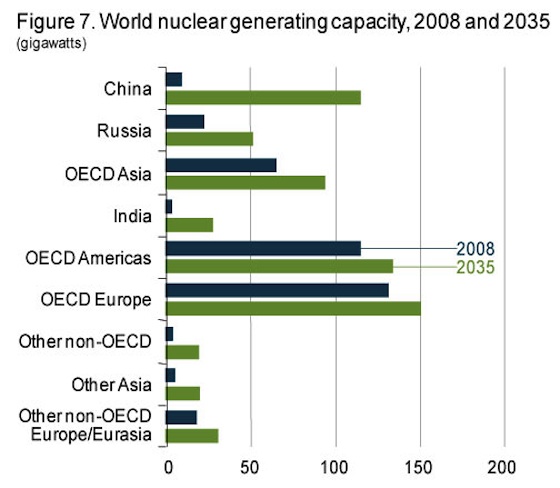
The Saudis could not have picked a better partner than China, which is working on the most ambitious plans in the world to boost its nuclear energy capability by 2035 is so far beyond other nations, that it bears no resemblance to its 2008 levels.
When China plans a move into a low-carbon form of energy it does not hesitate. It is already the world leader in hydro, and recently overtook the US to become the world leader in wind power.
It has begun building 27 nuclear reactors and will have 100 or more by 2030, which would amount to nearly a quarter of the 432 reactors in operation now.
China is pursuing alternatives to the traditional uranium-fueled nuclear power – such as reactors that run on thorium fuel, or that use unconventional designs such as fast neutron, molten salt and pebble bed.
Some nuclear experts believe that these new unconventional designs are potentially safer and more efficient than the traditional water cooled uranium-fueled reactors that have remained unchanged since the nuclear age.
Previously Saudi Arabia has been in talks with the French on developing the more traditional uranium power.
Official sources from Saudi Arabia say that they plan to get 20% of their electricity from nuclear, even while domestic demand is growing at an estimated 8% over the next ten years.
Related stories:


Go get ’em, Mike. As you know, we have to make things happen, not wait for them to happen.
Good work Mike!
Nuclear power isn’t the problem. The problem is with the reactors we’ve been using to make it. If the reactors at Fukushima had been Molten Salt Reactors (MSRs) they wouldn’t have a mess on their hands.
Molten salt reactor technology was developed at Oak Ridge National Labs in the 1960s. Although the test reactor worked flawlessly, the project was shelved, a victim of political considerations and Cold War strategy. But MSRs have been gathering a lot of new attention since the events in Japan.
An MSR (sometimes referred to as a LFTR – Liquid Fuel Thorium Reactor) is a completely different kind of reactor, as different as an electric motor from a gasoline engine. It can’t melt down, and automatically adjusts its output to meet changing workload demands. It requires no active cooling system and can be installed anywhere on earth, even an underground vault. A tsunami would roll right over it, like a truck over a manhole cover.
MSRs use liquid fuel⎯nuclear material dissolved in molten fluoride salt. Solid-fuel reactors are atomic pressure cookers, with the constant danger of high-pressure ruptures, meltdowns, and the forceful ejection of radioactive material. MSRs don’t use water, and always operate at ambient pressure.
An MSR can deliver 750ºC heat for industrial processes, or spin a high-temperature gas turbine to generate power. If disaster strikes and an MSR springs a leak, the spill cools to an inert lump of rock, chemically locking the nuclear material inside. The fuel can all be recovered and used again.
MSRs burn Thorium, a mildly radioactive material more common than tin and found all over the world. America has already mined enough Thorium to power the entire country for 400 years. It’s found by the ton in the tailings of our abandoned Rare Earth Element mines.
MSRs are highly resistant to proliferation. Thorium is bred into 233Uranium inside the reactor, but only enough to keep the MSR running, so no stockpiling occurs. While 233U is an excellent fuel, its harsh radiation makes it nearly impossible to steal, and extremely difficult to use in a weapon.
Liquid fuel can be continuously cleaned of the contaminants that spoil solid fuel. This unique feature enables MSRs to consume fuel so thoroughly that they can even use the spent fuel from other reactors, cleaning up our legacy of nuclear waste while producing a miniscule amount of waste themselves.
A 1-gigawatt MSR, big enough to power a city of one million, will run on one ton of Thorium per year, or about 2 teaspoons per hour. The long-term waste will be the size of a basketball, and virtually harmless in just 300 years.
While molten salt technology continues to languish on America’s drawing boards, realize that it’s now on China’s drawing boards as well. And they mean business. So if we don’t wrap up our R&D and start building some MSRs around here, we’ll soon be forced to buy our own invention from China.
If this isn’t a Sputnik Moment, then I don’t know what is.
Google: MSR, LFTR, Thorium Energy. See the Wired.Com article “Uranium Is So Last Century.
China is investing heavily in green energy, but unfortunately, it’s investing even more heavily in coal power. According to the China Daily 10-Nov 2011, China’s reliance on coal for power increased from 68% to 70% from 2006-2010. During this time, China’s carbon emissions increased by 33.6%. This doesn’t seem too green by any standards. (to compare, US reliance on coal for power dropped to 41% during this time).
Notably, this was during the time that the 3 Gorges Dam went on-line, a dam estimated to provide ~10% of China’s power needs. Hence, despite a huge influx of green energy by the dam, reliance on coal increased. And even this isn’t enough – China is worried about energy shortages.