

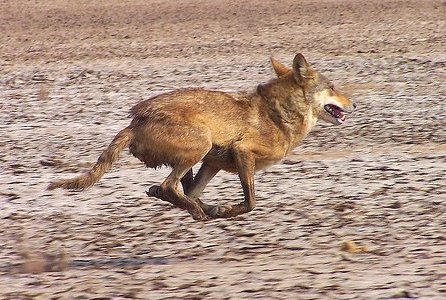
 The wolf pictured above is an Iranian wolf, which exists is dwindling numbers throughout Israel, Iran, and Turkey.
Our fear of the wolf is historically as deep-seated as our survival instinct, which may explain why only two countries in the Middle East have established official bans against hunting them. Two subspecies of the Gray Wolf occur in this region. The Iranian wolf (Canis lupus pallipes), which is the only wolf species in the world that is not in danger of extinction, can be found in dwindling numbers throughout Iran, Israel, Turkey, and Saudi Arabia, whereas the Arabian wolf (Canis lupus arabs) can be found in Israel, Iraq, Jordan, Oman, Saudi Arabia, and Yemen, and possibly some parts of Egypt’s increasingly degraded Sinai Peninsula as well. But only Oman and Israel subscribe to the notion that wolves have the right to coexist with man as part of natural ecosystems by giving them legal protection.
[youtube]http://www.youtube.com/watch?v=DClRw2GJM0M[/youtube]
A Bedouin man in Saudi Arabia raises a wolf in a small block of dirt outside his own home
Man’s best friend came from the Middle East
It emerged in 2010 that all dogs originated from wolves in the Middle East, whereas previously it was thought they came from Asia. 15,000 years ago, according to The New York Times, the first non-nomadic hunter gatherer communities began to “intervene in the breeding patterns” of wolves, turning them into the first domesticated dogs.
Dr. Robert K. Wayne of the University of California, who led the study that changed our beliefs about the origin of man’s best friend, told the paper, “I think a long history such as that would explain how a large carnivore, which can eat you, eventually became stably incorporated in human society.”
Danger for the wolves that resisted domestication
But not all wolves became dogs, and those that remain still have to share space and resources with humans – often with fatal consequences.The World Wildlife Fund reported in 2005 that wolves in Turkey not only have to contend with loss of prey and habitat destruction as a result of human “success,” but it is also considered a pest that is actively persecuted.
Although this doesn’t bode well for that country’s 1500 or so Canis lupus pallipes, Treehugger reported earlier this year that the environmental group KuzeyDoğa has collaborated with government officials and the mobile carrier Turkcell to tag and monitor two wolves in order to better understand their habitat and in turn minimize human and wolf conflicts.
Saudi’s Canis lupus arabs are even more endangered. Muhammad Al-Shawi, a desert enthusiast, recently told Arab News that he often sees wolves while traveling through the desert but has never had reason to harm them. “Most of the wolves in the Kingdom live in mountainous regions of Najd and Tabuk,” he said, adding that he often sees bodies of wolves hanging off signboards. The paper claims that many Saudis kill wolves for trophies.
Jordan’s wolves are hunted, poisoned, and run over.
Oman and Israel
Luckily in Oman, which has a relatively strong conservation record compared to many of its Gulf neighbors, the wolf population is on the rise. The UK Wolf Conservation Trust attributes this to a hunting ban that was finally put in place.
And in Israel, although wolves prey on livestock – particularly near the Golan heights – extraordinary measures are taken to protect them. In addition to paying for electric fencing and various species of guard dogs to deter wolves, the government offers partial compensation for predatory damages when they can’t be avoided.
Much less is known about wolves in Iran, Iraq, Jordan, Syria or elsewhere, except that they are not protected, and they are not doing well.
image via CosmoSmith

Hey there also another larger subspecies, Canis lupus cubanensis, roaming in the forests of Northern Turkey.
This is so sad! I’m from Kuwait and I’ve never seen a wolf. Feral dogs are everywhere and they are being shot and poisoned, along with cats. As for hunting, I believe modern Arabs think of anything that moves as a target. They shoot resident and migrating birds, feral animals, wildlife, and even pets sometimes. I know K’SPATH is working really hard to prevent such things and we do have reserves but it will not stop unless the government issues a strict law about murdering these poor animals.
Thank you for your comments and links. I feel so strongly about this that I’ve published a follow-up story using your input, which is incredibly valuable. Please pass this on to your friends and family if you can: http://www.greenprophet.com/2011/12/kuwaiti-kills-wolf/
We’ve got to get a better handle on wildlife conservation in the Middle East.
Hi,
I am from the South of Saudi Arabia, from the mountains between Baha and Abha cities. I have seen many wolves myself in the wild on the mountains but sadly people carry guns just to kill them wherever they find them to protect their sheep and goats. I used to see wolves when I was a child but not anymore! I do not no if they still exist or not. Many times we see dead wolves were hanged to trees by streets side just to show other people that someone killed a Wolf! That because when someone killed a wolf, he feels proud and try to show that to other people! Sometimes it is been like showing hunting skills! Also, it is been very very common to use poison to kill wolves! They put it in a meat and take it to places where they think a wolf will walk through, when a wolf eat it, just die immediately! My recommendation is to let those who care about wolves and the wild to contact government officials and to have many wolves to be raised at special protected homes and then to let them go just to help increase their numbers. In addition, governments should support locals who have sheep by money to let them keep their animals safe at protected areas which protected from wolves so people will not feel afraid from wolves and will let them go without killing them. Helping those locals to understand the important and the beauty of having wolves in the wild is also very important step. Thank you.
http://alwatan.kuwait.tt/ArticleDetails.aspx?Id=153818&YearQuarter=20114
Sad story. No protection for wolves here.
Samira, this is dreadful.
Thanks for reading @kmmasoud. Let us know if you think there are other issues in your country that need our attention.
it so nicely and finaly hearing good thing about saudi
iam from saudi arabia