Will Bridges of Recycled Plastic Work in Middle East?

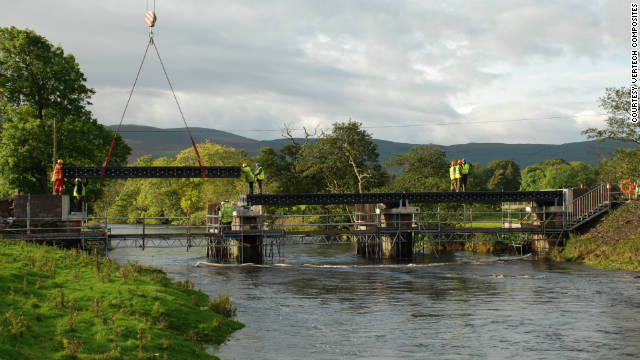
recycled plastic bridgeA bridge like this of recycled plastic could also work in the Middle East

A bridge from recycled plastic, and strong enough to support a car or truck’s weight? This may seem hard to believe; but after covering art from recycled socks, chairs from recycled newspapers, and even a large Christmas tree from recycled plastic drink bottles, this idea my not be very far fetched.

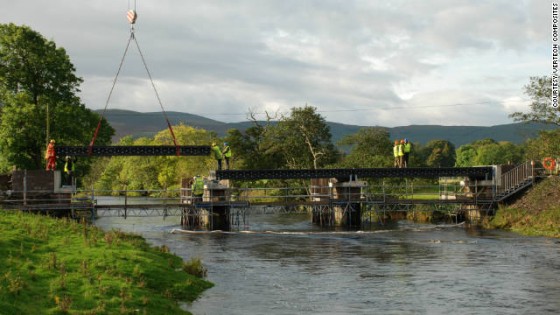
 A recent story in CNN’s Eco Solutions environmental covered 30 meter long bridge being put across the  waters of the River Tweed in Peeblesshire, Scotland. The bridge, reputed to be the longest such bridge in the world, was built on a private estate in order to not have to abide by existing traffic laws, which have not yet approved a bridge made form such material for use on a public road. Engineers who built the bridge, however, claim that the material used, constructed entirely out or recycled plastic, can support weights of up to 44 tons.

This much weight would allow such a bridge to support virtually all kinds of vehicles, except perhaps very heavy trucks. It would surely be enough to support weights of private cars and light to medium trucks. Vertech Composites, the British company behind the project, says that the bridge is a prototype that has the potential to meet future road and bridge requirements in an eco-friendly manner.

William Mainwaring, CEO of Vertech Composities, told CNN:

 “There are currently significant bridge and river crossing needs in rural and countryside areas and there will only be more in years going forward.”

Mainwaring claims that the plastic composite material is a more sustainable alternative to existing bridge construction materials and not as likely to degrade as steel, timber and concrete.

If this material is good for small bridges in Scotland, why wouldn’t it be good for similar bridges over small streams and rivers in the Middle East, especially in countries like Lebanon and Israel where literally tons of plastic material winds up in landfills or even finds its way into the sea? For instance, we reported that Lebanon dumps much of its garbage straight into the sea, and this must also include tons of plastic material.

It may be a while before bridges and other structures made form recycled plastic are seen in the Middle East. But the idea at least sounds very promising.

::CNN

More articles about  using recycled items:

Mosaic of Lost Socks at Festival Spotlights Recyclables as Art

Tal Gur’s Daily Chair Finds New Use for Yesterday’s Irrelevant Newspaper

Haifa Christmas Tree Made From Over 5,000 Recycled Plastic Bottles

Garbage Trucks Dump Straight into the Sea in Lebanon

Maurice Picow
Maurice Picowhttps://www.greenprophet.com/
Maurice Picow grew up in Oklahoma City, U.S.A., where he received a B.S. Degree in Business Administration. Following graduation, Maurice embarked on a career as a real estate broker before making the decision to move to Israel. After arriving in Israel, he came involved in the insurance agency business and later in the moving and international relocation fields. Maurice became interested in writing news and commentary articles in the late 1990’s, and now writes feature articles for the The Jerusalem Post as well as being a regular contributor to Green Prophet. He has also written a non-fiction study on Islam, a two volume adventure novel, and is completing a romance novel about a forbidden love affair. Writing topics of particular interest for Green Prophet are those dealing with global warming and climate change, as well as clean technology - particularly electric cars.
40 COMMENTS

Comments are closed.

TRENDING

From Pilot Plant to Global Stage: How Aduro Clean Technologies’ 2026 Expansion Signals a Turning Point for Chemical Recycling Investors Like Yazan Al Homsi

The company's Next Generation Process (NGP) Pilot Plant in London, Ontario, has officially moved into initial operating campaigns, generating the kind of structured, repeatable data that separates laboratory promise from commercial viability.

Urban miner Sortera raises $45 million USD to pull aluminum from the scrap pile

Sortera Technologies, founded in 2020 by Nalin Kumar and Manuel Garcia, is emerging as a major U.S. circular-industry player. Led by CEO Michael Siemer, the company uses AI and advanced sensors to turn scrap metal into high-value aluminum alloys. Its new ~$45 million funding round signals investor appetite for industrial decarbonisation—where emissions cuts come not from PR-friendly solar installs, but from upgrading the materials that power EVs, solar frames, and construction.

Waste Reform from the Ground Up: How Trash Balers Are Helping Cities Rethink Sustainability

If you’ve ever watched a recycling truck weaving through city streets, you’ve seen the problem firsthand. Most of what we call “recycling” still depends on long-distance transportation and centralized sorting facilities. Those systems are energy-intensive and prone to contamination — the dreaded mix of wet food, plastic wrap, and paper that renders recyclables useless.

Iran’s water mafia and thirst for war leaves the country on brink of being dry

Iran’s Lake Urmia, once the Middle East’s largest saltwater lake, has shrunk by 90 percent due to mismanagement, dams, and drought. As Tehran pours billions into foreign conflicts, water activists face repression at home. The crisis mirrors Syria’s drought-driven unrest, showing how water scarcity can destabilize entire regions.

Scientists Crack the Code for Low-Cost, Low-Carbon Plastic Recycling

While enzymatic recycling offers hope for managing existing plastic waste, scientists and environmental advocates agree it must be paired with the development of bio-based plastics—materials made from renewable biological sources like corn starch, sugarcane, or algae. Unlike conventional plastics derived from fossil fuels, bio-based alternatives can dramatically reduce carbon emissions at the production stage and are often compatible with closed-loop recycling.

Should You Invest in the Private Market?

startustartup Unlike public stock exchanges, which offer daily trading, strict...

How to build a 100-year-company

Kongō Gumi is a Japanese construction company, purportedly founded in 578 A.D., making it the world's oldest documented company. What can we learn about building sustainable businesses from them?

From Pilot Plant to Global Stage: How Aduro Clean Technologies’ 2026 Expansion Signals a Turning Point for Chemical Recycling Investors Like Yazan Al Homsi

The company's Next Generation Process (NGP) Pilot Plant in London, Ontario, has officially moved into initial operating campaigns, generating the kind of structured, repeatable data that separates laboratory promise from commercial viability.

How AI Helps SaaS Companies Reduce Repetitive Customer Support Work

SaaS products are designed for large numbers of users with different levels of experience, and also in renewable energy.

Pulling Water from the Air

Faced with water shortage in Amman, Laurie digs up...

Turning Your Energy Consultancy into an LLC: 4 Legal Steps for Founders in Texas

If you are starting a renewable energy business in Texas, learn how to start an LLC by the books.

Tracking the Impacts of a Hydroelectric Dam Along the Tigris River

For the next two months, I'll be taking a break from my usual Green Prophet posts to report on a transnational environmental issue: the Ilısu Dam currently under construction in Turkey, and the ways it will transform life along the Tigris River.

6 Payment Processors With the Fastest Onboarding for SMBs

Get your SMB up and running fast with these 6 payment processors. Compare the quickest onboarding options to start accepting customer payments without delay.

Related Articles

Popular Categories