
A 2012 Energy Forecast For Turkey: Heading Down A Tried-And-False Path

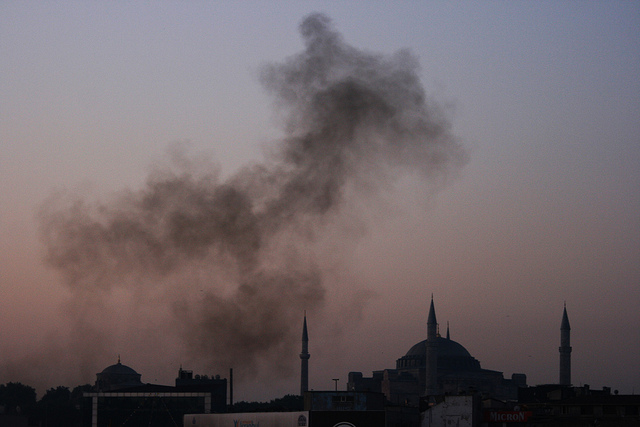
Increasingly smoggy skies are in store for Turkey if it follows the energy paths predicted.

A mostly dismal list of 2012 predictions that recently appeared in the Eurasia Review, courtesy of Haluk Direskeneli, an energy analyst, consultant, and member of the Chamber of Mechanical Engineers in Ankara, Turkey’s capital city. Low investor interest in alternate fuels and a reliance on other countries for fossil fuels will strain Turkey financially, even as new domestic  coal- and gas-fired power plants seek space and funding, Direskeneli says.

Read on to learn about noteworthy developments that Direskeneli predicts in Turkey’s energy sector, and their implications — locally and around the world.

An uncertain fuel supply from Turkey’s neighbors

Turkey’s dependence on its hydrocarbon-righ neighbors will pinch its pocketbook in 2012, Direskeneli says. Iran’s own needs will likely cause it to cut off its natural gas flow to Turkey for at least one month, causing Russia to jack up its own supply — and prices — for that period. Turkey’s contract with Russian natural gas pipeline Gazprom will terminate at the end of 2011, leaving large uncertainty over how Turkey will fill the fuel gap.

For its part, Russia’s lack of commercial financing will put the much-opposed nuclear power plant in Akkuyu, which Russian state energy agency ROSATOM would majority-own and operate, on hold for a bit longer. Given the lack of ready funding for the plant, Direskeneli points out, efforts to keep the project going are now “purely political” and should be discussed as such.

In the meantime, the French national electric and gas companies are negotiating for the contract to another nuclear power plant along Turkey’s Black Sea coast. But deteriorating diplomatic relations between Turkey and France may chill those plans as well, Direskeneli says.

The domestic front: dirty and getting dirtier

Turkey’s hopes for a natural gas source of its own in the eastern Mediterranean Sea appear to have been dashed, says Direskeneli.

Drilling off the coast of northern Cyrus did not turn up the expected reserves of natural gas, and it seems unlikely that any resource as enormous as the one originally advertised will be found.

Despite its own lack of hydrocarbons, Turkey seems determined to continue developing a fossil fuel-dependent domestic energy infrastructure. Of several major new power plants Direskeneli discusses that are currently under construction or seeking investment, all are fossil fuel-powered.

Just one, a 450 MW plant that is currently trying to attract investment, has a combined cycle design for improved efficiency; the others follow inefficient, conventional design models. Efforts to build polluting power plants in parts of the country where they would adversely affect populations, meanwhile, continue to be staunchly opposed — Direskeneli calls the situation in Gerze, where 10,000 Turks recently assembled to protest such a plant, “out of control.”

The government will continue to try to privatize the rest of its thermal power plants in 2012, Direskeneli says, but the global economic crisis has reduced many investors’ appetites and assets.

Unfortunately, this will most severely hurt the country’s emerging wind and solar industries. Without lots of foreign and local investment, these two sectors won’t be able to develop the production and distribution infrastructure they need to become profitable.

:: Eurasia Review


Read more about energy in Turkey:

10,000 Turks Gather To Protest Coal-Fired Plant

Turkey Expected To Cancel Nuclear Plans After Massive Earthquake

Turkish Village Goes Off The Grid With A Wind Turbine

Image via quinn.anya

Julia Harte
Julia Hartehttp://www.greenprophet.com
Julia spent her childhood summers in a remote research station in the Rocky Mountains of Colorado, helping her father with a 25-year-old experiment in which he simulated global warming over a patch of alpine meadow. When not measuring plant species diversity or carbon flux in the soil, she could be found scampering around the forests and finding snowbanks to slide down. Now she is a freelance journalist living in Istanbul, where her passion for the environment intersects with her interest in Turkish politics and grassroots culture. She also writes about Turkish climate and energy policy for Solve Climate News.

LEAVE A REPLY

Please enter your comment!
Please enter your name here

TRENDING

EU Ports Still Power Russia’s Arctic Gas Exports Despite Phase-Out Pledge

The findings suggest that rather than declining, Europe’s reliance on Yamal LNG intensified in 2025. Yamal cargoes accounted for 14.3% of the EU’s total LNG imports, equivalent to roughly one in every seven LNG ships arriving at European terminals.The findings suggest that rather than declining, Europe’s reliance on Yamal LNG intensified in 2025. Yamal cargoes accounted for 14.3% of the EU’s total LNG imports, equivalent to roughly one in every seven LNG ships arriving at European terminals.

Ecomondo 2025: Italy’s Green Expo Powers Global Circular Innovation

Each November, a quiet city on Italy’s Adriatic coast becomes the epicenter of the world’s circular economy conversation. What began in 1997 as a local waste management trade show has grown into Ecomondo, a global forum for environmental innovation, resource regeneration, and ecological transition.

Helion Energy, AI, and the New Cold Fusion War With China

Helion’s model plays to America's old strength: innovation through agility, not top-down megaprojects. Instead of waiting for 2050, Helion’s compact reactors aim to deliver electricity in a matter of years—and not just for cities, but for data centers, isolated industries, military bases, even disaster zones. Their current prototype, Polaris, is scheduled to fire in 2025. If Helion succeeds, it won’t just disrupt global energy. It could redraw the world map.

Trump’s “Shower Liberation” Proposal: A Disastrous Step Back or a New Path to Efficiency?

New findings revealed that at any given flow rate, higher-pressure showers were associated with lower water consumption. While low-flow showers delivered less water than high-flow-rate showers, high-pressure showers used less water overall because they were turned off sooner.

The UN builds an AI coalition to save the planet

Over 100 partners, including 37 tech companies, 11 countries and 5 international organizations, have joined forces with the UN under the Coalition for Environmentally Sustainable Artificial Intelligence, aiming to ramp up global momentum to place AI on a more environmentally sustainable path. 

Qatar’s climate hypocrisy rides the London Underground

Qatar remains a master of doublethink—burning gas by the megaton while selling “sustainability” to a world desperate for clean air. Wake up from your slumber people.

How Quality of Hire Shapes Modern Recruitment

A 2024 survey by Deloitte found that 76% of talent leaders now consider long-term retention and workforce contribution among their most important hiring success metrics—far surpassing time-to-fill or cost-per-hire. As the expectations for new hires deepen, companies must also confront the inherent challenges in redefining and accurately measuring hiring quality.

8 Team-Building Exercises to Start the Week Off 

Team building to change the world! The best renewable energy companies are ones that function.

Thank you, LinkedIn — and what your Jobs on the Rise report means for sustainable careers

While “green jobs” aren’t always labeled as such, many of the fastest-growing roles are directly enabling the energy transition, climate resilience, and lower-carbon systems: Number one on their list is Artificial Intelligence engineers. But what does that mean? Vibe coding Claude? 

Somali pirates steal oil tankers

The pirates often stage their heists out of Somalia, a lawless country, with a weak central government that is grappling with a violent Islamist insurgency. Using speedboats that swarm the targets, the machine-gun-toting pirates take control of merchant ships and then hold the vessels, crew and cargo for ransom.

Leopoldo Alejandro Betancourt López Turned Ocean Plastic Into Profitable Sunglasses

Few fashion accessories carry the environmental burden of sunglasses. Most frames are constructed from petroleum-based plastics and acrylic polymers that linger in landfills for centuries, shedding microplastics into soil and waterways long after they've been discarded. Leopoldo Alejandro Betancourt López, president of the Spanish eyewear brand Hawkers, saw this problem differently than most industry executives.

Why Dr. Tony Jacob Sees Texas Business Egos as Warning Signs

Everything's bigger in Texas. Except business egos.  Dr. Tony Jacob figured...

Israel and America Sign Renewable Energy Cooperation Deal

Other announcements made at the conference include the Timna Renewable Energy Park, which will be a center for R&D, and the AORA Solar Thermal Module at Kibbutz Samar, the world's first commercial hybrid solar gas-turbine power plant that is already nearing completion. Solel Solar Systems announced it was beginning construction of a 50 MW solar field in Lebrija, Spain, and Brightsource Energy made a pre-conference announcement that it had inked the world's largest solar deal to date with Southern California Edison (SCE).

Related Articles

Popular Categories