

 Looking deeper into the pitfalls and promise of Desertec at Dii conference in Cairo. Green Prophet’s Tafline is there and reports from the field.
Instead of scrambling to find funds and legislative support for the Desertec initiative, a handful of people gathered at the Dii conference in Cairo to explore the project’s overall environmental sustainability. The ambitious plan to develop solar and wind energy in North Africa’s deserts could replace harmful fossil fuel alternatives, but researchers are quick to dismiss the notion that renewable energy projects are completely innocent.
Dr. Anthony Patt from the International Institute for Applied Systems Analysis pointed out that scaled up Concentrated Solar Power (CSP) plants that utilize wet-cooling technology could use up to 20 percent of North Africa’s already dwindling water supply. And “that is simply not possible,” he said.
Exploring sustainability in a quiet corner
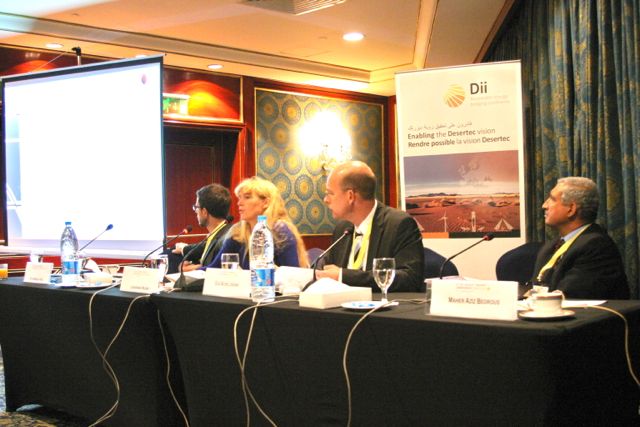
Apanel led by Gus Schellekens, Director of Pricewater Cooper’s Sustainability and Climate Change Team, quietly got together to discuss whether or not it is sustainable to meet 15% of Europe’s electricity demand by 2050 with wind and solar power projects already underway in North African countries.
Dr. Patt said that water withdrawals in the region already amount to twice what the water cycle can reasonably handle. Instead of withdrawing a sustainable 50 billion cubic meters of water each year, North African countries are withdrawing 100 billion cubic meters. Some of that is being taken from the Nile River, but much of it is being drawn from fossil aquifers that will never be recovered.
Water uptake is maxed out
Given that water uptake has already been maxed out, CSP technologies (concentrated solar power) that rely on wet-cooling technology absolutely can’t be implemented, but dry cooling technologies can. These, according to Dr. Patt, only require 2% of the water available, which is less than the fossil fuel industry currently extracts.
Lettemieke Mulder, the community relations representative from First Solar, a world-renowned photovoltaic producer that has already installed 4GW of solar power – enough to run roughly 2.3 million homes – claims that her company has already bypassed the emissions of 2.5 million metric tons of carbon dioxide into our environment.
But that’s not the only reason to pursue PV technology, she says. “Photovoltaics are the better option since they do not require water for cleaning.”
MENA countries need to bond
Eng. Maher Aziz Bedrous, Counsellor for Environmental Management and Studies Sector for the Egyptian Electricity Holding Company admits that the region is deeply vulnerable to resource scarcity and recommends that MENA countries come to some kind of agreement about this vulnerability.
He estimates that MENA countries combined will need to spend $2.7 billion to mitigate the affects of climate change, and another $7 billion every year to adapt. Meanwhile, oil-producing countries, which produce 74% of the MENA region’s carbon emissions, will be difficult to persuade since their economics rely so heavily on fossil fuels.
Asked whether the Egyptian government is ready to implement renewables responsibly, both Mulder and Schellekens noted that this could be a question for the Desertec team, which could recommend the adoption of recognized international standards. Looking outside at Cairo’s general mayhem, we certainly hope so!
:: Desertec
More news from the Dii Conference and Green Prophet:
Find Green Prophet at the 2nd Annual Dii Conference in Cairo
Green Prophet at Desertec Conference in Cairo
Water and the Middle East at a Glance (Infographic)



Thanks Tafline, I’m still hoping someone with technical knowledge would answer. I thought, maybe naively, that mirrors would be cleaned more or less the domestic way, but details like that are not publicised so people like me just assume things are done a certain way.
HI Xoussef. As always, thank you for reading. Yesterday I watched mirrors being cleaned with a pungent smelling chemical, so I’m not sure how easy it is to re-capture this water. Maybe in time a better solution will avail itself, but what Dr. Patt really wanted to convey is that dry-cooled CSP is the best solution for dry countries in the MENA region. I hope that helps.
Can anyone please explain how is CSP using water harmful? I mean that be it cooling or cleaning dust the water will not become poisonous or just disappear, unless it’s dumped in the desert. It could be captured and reused for the same purpose or to irrigate palm trees. Of course if there is no water to begin with it’s a problem (and your article says that dry technologies do exist), but if the Nile water was extracted to irrigate fields anyway, why not clean the mirrors with it first? Surely I’m missing something technical here, or the water really can’t be reused? I’d imagine that the grey water of a town like Ouarzazate could easily be treated (which it should be anyway) then reused in a power station then in agriculture!
Also PV uses a lot of rare earths that need special recycling and chemicals that evaporate under the sunlight and thus pollute, which makes its use at a large scale expansive and hazardous, for now at least.
It seems to me CSP, even if it uses water, is right now safer, cheaper, and more environmentally friendly. There are plenty semi-arid lands with enough room and water for CSP to cover the foreseeable needs, why worry about it being installed in desert and arid areas?
According to the article, CSP uses too much water resources, something that is lacking in desert regions.
An excellent article by the Power Programme Director for the European Climate Foundation explains how wet-cooling technology uses water, and why it is unsustainable: http://thinkprogress.org/romm/2009/04/29/204025/csp-concentrating-solar-power-heller-water-use/