

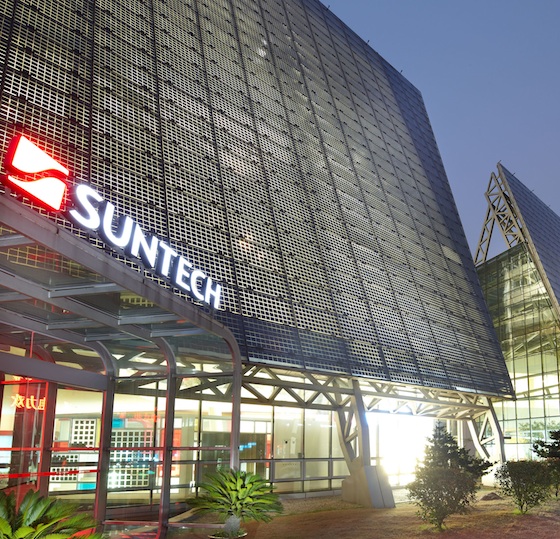
 A coal utility in Israel and the global leader in solar panel production form a joint project
Everybody knows that China is the world leader in cheap solar. By contrast, Israel has barely begun to tap the global solar market. Yet the world’s largest solar panel producer in China, Suntech, has invited Israel’s state-owned electric utility, Israel Electric Corporation (IEC) – which has no experience in solar power at all – to build three photovoltaic solar energy arrays in northern China, as part of a project worth $US 1.3 billion dollars.
IEC maintains and operates all of the power generation stations, sub-stations and transmission and distribution networks throughout Israel. All coal or gas. It has no solar projects under development. The project would be IEC’s most ambitious development overseas and its first ever solar PV power station. According to energy China Forum, the three solar arrays will total 240 MW, which is about the size of many coal plants. So… why IEC?
Despite an abundance of homegrown renewable engineering and innovation talent – from the pioneer of piezo-electricity to the solar window (Pythagoras Solar Wins a GE Ecomagination Challenge Award), that has attracted VC funders from Silicon Valley to GE (Israeli Companies Winners in GE Green Innovation Marathon) to invest in Israeli innovation, Israel has remained largely dependent upon fossil fuels for its electricity.
The panels will be produced by Suntech, the world’s largest solar panel producer. Yet, according to the IEC’s vice president Yakov Hain, who visited China for talks with Suntech in April, Suntech may be interested in financing research and development, as well as joint projects with IEC.
Hain said IEC and Suntech may develop a joint R&D team to investigate methods of raising the efficiency of solar panels, pointing out that the current average energy output rate of 19 percent is “rather low.”
IEC is studying ways of boosting the electric output efficiency to at least 40 percent, according to Hain. What? How can a coal power plant operator help the world’s leading PV panel maker increase PV efficiency? Isn’t this like selling coals to Newcastle?
If the solar project were solar thermal, not solar PV, then IEC’s long experience with coal-fired, and now, gas-fired, electric power plants could be directly useful, and indeed, might well translate into increases in efficiency, because, solar thermal power ultimately makes steam to drive a turbine (to make electricity) just like coal and gas.
However, Suntech makes solar photovoltaic (PV) panels, and PV simply makes electricity directly. Solar PV panels don’t need turbines, so they don’t need steam or heat to turn turbines to make electricity. IEC’s steam power experience with coal and gas would be relevant only if the project was steam-powered solar.
So why is China’s leading solar panel producer looking overseas, to Israel, and to a coal utility, to form a joint project to raise the efficiency of solar?
China may be the world leader in solar panel production, but Israel is an innovation leader. The IEC may be running on coal and gas now, but its Technology Innovation Center is devoted to some extremely innovative and green clean tech.
IEC’s Technology Innovation Center is developing Israel’s large and untapped engineering genius pool of “entrepreneurs, innovators, inventors, and other pioneers” who dare to break “technology glass ceilings.”
“We can use our creative minds and their experience to develop new equipment based on new materials,” says Yakov Hain.
Read more on Israel and China solar ties:
Suntech To Sell Home Solar Panels in Israel
Israel Establishes Consulate in China’s Powerhouse Province
Investigating the Business and Cultural Ties that Bind Israel to China


Oh Bob, I am sorry if I seemed to be “upset” – I agree that Israel does have some of the most ingenious solar innovators in the world – but what struck me about this was how odd it was, (a coal utility!) and, like you, I thought, China wouldn’t do this on a whim, so then when I checked out what IEC does that WOULD be helpful to them, I learned of all the green investment through its high tech green development – then it made sense.
I am wondering, why are you so upset about Israel’s IEC being given this contract. While there experience in the field may be extremely low on the outside. How do we know that there has not been many in Israel working on developing good solar power. Israel has some pretty smart people in it. I find that you being so upset about it though baffling. That is until I see the different ads that you have for other articles: “Solar Activist for Palestine” and “He Makes Green “Sheikh”” So is your angst about Israels supposed ignorance in the field of solar power, or is that you do not agree with Israel politics and you are joining the rest of the world and hating Israel? Green energy is a world wide boon. How can we start to get upset because a company decided to have IEC work on the solar power plant. Over all, this solar power plant will benefit everyone. So why does it matter who builds it. Why not congratulate Israel on the contract. Just to show that you are not swayed by politics. I am sure that China did not just choose Israel on a whim. I do not think that they would hire someone for over a billion dollars without knowing that they could do the job.
Bob,
If you read Green Prophet regularly I am sure you wouldn’t jump to the conclusions you have here. Susan is an experienced clean tech writer, and she writes from a very knowledgeable and objective point of view. And our editorial (that’s me) puts a strong focus on Israeli cleantech. I stand 100% behind what Susan writes, because it’s true. The IEC isn’t doing great things for renewables in its own country so why in the world should we expect this country to be building big power plants in China. I think that was Susan’s question, and while I understand your desire to promote Israel’s positive sides, investors looking to Israel need to see the bigger story and not just a narrow one developed by a PR machine.
I hope you sign up for our newsletter and enjoy reading the website on a regular basis.
-Karin Kloosterman