Power + Water: Middle East to Bring Energy Sector Together With Desalination Industry

Power and water are inextricably linked in the rapidly growing Middle East. An exhibit hopes to green up both

Desalination and water treatment have seen massive growth in the MENA region, which has now emerged as the largest market in the world.  The region will have to build approximately three million cubic meters per day of desalination capacity every year to meet the mounting water demand, according to a report from Ventures Middle East.

Needed investment in desalination and water treatment will total a staggering $20 billion over the next four years. Massive amounts of energy are needed to power desalination, and water can potentially host massive renewable energy plants too. The two could be synergistic and could release the potential for a cleaner future.

So how much of this new water infrastructure could be run on clean renewable energy? Mark your calendars: October 16th to 18th, to attend the Power + Water Middle East exhibition to find out.

“The renewable energy sector in particular is seen as an area of immense growth in the region” says the report from Ventures Middle East, “particularly as global warming and spiraling oil prices have forced world leaders to plan ahead for more sustainable forms of energy production that includes nuclear, solar, wind and biomass.”

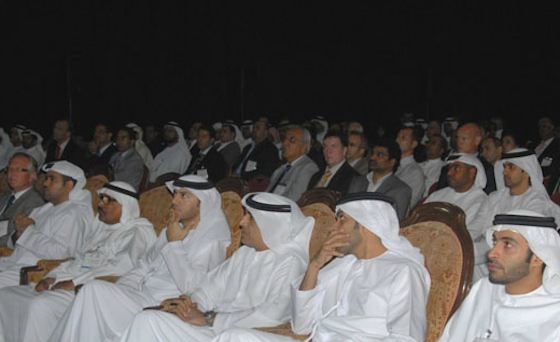
To bring together these two groups with intersecting interests, next month the Power + Water Middle East exhibition will take place at the Abu Dhabi National Exhibition Centre.

Ventures Middle East released the latest figures ahead of the second annual Power + Water Leaders’ Forum, which will run at the same time as the exhibit. The simultaneous growth in water and energy use is skyrocketing in the region.

Their report notes that in the GCC, as economies diversify and population grows at a steady pace, energy consumption has increased by 91 per cent, from 160.4 billion kilowatts per hour in 2000 to 306.5 billion in 2011. To supply this burgeoning growth, electricity production across the six States has increased by 90 per cent in the last ten years, from 176.1 billion kilowatts per hour in 2000 to 335.3 billion in 2011.

And, increasingly, renewable energy is being considered to replace the finite fossil fuels that served to grow the region in the first place. MENA developing countries are overtaking the developed ones for the first time, with 104 per cent growth in projects driven by new renewable energy mandates like clean energy regulations, government subsidies and economic stimulus.

::Power + Water Middle East
::Ventures Middle East

Related stories:

Saudi Options Narrow With Peak Water
“Green Reverse Osmosis” From Grandfather of Desalination – How Green?
Israel’s Water Industry at Crossroads

LEAVE A REPLY

Please enter your comment!
Please enter your name here

TRENDING

Astro uses AI to help procure land for renewable energy

For oil-rich, environmentally vigilant Gulf states, Astro isn’t just another startup story. It is a blueprint for accelerating an energy transition that is now existential, not optional.

Huge Fish Nursery Discovered Under Freezing Arctic Seas

In 2019, an underwater robot camera exploring the seabed...

Remilk makes cloned milk so cows don’t need to suffer and it’s hormone-free

This week, Israel’s precision-fermentation milk from Remilk is finally appearing on supermarket shelves. Staff members have been posting photos in Hebrew, smiling, tasting, and clearly enjoying the moment — not because it’s science fiction, but because it tastes like the real thing.

The US leaves 66 United Nations organizations to “put America first”

The world needs a reset and to restart well intentioned cooperation projects from start. Because right now the UN and EU projects look like software built on code from the 80s, rickety, patched, slow to adapt, and prone to crashing under the weight of outdated assumptions.

Turkey named as climate change COP31 home in 2026

Murat Kurum as President-Designate of COP31

6 Payment Processors With the Fastest Onboarding for SMBs

Get your SMB up and running fast with these 6 payment processors. Compare the quickest onboarding options to start accepting customer payments without delay.

Qatar’s climate hypocrisy rides the London Underground

Qatar remains a master of doublethink—burning gas by the megaton while selling “sustainability” to a world desperate for clean air. Wake up from your slumber people.

How Quality of Hire Shapes Modern Recruitment

A 2024 survey by Deloitte found that 76% of talent leaders now consider long-term retention and workforce contribution among their most important hiring success metrics—far surpassing time-to-fill or cost-per-hire. As the expectations for new hires deepen, companies must also confront the inherent challenges in redefining and accurately measuring hiring quality.

8 Team-Building Exercises to Start the Week Off 

Team building to change the world! The best renewable energy companies are ones that function.

Thank you, LinkedIn — and what your Jobs on the Rise report means for sustainable careers

While “green jobs” aren’t always labeled as such, many of the fastest-growing roles are directly enabling the energy transition, climate resilience, and lower-carbon systems: Number one on their list is Artificial Intelligence engineers. But what does that mean? Vibe coding Claude? 

Somali pirates steal oil tankers

The pirates often stage their heists out of Somalia, a lawless country, with a weak central government that is grappling with a violent Islamist insurgency. Using speedboats that swarm the targets, the machine-gun-toting pirates take control of merchant ships and then hold the vessels, crew and cargo for ransom.

Leopoldo Alejandro Betancourt López Turned Ocean Plastic Into Profitable Sunglasses

Few fashion accessories carry the environmental burden of sunglasses. Most frames are constructed from petroleum-based plastics and acrylic polymers that linger in landfills for centuries, shedding microplastics into soil and waterways long after they've been discarded. Leopoldo Alejandro Betancourt López, president of the Spanish eyewear brand Hawkers, saw this problem differently than most industry executives.

Why Dr. Tony Jacob Sees Texas Business Egos as Warning Signs

Everything's bigger in Texas. Except business egos.  Dr. Tony Jacob figured...

Related Articles

Popular Categories