

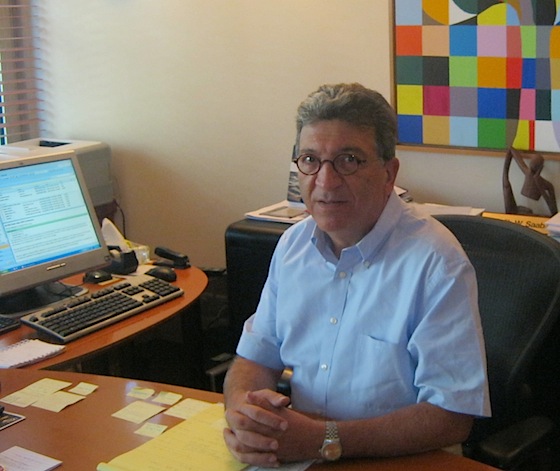
 Rola chats with Najib Saab about the pitfalls of environmental journalism and advocacy in the Middle East
For those with any interest in the environmental issues in the Arab world, “Al- Bia Wal-Tanmia” is a familiar name. Started in 1996, the only Pan Arab environmental magazine was the precursor of the Arab Forum for Environment and Development (AFED), a regional non-profit organization based in Beirut which has become a public forum for influential eco-advocates from around the region and a source of the latest regional environmental data. Meet Najib Saab, the Zayed award-winning Editor who continues to lead the way in the face of mounting environmental and financial challenges.
Green Prophet: How did you get involved in environmental issues?
Najib Saab: I graduated from the American University of Beirut in architecture and mass communication, but came from a family of journalists so have always been in this field. At AUB, I founded a student forum, Wujhat Nazar (Viewpoint) which was active in rural development, published a student magazine carrying the same name, and was reporter for Al Nahar newspaper. After graduating, I started working with UNEP as their Regional Information Officer.
Two years later, in 1979, I decided to go on my own. I started a regional architectural practice in Beirut under the motto of ‘environmental design’, along with a publishing company (Technical Publications) specialized in development titles. However, I continued to do UNEP work on the side, living between Lebanon and Saudi Arabia, before I settled in Holland with my Dutch wife.
In 1995, we came to Beirut with a dream, to do something real for the environment. At the time we still had dreams. We were hoping things could change for the best after the war. I wanted to have an independent environmental magazine to reach everybody. A specialized topic for the general reader. Many people thought it was too niche and therefore a wrong approach. But I have always believed the magazine should be displayed near newsmagazines like Newsweek and general/lifestyle magazines like Cosmopolitan. My aim has always been to bring environment to all readers’ categories, and not to convert the converted. As a mainstream environmental magazine, it’s neither a trade or NGO publication nor an academic journal, although we make sure every piece of information is scientific and well researched.
From the first months we decided to focus on the younger generation with student programs for schools on a pan-Arab scale.In 1997/1998 we expanded with training programs for teachers, in an attempt to introduce change as fast as possible through training thousands of teachers. At the time we got financing from the Germans (GTZ) and were able to help establish environment clubs in more than 350 schools. We also produced country specific manuals for UAE and Syria for example, with the aim of training teachers to continue the work from there, with credible reference material.
We started an environment hotline in 2004 with three full time people (one operator and two investigators) and were able to find solutions to 80% of the problems. We threatened to expose the guilty parties or give evidence for those who called to enable them to go to court. It was in association with 3 daily newspapers and one radio station. A year ago, with more newspapers, radio and TV channels for consumer complaints becoming available, we decided to hand over this service to them but we still provide technical assistance. Two significant examples are AlJazeera and LBC, where we helped place the environment seriously in major prime time talk shows: Ahmad Mansour’s ‘Bila Houdoud” at Al Jazeera and Marcel Ghanem’s ‘Kalam Annas’ at LBC have included environment as main topic over the past 5 years, dedicating some 20% to it in their otherwise political programs.
Based on demand and unmet needs, we are now back to the school programs with more teacher training manuals to be used as reference of curricula in schools, sponsored by AFED. The new program, to be launched in October, includes ready teaching-training kits on all aspects of environment, supported by graphics and audio-visuals. All will be available online.
Green Prophet: What are the main challenges you are facing?
Najib Saab: From the start, I financed the whole operation from my income as an architect. I probably would have attracted more funding if I had produced an Arabic Playboy. Support was minimal from the beginning. Back in Holland, some Dutch officials told me that if I were doing the same in Europe governments would have offered support without us even applying. The only time we got fees was for training, so we still struggle for funding. It’s easier to find funding for something that is PR oriented with no long term benefit. Some of the funding goes in the right direction but 90% goes to serve bureaucracy, with no results.
In 2003 the magazine started to break even. The magazine is sold on newsstands, has subscribers all over the region, and is circulated via AFED network. Our income comes mainly from advertising and subscriptions. News stand sales do not provide any net income, as we pay 50% as distribution commissions and cover the airfreight cost. The dilemma is that the more we sell on newsstands, the more we lose. But while this should boost advertising income, the fact is that advertising budgets for print media are becoming meager. Moreover, advertisers tend to spend available budgets on women’s/lifestyle publications. We are surviving, although it is an uphill struggle.
Maintaining our independence is important for us. Attracting funding by praising rulers or agencies would be easy, but it’s important we keep our editorial integrity. We have gained respect from big names like OPEC Fund, Islamic Bank for Development, Kuwait Fund, Abu Dhabi Environment Agency, but the funding remains insufficient and we continue to operate on a very limited budget.
Green Prophet: What are some of your major achievements?
Najib Saab: We have been able to change a lot at the government level across the region. Many officials have taken our work as a reference for their campaigns, for example the UAE’s campaign to stop asbestos use, Saudi Arabia’s regulation to impose import of fodder equivalent to 1,000 liters of water for each one liter of milk exported, or Abu Dhabi’s Declaration on Corporate Environmental Responsibility (CER).
In 2006, when the magazine became 10 years old, we carried out a region-wide survey on Arab public opinion and the environment , presented at a conference to share the information. We got a lot of fans from all over the Arab countries, who were regular readers of the magazine. It was then that we founded AFED, Arab Forum for the Environment and Development , which began as a forum for subscribers. Members now include institutions, the private sector, NGOs, alongside government bodies as observers. Our Board of Trustees includes some of the most experienced Arab environmental experts, such as Mostafa Kamal Tolba and Mohamed El-Ashry. I turned over the magazine to AFED, having in mind something like National Geographic– the Society and the Magazine.
The role of AFED is essentially to give recommendations to government and private sector, acting as a think tank on environmental issues in the Middle East, and the annual report is its main product. We try to market the report to different countries and use AFED media members to disseminate the information. We employ science to influence policy change.
Green Prophet: What are your future plans?
Najib Saab: Survival. The present situation is not easy. We have to work very hard to keep environmental issues high on the agenda and separating these issues from PR stories. At the same time minimal scientific research is being conducted. The biggest hurdle is finding credible data because most projects are financed to collect and not generate data. Much more investment in serious research is required. So scientific and fiscal measures are missing. We are hopeful with new developments started by the Arab spring, this might change. If people are more in control of their destiny through representative governments they will work for the long term.
:: For more information, take a look at this CNN video about Najib Saab’s work in the Middle East
Interviews with other brave green warriors in the Middle East:
Interview with Treehugger Blogger Jennifer Hattam


i can consent using the article