
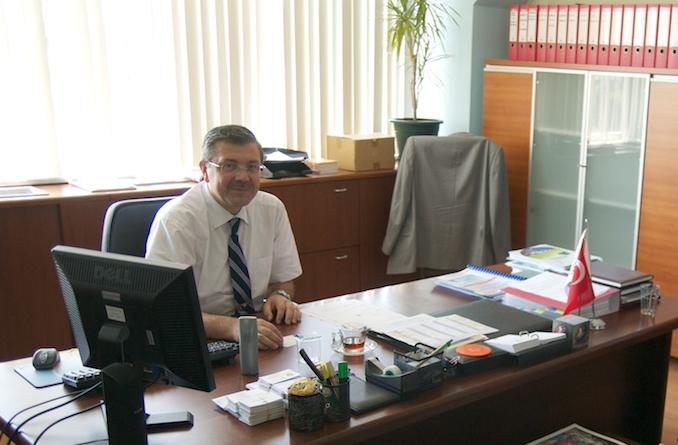

 Hydrogen-fueled vehicles and power systems could be feasible in Turkey by 2020, says Mustafa Hatipoğlu, managing director of the UN’s International Centre for Hydrogen Energy Technologies in Istanbul.
Since it was established in Istanbul eight years ago, the International Centre for Hydrogen Energy Technologies (ICHET), a project of the United Nations International Development Organization, has been developing a series of small, experimental hydrogen energy projects. But Turkey is beginning to lay the infrastructure for a much larger hydrogen economy, according to the man at the head of ICHET, Mustafa Hatipoğlu.
Green Prophet recently sat down with Hatipoğlu for an exclusive interview about the future and progress to date of hydrogen energy in Turkey.
Hydrogen’s potential
The advantages and limitations of hydrogen as an energy carrier are well illustrated by the most significant project ICHET has completed so far, the EkoKaravan.
Released last year, the EkoKaravan is a mobile home that runs off wind, solar, battery, and hydrogen energy systems and could be used for anything from disaster relief situations to tourism. It’s also the first vehicle to combine four energy systems, according to Hatipoğlu. A 1kW wind turbine and 1.7kW solar array are the caravan’s primary sources of energy, and 17kWh batteries hold about three days’ worth of energy in the bottom of the vehicle. A hydrogen fuel cell converts excess energy into hydrogen so that if all these sources are depleted, the hydrogen can be converted into electricity by the same fuel cell. Hydrogen extends the range of the vehicle, in other words, but is not its primary fuel.
“The energy storage capacity of batteries, even with the latest technology, is very low compared to hydrogen’s storing capacity,” says Hatipoğlu. “So for now, we can say that hydrogen fuel cells are useful as range extenders for battery-powered vehicles.”
For comparison, regular petroleum has an energy storage density of about 12,000 watt-hours per kilogram. A lithium-ion battery stores just 180 Wh/kg. But hydrogen packs 33,000 Wh/kg. In a regular-sized passenger car, this enables the car to run farther than it can on a battery alone, without requiring significantly more space. General Motors’s hydrogen-electric hybrids, for example, use hydrogen fuel cells to boost their cruising ranges up to 480 kilometers.
This high energy density is hydrogen’s main advantage — and it’s why Hatipoğlu thinks hydrogen fuel cell technology will eventually be used to fuel vehicles and even power buildings worldwide.
Current projects
A few weeks ago, Turkish daily Today’s Zaman reported that Turkey could become an international center for hydrogen energy production if a proposed second canal was built in Istanbul, diverting ship traffic from the Bosphorus. According to that article, the flow of the Bosphorus could instead be used for electrolyzing hydrogen, which could be pumped into cars and ships at fueling stations along the shore of the strait.
That plan may not be so feasible after all, according to Hatipoğlu. Transportation ferries would still travel along the Bosphorus, meaning that any hydrogen production activity would have to occur within 15 meters of the shore, where the current isn’t sufficiently fast.
However, a fueling station is currently in the works off the shore of the Golden Horn, a branch of the Bosphorus that bisects the European side of the strait. For now, hydrogen will be electrolyzed there with electricity from the grid. Eventually, however, Hatipoğlu hopes the Istanbul Metropolitan Municipality will invest in a solar array for the station, which would enable totally clean, renewable hydrogen production. ICHET is also beginning to plan a second fueling station in Ankara, Turkey’s capital.
The fueling station will supply fuel to a hybrid battery/fuel-cell boat that is also currently being built, Hatipoğlu says, which will carry tourists up and down the Golden Horn. At least one municipal bus that runs on a similar hybrid engine has already been completed, and others will be furnished upon the municipality’s request.
ICHET has also invited consortia of academic and private industry groups to participate in several design competitions, out of which innovative models of hydrogen-fueled vehicles have come. On one of the Marmara Sea islands near Istanbul, ICHET has also tested a backup hydrogen-generated power system for the governor’s house.
Hydrogen’s future in Turkey
These are all just first glimpses at a hydrogen economy. They showcase the potential of the technology, which Hatipoğlu hopes will galvanize private companies to start serial production of hydrogen vehicles. To achieve that, he acknowledges, “you need a lot of tests, a lot of experiments.”
But he is hopeful that by 2015, or 2020 at the latest, electricity from hydrogen will begin to be demanded on a much larger scale. It must, he says, because “customers will eventually see that the range of battery power is not sufficient, and will ask for more distance in their vehicles.”
For now, it is cheapest to generate hydrogen from natural gas or biomass regasification, according to Hatipoğlu. These aren’t the cleanest ways, of course, although they are at least 30 percent cleaner than conventional energy generation from natural gas. As renewable resources become cheaper to harness, however, 100% clean, sustainable hydrogen electrolysis will become much more feasible.
Hydrogen may or may not live up to Hatipoğlu’s vision. Much depends on how much the government subsidizes the necessary infrastructure, and how much the price of fossil fuels rises. But if hydrogen does become widely used around the world, Turkey will undoubtedly be a major center of production, thanks to ICHET’s work.
Read more about hydrogen energy in Turkey and beyond:
Bosphorus to Become Center of Hydrogen Energy Production If Second Canal is Built
GM Hydrogen Hy-Wire and Sequel Cars Could Power Our Future
Denmark Prepares to (Slowly) Enter Electric Car Network
Image via Mustafa Hatipoğlu


