
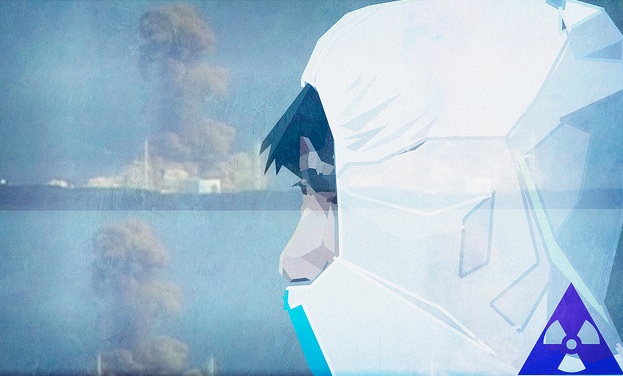

 Physicist and guest blogger Susan Goodman puts the Japan nuclear news in proportion to non-scientists.
Perhaps in the west we still retain some false sense of culpability for the discovery of nuclear fission. Maybe the very name Fukushima has resonances with that of Hiroshima – invoking memories of horrors that for most of us are well before living memory. Something has to explain the irrational, overhyped, disinformation that has pervaded much of the western media since Japan’s cataclysmic earthquake and tsunami triggered the crisis in a clump of that nation’s nuclear reactors.
Disinformation exemplified by the headline used in the Green Prophet last week “Japan Nuclear Meltdown Will Seriously Affect World Environment”. The hysterical headlines abounded in the western press, and even that premier of news agencies, the BBC, included as part of its World Service news coverage the strained tones of a Japanese woman who had decided to leave Tokyo because of a (negligible) rise in radiation in that city, adding “the radiation levels should be zero”. What listener could fail to agree with that? Except that we are all exposed to natural radiation, with over 97 percent originating in the rocks of the earth or in outer space, nothing to do with the meddling of man. Levels of radiation are never zero.
The media was filled with myth and half truths, made more credible by the absurd decision of several world leaders to announce they were going to abandon their programs to develop nuclear reactors. Politicians doing what politicians do best – pandering to ignorance.
But rather than dissect these articles, separating fact from fiction phrase by phrase, let me present a different scenario:
Tainted spinach equals a CAT scan
Japan having suffered a massive earthquake and a cataclysmic tsunami was faced with a total failure of a cascade of security procedures in a group of nuclear reactors. But far from the result being a massive humanitarian disaster the reactors have been brought under control, about five lives have been lost and minimal levels of radioactivity have been released. (Please note that the levels recently reported in spinach and milk are extremely low. Experts in the US and Japan have both ruled out that these pose any threat to health, noting that the level of radioactivity found in the spinach would, if eaten for a year, equal the radiation received in a single CAT scan).
It should also be remembered that these are reactors built about 40 years ago and safety features have considerably improved since then. By any risk assessment relating to loss of life this has not been a catastrophe.
But reflect for a moment on the number killed each year in Japan from industrial accidents, over 1000 – none of them relating to nuclear power. In fact over three hundred are in the construction industry alone. These are typical figures which can be found in any industrial nation. It would be nonsense to decide to curtail construction based on these statistics.
For a truly terrifying story of suffering and loss consider the world’s worst industrial disaster: in 1984 at the Union Carbide chemical plant in Bhopal in India. It claimed more than 10 000 lives. There has of course been no outcry against the manufacture of chemicals. We believe, as indeed we should, that lessons are learned from accidents and that improvements in safety procedures can then be instituted.
Japan, and the rest of the world, should move towards decommissioning old reactors and updating safety procedures. Something the level-headed Japanese with their amazing commitment to survival will no doubt move towards.
Surely an example to us all.
Susan Goodman is a physics graduate of Oxford University. A science journalist and writer, she is committed to increasing scientific awareness among non-scientists. She now lives in Jerusalem and teaches academic reading and writing to science students at the Hebrew University and Jerusalem College of Engineering. She is also working towards a doctorate which examines different ways of promoting scientific awareness among young people.
Image via ssoosay




How did you get a degree?
Have you read the BEIR VII report?
Do you have children?
Comparing ingestion to a CT scan is NOT a valid comparison! ..and if your really want some facts then know that 1 in 270 people who get a CT scan each year will get cancer as a direct result. (look it up) It was proven in 1970 that x-rays of the pelvis of pregnant women caused an huge increase in childhood leukemia’s. So we don’t do that anymore. Before 1970 it was standard procedure paid for by insurance. We know better now. We will soon know even more, unfortunately, thanks to Fukushima. People don’t need to panic, they need to become angry at people who talk down to others with their arrogance!
So okay, lets say you ONLY eat spinach. (probably not healthy) What if you have dairy products too along with your seafood. Sooner or later this adds up. If it’s on the spinach then it’s in the surface water too. EPA is NOT doing their job!
The half life of Cesium is 30 years which means in reality it remains ‘hazardous’ for 200 plus years.
btw – I have a degree in Physics too.
I’ve been reading these same nuclear industry talking points all week, but with all due respect I think that the present crisis, even if it is brought under control (which it had better be) is pointing out a fatal flaw in reactors as they exist today.
Quite simply, there isn’t presently any technology to dispose of nuclear waste or reprocess the spent fuel, so it is typical for a facility to retain all of this on-site. As it happens, about 60 percent of the spent fuel from the entire 40 year history of the 6-reactor Fukushima site is packed into a single Common Storage Pool building behind reactor #4. It’s a tenth facility that is only now being discussed, and is certainly not an acceptable risk lying so close to one of the world’s great cities.