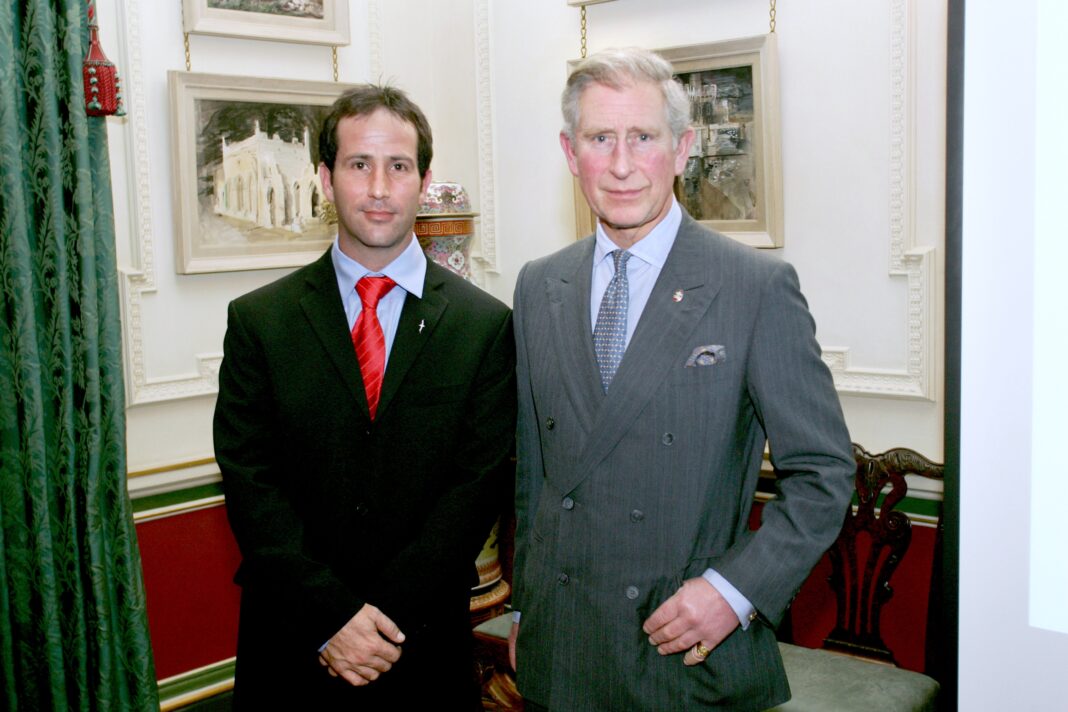
 Meidad poses with Prince Charles at the Clarence House in London, where they discussed the progress of the Albatross Task Force.
Like David de Rothschild, Meidad Goren has spent considerable time at sea working toward nature conservation. His most recent project focused on saving albatrosses. These sea birds become entangled with commercial fishing lines and die at a rate of roughly 100,000 each year. Birdlife International’s South African Albatross Task Force was the first of six teams created worldwide to saving the albatross from the grassroots level up. With support from Prince Charles, and the Royal Society For The Protection of Birds (RSPB), Goren and his team helped reduce albatross mortality rates in South Africa by 85%. The intrepid bird-lover has since returned to Israel to start up his own conservation project. 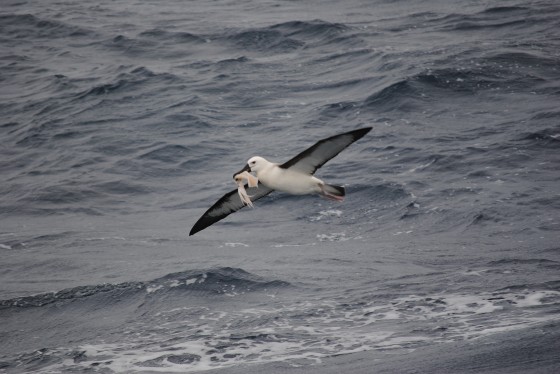
Meidad, how did you become involved with the Albatross Task Force?
In late 2004 I moved to South Africa from Israel and started working as a fisheries observer collecting fishing data on-board longline vessels. Since I was young I was fascinated by birds and at sea I became passionate about the unique bird life. Unfortunately, I witnessed a large number of these birds getting accidentally killed during fishing operations, a problem that occurs all over the world that puts most species of albatrosses under threat of extinction. After a few months I was offered to join BirdLife South Africa’s first Albatross Task Force (ATF) team and happily took the offer.
Can you tell us why the ATF was formed?
The ATF was formed to fill the large gap that existed between scientists and conservationists who studied the issue of seabird accidental mortalities on board fishing vessels, mainly longline boats. These vessels use sharp hooks that are baited with fish or squid to attract big game fish such as tuna and swordfish. Unfortunately, these baited hooks also attract other animals such as sharks, turtles and seabirds. The latter come in the thousands and try to steal the bait from the hook. Once the seabird is caught on the hook it will drown and die. It is estimated that 100,000 albatrosses die this way every year. Solutions have been developed by scientists but the implementation is very tricky. In order to make change, it is necessary to reach every fisherman and teach him how to fish responsibly. The ATF was formed to do that, to work on the grassroots level and directly with fishermen.
How did you convince fishermen that it was worthwhile to change their fishing technique, and do you think what you asked of them comprised a big challenge?
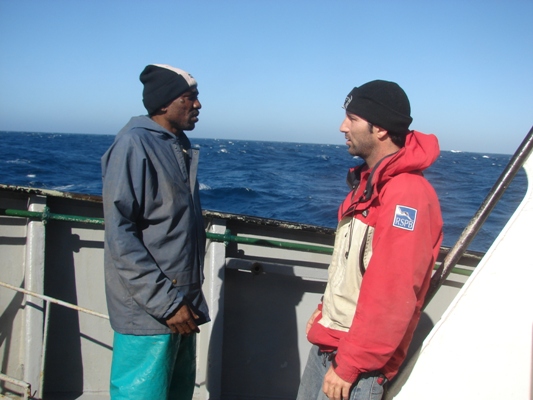
What stood to my advantage was the fact that the accidental catch of seabird (known as bycatch) caused the fishermen to lose fish. In other words, every bird on the hook is one less potential fish. They were also very much aware of the negative impact this has on the fishery’s image. It took me a little time to gain their trust mainly through positive experience; but once they saw my sole interest is to prevent bird deaths it wasn’t difficult to gain their cooperation. I went to sea with them not just to preach but also to learn about their lives and their work. I learned a lot from the weeks I spent at sea with them. This experience also helped me devise strategies and solutions that were both easy and practical for fishermen to implement. The best tool I had was their vast knowledge and experience and most of them took the challenge gladly and helped me. Without this we would never have been able to achieve anything.
Since you, Birdlife International, and the Royal Society for the Protection of Birds became involved, the threat to Albatrosses has decreased by 85%. What have you learned about conservation as a result of this project?
We managed to decrease the mortality levels in the South African longline fleet by 85% since we started. One of the main I things I learned is that most of the times working with and not against is much more productive and can lead to great results. It is important to respect the people you work with, even if sometimes we don’t think the same way, to be patient, and to have a vision and keep on track with it. Conservation is working with people. Finally, if you are committed to your goals nothing can hold you back.
You have communicated directly with Prince Charles. Why is he interested in this project?
I was asked to attend an event held at Clarenece House in London and tell the Prince all about the ATF work. He is one of the biggest supporters of the albatross and has followed the project from the beginning. HRH served in the Royal Navy and mentioned that he loved watching the albatrosses as they followed the ships. He was devastated to hear about the threats they encounter and decided to support the conservation efforts in any way he can.
You also worked with the wildlife artist Bruce Pearson. What was his involvement, and how do you think art impacts a society’s consciousness of conservation issues?
In the last few years Bruce has been working on an art project aimed to raise funds for the conservation of albatrosses and other seabirds. He wanted to join me on a fishing trip to see the fisherman’s side of this story and the work that I do. Bruce spent 3 weeks with me on land and a week at sea, during which time he met and interviewed several fishermen. He painted throughout this time. I think that art can get to the hearts of people who appreciate beauty but are not necessary passionate about nature and therefore are not aware of this whole story.
Your job required you to spend weeks at sea. Can you tell us about this experience?
In the five years that I was involved with the project I spent close to 400 days at sea. I joined fishermen on their fishing trips which usually stretched up to three weeks. It wasn’t always easy but I loved it. The fishermen hosted me on a completely voluntary basis. Most of my time at sea was dedicated to collecting data and conducting experiments with fishing gear to see how is it possible to reduce seabird moralities. The time spent with fishermen at sea was very important to understand their life and to gain a deep understanding on the issue of seabird bycatch. It was also very important to create personal and professional relationships with the fishermen, some of them are still good friends even now that I’m back in Israel.
And now you’ve moved back to Israel, and are currently working on a new venture in the Negev. Can you tell us what you have in mind?
I am now setting up a birding center in the Negev, which provides habitat for very special birds. It is also an important part of the migration path to the birds who migrate annually from Europe to Africa and back. Some of these birds travel all the way to South Africa every year. Due to pressure from the local people their habitats are constantly under threat; one of my main objectives will be to try and protect those habitats and raise awareness of the importance of the conservation of birds in a very fast developing country. We will work with the local community and visitors and also conduct research and surveys on the birds of the Israeli desert to improve our educational and monitoring tools. My objective is to get this project going alone, but with the strong support of the local municipality, the Society For The Projection Of Nature In Israel and The Nature and Parks Authorities.
Thanks so much Meidad. We wish you all the best and look forward to checking in with you again.
More on Wildlife Conservation in Israel:
UNESCO Protected Biosphere Is A Refuge For Prophets, People and Wildlife