
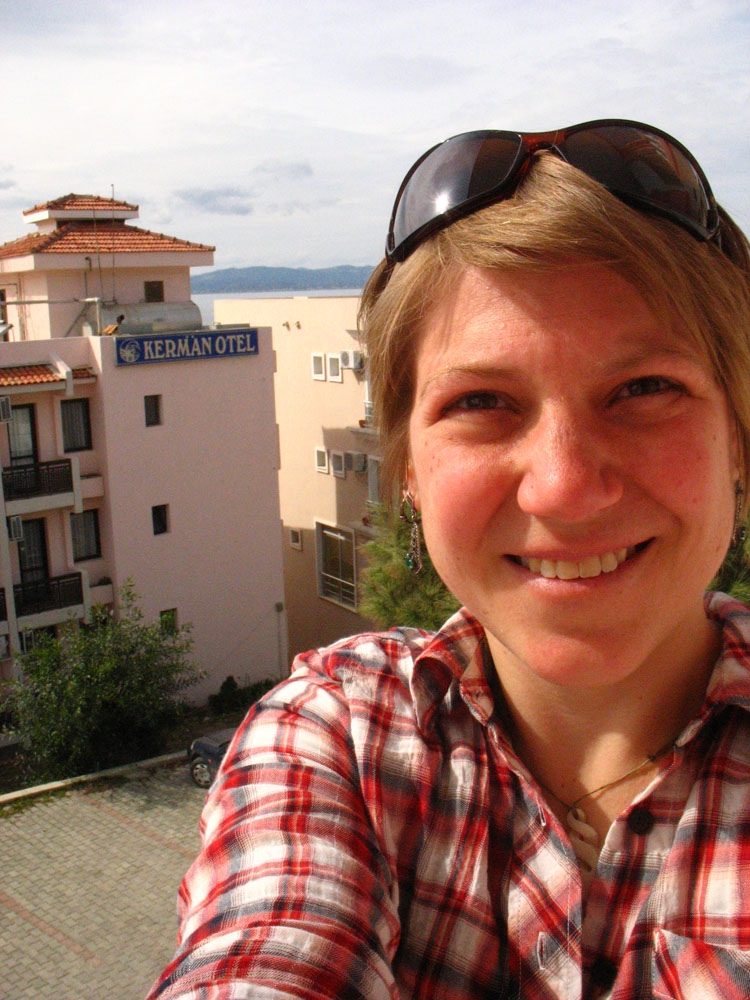

Treehugger blogger Jennifer Hattam writes about environmental  issues in Turkey and the greater Middle East.
Following a long career with Sierra magazine, Jennifer Hattam packed her bags and moved to Turkey.
There she writes about environmental issues for Treehugger (including Turkey’s plans to install nuclear power plants despite the Fukushima disaster in Japan) and the wider Middle East region while keeping up with her personal blog.
Jennifer spoke with Green Prophet about her experiences as an expat environmentalist.
 Jennifer, before you started blogging for Treehugger, you worked as an editor for the well-known Sierra magazine. You eventually became their “green lifestyle” expert. Can you tell us how that came about?
I had been working at Sierra for several years, covering a wide range of environmental news as a writer and editor, when the boom in “eco-friendly” goods and services really began. We ran a special issue in January 2005, called “The best things in life are green,” about some of the then-new developments in green lifestyle products — from clothes to furniture to food to slick bikes.
The issue was hugely popular with our readers and I proposed spinning it off into a regular section, “The Green Life,” which I ended up editing. As part of that, I created a companion lifestyle blog — with technical help from our web team — and began fielding calls from other media outlets asking the Sierra Club’s take on different lifestyle-related issues. I also edited a book by our advice columnist, “Hey Mr. Green,” made regular appearances on the Sierra Club Radio show to talk about lifestyle topics, and even did a few interviews with other radio and TV programs.
Then you decided to move from San Francisco to Istanbul. What motivated that switch, and how long have you been there?
I had been smitten with Istanbul (and Turkey in general) since first traveling there in 2001 to visit a friend and had long daydreamed about moving there and trying to make a go of it as a foreign correspondent of sorts. After nine years at Sierra, I felt in need of a change and decided I would regret it if I didn’t make the leap. That was a little bit more than three years ago.
How well have you been able to continue living a “green” lifestyle in Turkey? Have you encountered many challenges?
It’s a real mixed bag, actually. In some ways, my life abroad is greener than it was at home, mostly due to reduced consumption. While I didn’t have a car in San Francisco either, I w as often getting rides with friends; here, hardly anyone I know has a car. On the flip side, I do probably rack up more air miles — each (infrequent) 8,000-mile trip home surely wipes out any environmental good I did throughout the year.
I don’t eat as much food labeled “organic,” but I do eat a lot more seasonally than I did before, just because it’s easier here. I could never be bothered to line-dry my clothes at home, despite knowing about the benefits; here, dryers are rare, so one of my first purchases was a drying rack. Recycling remains a big question mark: I try to separate out cans, bottles, and paper and cardboard so the local scavengers can find them more easily, but I really have no idea what happens to most of the trash I throw away.
In your view, what are some of Turkey’s most serious environmental problems?
The government’s massive push to build dams across the country is deeply troubling to me. One high-profile and controversial project, the Ilısu Dam, is already displacing residents in Southeast Turkey and threatens to inundate 10,000 years of history in the ancient city of Hasankeyf.
Dam construction is also tearing apart the country’s lush, rugged Black Sea region — all to meet just 2 to 3 percent of the electricity needed in a country with an 18 percent loss rate in electricity transmission. Plans to build Turkey’s first nuclear plants are looking especially problematic in the wake of the ongoing disaster in Japan; Turkey is also a very seismically active country and, in my opinion, is not doing a very good job ensuring safety at its current industrial facilities, from shipyards to factories to mines.
And what are some of the country’s best initiatives?
To be honest, I can’t say there are a lot of good initiatives at the national level. Turkey has the solar and wind potential of Spain or Portugal, but the government is not doing much to encourage its development. And because of the very top-down way things are typically structured, local officials don’t have a lot of freedom to break ranks and become environmental leaders the way a lot of mayors and governors in the United States have.
Businesses are doing some good things, but there’s not enough consumer  demand for them to really make sustainability a selling point.
Environmental benefits are typically a side effect, rather than a goal, though some good things do result: way more buildings here than at home have timers or motion sensors on their lights, and large companies are required to provide transportation to their employees, meaning many people who might otherwise have to drive alone to remote office locations are traveling as a group on private service buses.
What I’ve found to cheer me here very much comes from the individual, grassroots level: The small NGO fighting to protect key wetlands in Eastern Turkey, the people setting up organic farmers’ markets and permaculture trainings, the slow-food advocates trying to save an iconic Istanbul fish, the young entrepreneurs designing and selling hip organic clothes.
Has Turkey been spared the kind of tension that the many Arab countries are grappling with?
Turkey does seem to have remained strangely unaffected by the wave of Arab unrest, but it’s got plenty of its own ongoing tensions: anger over crackdowns on press freedom (including the jailing of journalists) and bans on popular Internet sites, alleged coup plots, excessive police force against student protesters, the long-running headscarf debate, a lack of rights for religious minorities, and, of course, the continued — and sometimes violent — troubles in the heavily Kurdish Southeast. To name a few.
 Based on your experience, what are some of the best methods to spread environmental awareness in the Middle East?
I can’t speak for the Middle East as a whole, although some of these factors may be similar region-wide. But in Turkey, despite the sometimes frenzied recent embrace of consumerism, I think there’s untapped potential to appeal to the fact that so many people are less than a few generations removed from rural lifestyles — and often retain tight connections to their home villages.
The strong ties to the land and nostalgia for the tastier vegetables and closer-knit communities of their childhoods seem like fertile soil in which environmental consciousness might grow. The strong sense of national pride could also be tapped, I think, to rally people behind efforts to make Turkey a world leader in, say, renewable energy — if the government took an interest.
How long have you been writing for Treehugger, and what kind of stories are you mostly interested in?
I’ve been writing for TreeHugger since October 2008. I try as much as possible to focus on news from Turkey and the broader region — the Middle East, Eastern Europe, Central Asia, anywhere, really, that I feel is not getting much environmental coverage. I’m also personally very interested in the visual arts, particularly photography, as well as urban planning and city life.
Finally, we hear you’re learning Turkish… how is that going?
Yavaş yavaş (slowly, slowly) as we say here. I took a six-month course when I first moved here that has made me functional in the language, if not exactly fluent. I can get all my daily tasks done, and engage in chit-chat, but I’m unfortunately quickly lost in serious conversation about politics or social issues — just what I want to be talking about.
Read More Interview with Eco-Minded Bloggers and Writers:
Senior Grist Editor Lisa Hymas, in Blue, Waxes Green
Bracing For A Warmer Future With Bill McKibben
The Moneyless Man Talks To Green Prophet About The Middle East

Jake,
Could you send us a guest post with pictures on the solar hot water heaters in Adana? The global village would love to know more…
Thanks, Jake. I definitely should have mentioned the solar water heaters — they’re not very common in Istanbul but I have seen them a lot in my travels in other parts of the country.
Wow, this is a really great article for someone also living in Turkey. As many green-related movements have become so popular in the US (growing and raising your own food, local foods, renewable energy, etc) we’ve been here in Turkey kind wishing we could be a part of it all. I’m not a tree hugger or anything, but I do love the world I live in and want a deeper connection to it, the hardest thing for me is living on the 4th floor of a building in the middle of a concrete jungle.
Jennifer, I’m surprised that you didn’t cite the robust use of solar water heaters as one positive thing here in Turkey. At least down here in Adana, it’s pretty standard. The reason is that the cost of electricity or LPG (the two usual methods for heating water) is so high that it’s actually a good value to spend a couple thousand dollars on a solar energy system.
Loved the article.
Thanks fo the article. I would be interested in a follow-up on recycling incentives for people in Turkey.