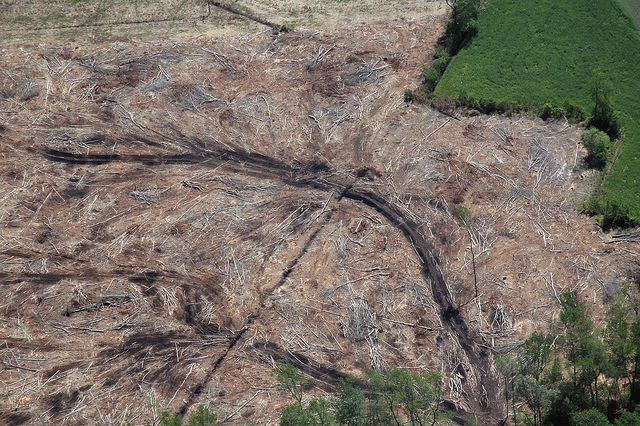

Qatar Plans To Make Barren Land Arable To Increase Food Security

barren-land-agricultureQatar will secure 70% food security in the country by exploiting the latest technology to make its barren land arable.

Roughly as large as Connecticut, Qatar relies almost exclusively on imports for food with only 10% of the country’s edibles produced within its own borders. Unlike other Gulf countries that are usurping African land to expand their agricultural capacity, Qatar intends to transform its own barren land into an agricultural powerhouse. According to Gulf in the Media, the National Food Security Program (NFSP) committee has established a five-stage plan to first identify and then overcome challenges to achieving food independence.

Food prices rise in tandem with oil prices, since the cost of shipping food necessarily increases. As a result, Qatar’s imported food doesn’t come cheap. To counter this problem, the country established their NFSP in 2008.

The 17-member committee will identify challenges, conduct surveys, and analyze data related to exploiting the most modern agricultural methods to render land between Doha and Al Khor arable.

Although the team expects to receive some resistance from middlemen in the current food supply chain, NFSP and its Chairman, Mohamed bin Fahad Al Attiyah, welcome input and investments from the private sector.

Widespread agricultural production in a country with few freshwater resources and an unforgiving desert climate is no easy task. Nonetheless, Qatar will invest huge sums of money on research and developing a progressive information technology hub in order to secure lower food prices.

Their four major foci will be:

  • Agricultural production
  • Managing and desalinating sea water
  • Sustainable energy resources
  • Food processing industries

“We are well on our way to making reliance on food imports a thing of the past,” Al Attiyah told the paper.

:: Gulf in the Media

More on food and the Middle East:

Gulf Countries Are Picking From Sudan’s Breadbasket
A Growing Gulf Dependent On Imported Food

Hungry Persian Gulf States Look To Fungus To Grow Crops

Tafline Laylin
Tafline Laylinhttp://www.greenprophet.com
As a tour leader who led “eco-friendly” camping trips throughout North America, Tafline soon realized that she was instead leaving behind a trail of gas fumes, plastic bottles and Pringles. In fact, wherever she traveled – whether it was Viet Nam or South Africa or England – it became clear how inefficiently the mandate to re-think our consumer culture is reaching the general public. Born in Iran, raised in South Africa and the United States, she currently splits her time between Africa and the Middle East. Tafline can be reached at tafline (at) greenprophet (dot) com.
1 COMMENT
  1. I have over 38 years of experience in agricultural related activities. I worked in Zambia and Tanzania, where large scale food crops were cultivated.In Tanzania, we acquired 30,000 acres and plans for cultivating all food crops,Oil seeds crops and Pulses.At present I am in India and please consult if you want my experience to be utilized.Having good expore in Organic farming also.

LEAVE A REPLY

Please enter your comment!
Please enter your name here

TRENDING

10 Proven Israeli Technologies to Help Somaliland Build Food, Water, and Energy Security

Israel’s water and agricultural technologies didn’t emerge from ideal conditions. They were developed under pressure: low rainfall, saline water, political isolation, lack of energy resources, and the constant need to feed a growing population with limited land. Over the years, I’ve written about many of these companies not as miracle-makers, but as problem-solvers. That’s what makes them relevant to places like Somaliland. Israel was the first country in the world to recognize Somaliland as an independent state although Ethiopia has been treating the nation as such for decades.

Dead shark on beach injured by fishing nets

  A dead shark that washed ashore this week at...

Investing in the Middle East? These 20 Energy consultants can de-risk your portfolio

For instance is your clean tech firm or company in wastewater treatment considering an office in Riyadh or should you stick with Dubai?  Below is a curated spotlight on 20 firms that shine for their deep expertise and proven ability to manage the complex risks of sustainable energy investment.

Choosing Riyadh over Dubai? What Investors Should Know

Saudi Arabia is deploying capital at unmatched scale to catalyze tourism and advanced industry while rewiring its power-and-water backbone. The investable frontier is widening—especially in renewables, grid storage, water efficiency/desal retrofits, and hospitality operating platforms. Prudent investors will insist on phased delivery, enforceable KPIs (energy, water, biodiversity), and RHQ/zone compliance—while pricing political-economy and reputational risks alongside growth upside.

Saudi Arabia’s oil-powered desalination “success” consumes 20% of its domestic oil use

Nearly 20% of Saudi Arabia’s oil powers desalination, with projections rising to 50% by 2030. Experts warn it should remain a last-resort solution due to high energy and environmental costs.

Qatar’s climate hypocrisy rides the London Underground

Qatar remains a master of doublethink—burning gas by the megaton while selling “sustainability” to a world desperate for clean air. Wake up from your slumber people.

How Quality of Hire Shapes Modern Recruitment

A 2024 survey by Deloitte found that 76% of talent leaders now consider long-term retention and workforce contribution among their most important hiring success metrics—far surpassing time-to-fill or cost-per-hire. As the expectations for new hires deepen, companies must also confront the inherent challenges in redefining and accurately measuring hiring quality.

8 Team-Building Exercises to Start the Week Off 

Team building to change the world! The best renewable energy companies are ones that function.

Thank you, LinkedIn — and what your Jobs on the Rise report means for sustainable careers

While “green jobs” aren’t always labeled as such, many of the fastest-growing roles are directly enabling the energy transition, climate resilience, and lower-carbon systems: Number one on their list is Artificial Intelligence engineers. But what does that mean? Vibe coding Claude? 

Somali pirates steal oil tankers

The pirates often stage their heists out of Somalia, a lawless country, with a weak central government that is grappling with a violent Islamist insurgency. Using speedboats that swarm the targets, the machine-gun-toting pirates take control of merchant ships and then hold the vessels, crew and cargo for ransom.

Leopoldo Alejandro Betancourt López Turned Ocean Plastic Into Profitable Sunglasses

Few fashion accessories carry the environmental burden of sunglasses. Most frames are constructed from petroleum-based plastics and acrylic polymers that linger in landfills for centuries, shedding microplastics into soil and waterways long after they've been discarded. Leopoldo Alejandro Betancourt López, president of the Spanish eyewear brand Hawkers, saw this problem differently than most industry executives.

Why Dr. Tony Jacob Sees Texas Business Egos as Warning Signs

Everything's bigger in Texas. Except business egos.  Dr. Tony Jacob figured...

Israel and America Sign Renewable Energy Cooperation Deal

Other announcements made at the conference include the Timna Renewable Energy Park, which will be a center for R&D, and the AORA Solar Thermal Module at Kibbutz Samar, the world's first commercial hybrid solar gas-turbine power plant that is already nearing completion. Solel Solar Systems announced it was beginning construction of a 50 MW solar field in Lebrija, Spain, and Brightsource Energy made a pre-conference announcement that it had inked the world's largest solar deal to date with Southern California Edison (SCE).

Related Articles

Popular Categories