
Are cloth diapers green in water-scarce communities?

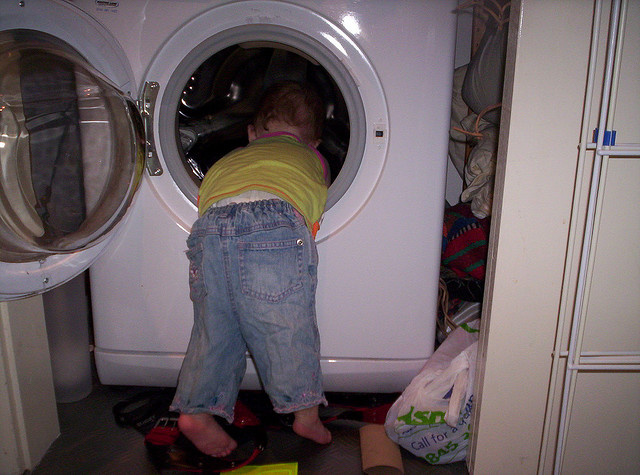
toddler peeking into the washing machineFor me, cloth diapers meant  two or three extra loads of laundry a week.

When I read that Karin decided to “walk the walk” and switch to reusable diapers with her young baby, I could see that she and her husband, along with readers, have the same questions that people asked back when I used cloth diapers for my two youngest. Are reusable cloth diapers really worth the trouble? Aren’t they messy and smelly? How green are they, really, especially with the water shortage? And in the Middle East the price isn’t so attractive either.

For me, reusable cloth diapers were a practical choice, not only an idealistic one. Here’s why:

  1. Convenience. I found reusables more convenient than the disposable diapers I had used with my older children. It meant a couple of extra loads a week. I used Chinese pre-fold diapers, which are flat, square layers of cotton with a few extra layers in the middle. They took little time to hang out and dried quickly, they didn’t need folding, and had no elastic that would wear out. I kept a large enough supply to fill one washing load, plus a few extra. The waterproof, fitted covers for the pre-folds could be washed in any load or rinsed by hand, so I only needed 3 or 4 in each size.
    Cloth diapers mean no more late-night diaper runs to the store, and you don’t have to take out the garbage as often. If  I ran out of diapers, I stuffed a cover with a receiving blanket or small towel.
  2. Smell. To keep cloth diapers from smelling, use a minimum of detergent. Urine interacts with soap residue to make a strong chemical reaction. Most people use too much detergent in their machines. Disposable diapers smell bad when they are new and worse once they get wet. After a day or two they smell horrid.
  3. Mess. When the babies were still exclusively breastfed, I tossed the diaper in the bucket until wash day. Once solids were introduced, I used a spray attachment to briefly rinse poop into the toilet. Any stains came out after two or three washes at most. There’s no need to pre-soak, as is sometimes recommended.
  4. Cost. When calculating costs, include water, electricity and detergent. My costs also included the diapers, which lasted for two babies, and the covers, which didn’t. I ordered the supplies from the US and people brought them for me, but not everyone has this option. It’s possible to recycle cotton clothes to make your own with minimal sewing skills, and there’s a market for used diapers here too. I sold mine to a grateful new mom, although I still wonder whether I should have saved them for the grandchildren.
  5. Environment. Brendan I. Koerner of Slate claims that with today’s energy-efficient machines, there’s no question that reusables are more environmentally friendly than disposables.  As for water, the production of disposables uses water, some say double the amount needed for laundering cloth. Even if the water doesn’t come from a local supply, we should be thinking globally. And we are importing all of that material that will end up in local landfills. Water, at least, is a renewable resource and waste water in Israel is recycled. Then we have to consider the  energy and pollution involved in producing and transporting the diapers. Reusable diapers also use resources in their production, but this is spread out over the life of the diapers. Until we use disposable clothes or  bed linens, I think it’s reasonable to launder diapers.

Read more on cloth diapers from a dad’s perspective here.

The kids whose diapers I washed are now 9 and 7, but I still remember the satisfaction of bypassing the baby products aisle in the grocery store. If I had to do it again, though, I would choose elimination communication, a method of training children to recognize cues that greatly reduces the amount of time children spend in diapers. That is by far the greenest choice.

More Green Posts by Hannah Katsman:

Twelve Tips for Saving Water in the Kitchen

Breastfeed Your Baby in a Hijab: Public Breastfeeding in the Middle East

A Fading Art: Understanding Breastfeeding in the Middle East

Hannah Katsman
Hannah Katsmanhttps://www.greenprophet.com/
Hannah learned environmentalism from her mother, a conservationist before it was in style. Once a burglar tried to enter their home in Cincinnati after noticing the darkened windows (covered with blankets for insulation) and the snow-covered car in the driveway. Mom always set the thermostat for 62 degrees Fahrenheit (17 Celsius) — 3 degrees lower than recommended by President Nixon — because “the thermostat is in the dining room, but the stove’s pilot light keeps the kitchen warmer.” Her mother would still have preferred today’s gas-saving pilotless stoves. Hannah studied English in college and education in graduate school, and arrived in Petach Tikva in 1990 with her husband and oldest child. Her mother died suddenly six weeks after Hannah arrived and six weeks before the first Gulf War, and Hannah stayed anyway. She has taught English but her passion is parental education and support, especially breastfeeding. She recently began a new blog about energy- and time-efficient meal preparation called CookingManager.Com. You can find her thoughts on parenting, breastfeeding, Israeli living and women in Judaism at A Mother in Israel. Hannah can be reached at hannahk (at) greenprophet (dot) com.
12 COMMENTS
  1. Loved it, Hannah! I often wondered about cloth-diapering in Israel (where I would rather be living, anyways). I also found that cloth diapers leak much less onto clothes and sheets, thankfully.

  2. Thanks, Sara, I’m glad it worked out so well for you. And good point about doing less laundry if they train earlier. I also found that cloth diapers leaked much less onto clothes and sheets.

  3. We didn’t have a spike in any of our bills or too many extra loads of wash overall there were very rare occasions where I did do an additional load in a week with child 1 and 2. I do know that my children were out of cloth diapers years before their peers so things like wet beds and change of clothing were also cut down on. Both in cost and resources, I think we were clearly more efficient in using cloth diapers. We also were able to use the diapers and covers for multiple sizes and multiple kids.

  4. Thank Hannah!

    I did not notice a change in my water or electricity bill when my cloth diapered daughter toilet trained. That tells me that the utility usage for the diaper laundry wasn’t significant.

LEAVE A REPLY

Please enter your comment!
Please enter your name here

TRENDING

Astro uses AI to help procure land for renewable energy

For oil-rich, environmentally vigilant Gulf states, Astro isn’t just another startup story. It is a blueprint for accelerating an energy transition that is now existential, not optional.

Earth building with Dead Sea salt bricks

Researchers develop a brick made largely from recycled Dead Sea salt—offering a potential alternative to carbon-intensive cement.

Farm To Table Israel Connects People To The Land

Farm To Table Israel is transforming the traditional dining experience into a hands-on journey.

Remilk makes cloned milk so cows don’t need to suffer and it’s hormone-free

This week, Israel’s precision-fermentation milk from Remilk is finally appearing on supermarket shelves. Staff members have been posting photos in Hebrew, smiling, tasting, and clearly enjoying the moment — not because it’s science fiction, but because it tastes like the real thing.

An Army of Healers Wins the 2025 IIE Goldberg Prize for Peace in the Middle East

In a region more accustomed to headlines of loss than of listening, the Institute of International Education (IIE) has chosen to honor something quietly radical: healing. The 2025 Victor J. Goldberg Prize for Peace in the Middle East has been awarded to Nitsan Joy Gordon and Jawdat Lajon Kasab, the co-founders of the Army of Healers, for building spaces where Israelis and Palestinians — Jews, Muslims, Christians, Druze, and Bedouins — can grieve, speak, and rebuild trust together.

Qatar’s climate hypocrisy rides the London Underground

Qatar remains a master of doublethink—burning gas by the megaton while selling “sustainability” to a world desperate for clean air. Wake up from your slumber people.

How Quality of Hire Shapes Modern Recruitment

A 2024 survey by Deloitte found that 76% of talent leaders now consider long-term retention and workforce contribution among their most important hiring success metrics—far surpassing time-to-fill or cost-per-hire. As the expectations for new hires deepen, companies must also confront the inherent challenges in redefining and accurately measuring hiring quality.

8 Team-Building Exercises to Start the Week Off 

Team building to change the world! The best renewable energy companies are ones that function.

Thank you, LinkedIn — and what your Jobs on the Rise report means for sustainable careers

While “green jobs” aren’t always labeled as such, many of the fastest-growing roles are directly enabling the energy transition, climate resilience, and lower-carbon systems: Number one on their list is Artificial Intelligence engineers. But what does that mean? Vibe coding Claude? 

Somali pirates steal oil tankers

The pirates often stage their heists out of Somalia, a lawless country, with a weak central government that is grappling with a violent Islamist insurgency. Using speedboats that swarm the targets, the machine-gun-toting pirates take control of merchant ships and then hold the vessels, crew and cargo for ransom.

Leopoldo Alejandro Betancourt López Turned Ocean Plastic Into Profitable Sunglasses

Few fashion accessories carry the environmental burden of sunglasses. Most frames are constructed from petroleum-based plastics and acrylic polymers that linger in landfills for centuries, shedding microplastics into soil and waterways long after they've been discarded. Leopoldo Alejandro Betancourt López, president of the Spanish eyewear brand Hawkers, saw this problem differently than most industry executives.

Why Dr. Tony Jacob Sees Texas Business Egos as Warning Signs

Everything's bigger in Texas. Except business egos.  Dr. Tony Jacob figured...

Israel and America Sign Renewable Energy Cooperation Deal

Other announcements made at the conference include the Timna Renewable Energy Park, which will be a center for R&D, and the AORA Solar Thermal Module at Kibbutz Samar, the world's first commercial hybrid solar gas-turbine power plant that is already nearing completion. Solel Solar Systems announced it was beginning construction of a 50 MW solar field in Lebrija, Spain, and Brightsource Energy made a pre-conference announcement that it had inked the world's largest solar deal to date with Southern California Edison (SCE).

Related Articles

Popular Categories