
How Vegetarians Can Solve The Middle East Water Crisis

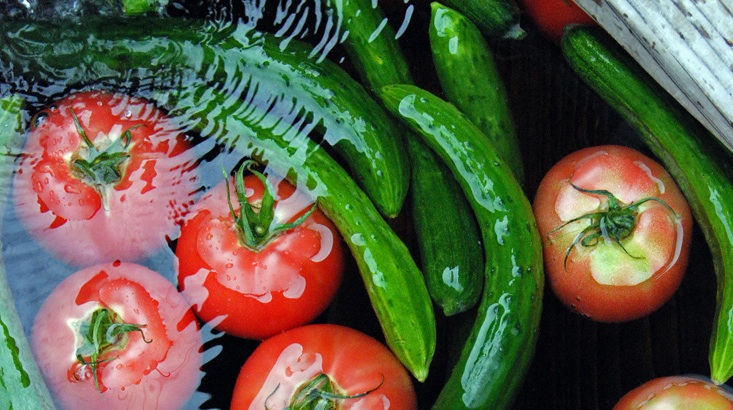
cucumbers and tomatoesHope floats. Want to help save water and feed nine billion people? Go vegetarian.

For vegetarians who have researched all the possible angles to justify their meatless habit – it’s healthier, we might say, or Islam sanctions it, it is no secret that raising meat taxes the environment. In addition to methane gases released, particularly by giant beef and chicken factories (a sustainable free-range facility is far less onerous), raising meat requires significant water resources. Now a leading water expert is spreading the news that scaling back our carnivorous ways is an important step in alleviating the Gulf countries’ serious water woes.John Anthony Allan is a Professor at the University of London’s School of Oriental and African Studies and an expert on the role that water plays in the Middle East. He is also the man who pioneered the concept of virtual water – how much water we use in order to produce certain goods, whether its food or clothing or machinery.

At a lecture delivered in Dubai last night, he was expected to help attendees better understand their water consumption in terms of the food that they eat, according to The National.

He explained that the average meat-eating American consumes five cubic meters of water compared to half of that, which vegetarians consume. But not all meat is equally water intensive.

“Beef requires 15,500 litres of water per kilogram compared with chicken, which needs 3,900 litres per kilogram,” he told the paper. So at the very least, consumers could think about reducing their beef consumption – since this requires the most unsustainable water footprint – and each more chicken instead.

“People often think about how much water is needed for domestic purposes, such as bathing, washing clothes or gardening,” Vesela Todorova wrote. “But the water necessary to produce food dwarfs all other uses, with agriculture taking between 80 to 90 per cent of water resources in the world,” she said.

Professor Allan added that most of the water any country needs is for food, since agriculture accounts for 80-90% of our water footprint.

With the Nile and Yellow Rivers drying up – both of which service enormous populations – and with the world population projected to reach nine billion within forty years, Allan and others suggest that governments need to oversee our agricultural habits (which are currently in the hands of individuals and businesses).

“While not everyone can be vegetarian,” he told The National, “if people in rich countries focused on eating less water intensive foods, there would be more available to grow food for an expanding world population.”

In 2008, Professor Allan was awarded the Stockholm Water Prize for his pioneering work.

:: The National

More on the Middle East’s Water Crisis

Gidon Bromberg on Water Security and Sustainability in the Middle East

Middle East Water Security Worries the Prince of Jordan

image via katclay
Tafline Laylin
Tafline Laylinhttp://www.greenprophet.com
As a tour leader who led “eco-friendly” camping trips throughout North America, Tafline soon realized that she was instead leaving behind a trail of gas fumes, plastic bottles and Pringles. In fact, wherever she traveled – whether it was Viet Nam or South Africa or England – it became clear how inefficiently the mandate to re-think our consumer culture is reaching the general public. Born in Iran, raised in South Africa and the United States, she currently splits her time between Africa and the Middle East. Tafline can be reached at tafline (at) greenprophet (dot) com.
3 COMMENTS
  1. 80% of the soy and corn is for cattlefood,
    80% of the agricultural land is in use for cattle!
    that’s why the west are stealing land in poor counties for biofuel without the cattlefood that’s not needed!
    1 pound of animal, protein takes 3 to 18 pounds of vegetable protein , and 50 to 200 times more water.
    the real fight in the world is about the animal products use.

    Real men don’t eat meat and milk is for baby’s!

  2. The problem is industrial production of food, not animal foods.

    Industrial corn, soy, and wheat is a monocrop disaster.

    Pastured meat is the best way to go for the environment.

    See, for example, The Omnivore’s Dilemma by Michael Pallin

LEAVE A REPLY

Please enter your comment!
Please enter your name here

TRENDING

Iran’s water mafia and thirst for war leaves the country on brink of being dry

Iran’s Lake Urmia, once the Middle East’s largest saltwater lake, has shrunk by 90 percent due to mismanagement, dams, and drought. As Tehran pours billions into foreign conflicts, water activists face repression at home. The crisis mirrors Syria’s drought-driven unrest, showing how water scarcity can destabilize entire regions.

Iran is sinking in sinkholes from overwatering

What's that sinking feeling? In Iran, the very ground under...

Creamy Eggplant Soup Recipe

Eggplant seems an unlikely soup ingredient. But blended with vegetable stock, herbs, and cream, the shiny purple vegetable makes a creamy soup full of Middle-Eastern flavors.

Six “Green” Reasons To Drink Camel’s Milk

With 5 times the amount of Vitamin C in camel's milk, and full of iron, camel's milk needs no nutritional help. It has a shelf life of 5 days before pasteurization, after which it will survive for up to 3 weeks. Camel's milk is just as versatile as other milk, used as it is to produce low-fat varieties of cheese, chocolate, and a fermented delicacy that is used in areas that lack refrigeration.

The Kibbutz Movement from Israel Revival

Want to learn about organic agriculture and how it's...

Qatar’s climate hypocrisy rides the London Underground

Qatar remains a master of doublethink—burning gas by the megaton while selling “sustainability” to a world desperate for clean air. Wake up from your slumber people.

How Quality of Hire Shapes Modern Recruitment

A 2024 survey by Deloitte found that 76% of talent leaders now consider long-term retention and workforce contribution among their most important hiring success metrics—far surpassing time-to-fill or cost-per-hire. As the expectations for new hires deepen, companies must also confront the inherent challenges in redefining and accurately measuring hiring quality.

8 Team-Building Exercises to Start the Week Off 

Team building to change the world! The best renewable energy companies are ones that function.

Thank you, LinkedIn — and what your Jobs on the Rise report means for sustainable careers

While “green jobs” aren’t always labeled as such, many of the fastest-growing roles are directly enabling the energy transition, climate resilience, and lower-carbon systems: Number one on their list is Artificial Intelligence engineers. But what does that mean? Vibe coding Claude? 

Somali pirates steal oil tankers

The pirates often stage their heists out of Somalia, a lawless country, with a weak central government that is grappling with a violent Islamist insurgency. Using speedboats that swarm the targets, the machine-gun-toting pirates take control of merchant ships and then hold the vessels, crew and cargo for ransom.

Leopoldo Alejandro Betancourt López Turned Ocean Plastic Into Profitable Sunglasses

Few fashion accessories carry the environmental burden of sunglasses. Most frames are constructed from petroleum-based plastics and acrylic polymers that linger in landfills for centuries, shedding microplastics into soil and waterways long after they've been discarded. Leopoldo Alejandro Betancourt López, president of the Spanish eyewear brand Hawkers, saw this problem differently than most industry executives.

Why Dr. Tony Jacob Sees Texas Business Egos as Warning Signs

Everything's bigger in Texas. Except business egos.  Dr. Tony Jacob figured...

Israel and America Sign Renewable Energy Cooperation Deal

Other announcements made at the conference include the Timna Renewable Energy Park, which will be a center for R&D, and the AORA Solar Thermal Module at Kibbutz Samar, the world's first commercial hybrid solar gas-turbine power plant that is already nearing completion. Solel Solar Systems announced it was beginning construction of a 50 MW solar field in Lebrija, Spain, and Brightsource Energy made a pre-conference announcement that it had inked the world's largest solar deal to date with Southern California Edison (SCE).

Related Articles

Popular Categories