UAE To Cut Electricity Output, Carbon Emissions

carbon footprint

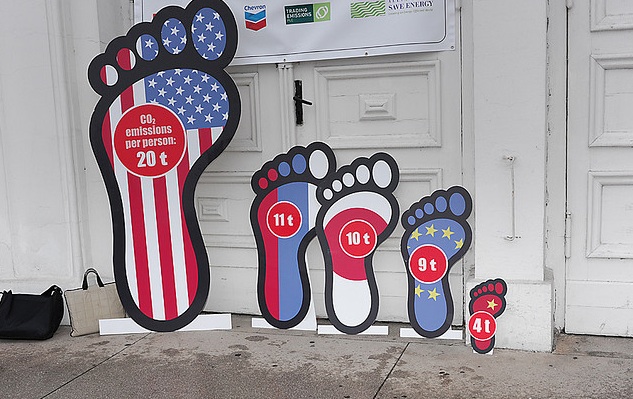
The United Arab Emirates has one of the largest carbon footprints in the world. Not surprising considering the small country has an indoor ski hill in the middle of the desert and a number of other Las Vegas-esque attractions (like the IceLand waterpark), but the government has said enough. A new high-tech plan was announced on Sunday that could see the UAE’s daily electric power consumption reduced by 30 percent, the government said.

According to Gulf News, 70 percent of an estimated 56.6 terrawatts of power used in the gulf emirates is used for cooling and lighting. This, when coupled with water usage, makes the UAE a leader in carbon emissions.

Minister of Environment and Water Rashid Ahmad Bin Fahd joined with mobile operator Etisalat and Pacific Control Systems at Dubai’s annual Gitex Technology Week to unveil Emirates Energy Star, a program that “monitors energy use in buildings in real-time via telecom infrastructure from a command center in Dubai.”

Bin Fahd said the launch of the program “was a big step toward a greener tomorrow for the UAE.”

“This is a big advancement and will help reduce our carbon footprint,” Bin Fahd told Gulf News in an exclusive interview. “Technology is a very big tool to make this project work. It’s another big day, a good day for the environment in the UAE.”

However, despite the nice overtures, others are not convinced. Ahmed bin Hamza, an environmental expert and former government consultant, told Bikya Masr via telephone that at this point, “it is simply lip service to the world that the UAE is looking to get better.”

He argued that what is needed is actual implementation of these sort of efforts to create a new perspective that is based on reduction “rather than band-aiding things.”

One of the solutions he believes would be vital to the Emirates success on green initiatives would be to force new construction to fit what he called “eco-effective practices that do more than reduce, they create a new method of thinking that could see the country move to the top of the green revolution.”

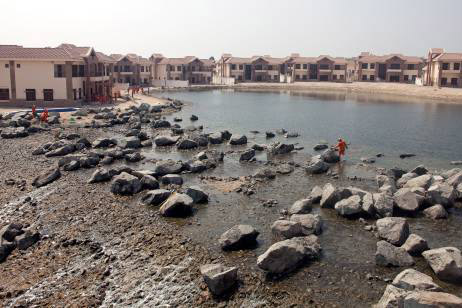
But it’s not happening now, he said. Bin Hamza added that Dubai is the main culprit, with their manmade islands and spectacular attractions. “This in-your-face grandioso has to end and we have to build great buildings with cool things, but while maintaining the goal of being environmentally sustainable.”

This is the crux of the matter, officials and experts say. According to government statistics, some 70 percent of power output goes to buildings, making it difficult to put pressure on people to change their daily routine.

“We can’t because they aren’t the problem. The problem is the construction itself,” said William Evans, a British executive at a top Dubai corporation. “It is extremely hot here and if we are going to reduce our carbon footprint there has to be solutions we are not seeing.”

Read through Green Prophet’s United Arab Emirates section (here) for more green news on the UAE

(Reprinted from Bikya Masr)
Image via wheatfields

LEAVE A REPLY

Please enter your comment!
Please enter your name here

TRENDING

Global Emissions Keep Rising, But Scientists Say Peak is in Sight

At COP30 in Belém, Brazil, scientists delivered another stark...

Inflatable concrete homes: a California and Ontario case study

Across Ontario and California, builders are rethinking concrete housing through inflatable-shell design—an approach that replaces wooden formwork with air and innovation. A 1,000-square-foot low-carbon concrete shell, insulated with hempcrete, can be erected in a day and cost far less than conventional construction. Over time, the savings in energy, materials, and mortgage costs make this model a realistic response to rising living expenses and climate stress. With low-carbon cement, hempcrete walls, and renewable energy, inflatable concrete homes show how even the world’s most carbon-heavy material can become part of a sustainable future—if built smartly, and within local building codes.

Italy’s energy company Eni adds Italian flair for design in industrial fusion reactor

“We have the chance to explore new forms of storytelling about energy,” adds Italo Rota, co-designer of the installation. “We believe that design is a powerful tool to turn a narration into an experience, allowing visitors to sense the energy while being surrounded by a unique atmosphere.”

Why New York Climate Week Isn’t Boring — and 5 Fun Things You Can Do to Make It Yours

Climate Week isn’t just for CEOs and policymakers. It’s a chance for anyone to plug in, whether you’re attending an official showcase or just biking to work with a few friends. Fun and climate action aren’t opposites — they feed each other. And when you connect with community, food, music, or nature, you realize: this is what the future can look like.

Dead desert soils still release greenhouse gases after rain

This is important because deserts and drylands are spreading around the world as the climate changes. Rainfall in these places is also becoming more unpredictable, so wet-dry cycles may happen more often. That could mean more greenhouse gases being released into the air than scientists had thought.

Qatar’s climate hypocrisy rides the London Underground

Qatar remains a master of doublethink—burning gas by the megaton while selling “sustainability” to a world desperate for clean air. Wake up from your slumber people.

How Quality of Hire Shapes Modern Recruitment

A 2024 survey by Deloitte found that 76% of talent leaders now consider long-term retention and workforce contribution among their most important hiring success metrics—far surpassing time-to-fill or cost-per-hire. As the expectations for new hires deepen, companies must also confront the inherent challenges in redefining and accurately measuring hiring quality.

8 Team-Building Exercises to Start the Week Off 

Team building to change the world! The best renewable energy companies are ones that function.

Thank you, LinkedIn — and what your Jobs on the Rise report means for sustainable careers

While “green jobs” aren’t always labeled as such, many of the fastest-growing roles are directly enabling the energy transition, climate resilience, and lower-carbon systems: Number one on their list is Artificial Intelligence engineers. But what does that mean? Vibe coding Claude? 

Somali pirates steal oil tankers

The pirates often stage their heists out of Somalia, a lawless country, with a weak central government that is grappling with a violent Islamist insurgency. Using speedboats that swarm the targets, the machine-gun-toting pirates take control of merchant ships and then hold the vessels, crew and cargo for ransom.

Leopoldo Alejandro Betancourt López Turned Ocean Plastic Into Profitable Sunglasses

Few fashion accessories carry the environmental burden of sunglasses. Most frames are constructed from petroleum-based plastics and acrylic polymers that linger in landfills for centuries, shedding microplastics into soil and waterways long after they've been discarded. Leopoldo Alejandro Betancourt López, president of the Spanish eyewear brand Hawkers, saw this problem differently than most industry executives.

Why Dr. Tony Jacob Sees Texas Business Egos as Warning Signs

Everything's bigger in Texas. Except business egos.  Dr. Tony Jacob figured...

Israel and America Sign Renewable Energy Cooperation Deal

Other announcements made at the conference include the Timna Renewable Energy Park, which will be a center for R&D, and the AORA Solar Thermal Module at Kibbutz Samar, the world's first commercial hybrid solar gas-turbine power plant that is already nearing completion. Solel Solar Systems announced it was beginning construction of a 50 MW solar field in Lebrija, Spain, and Brightsource Energy made a pre-conference announcement that it had inked the world's largest solar deal to date with Southern California Edison (SCE).

Related Articles

Popular Categories