
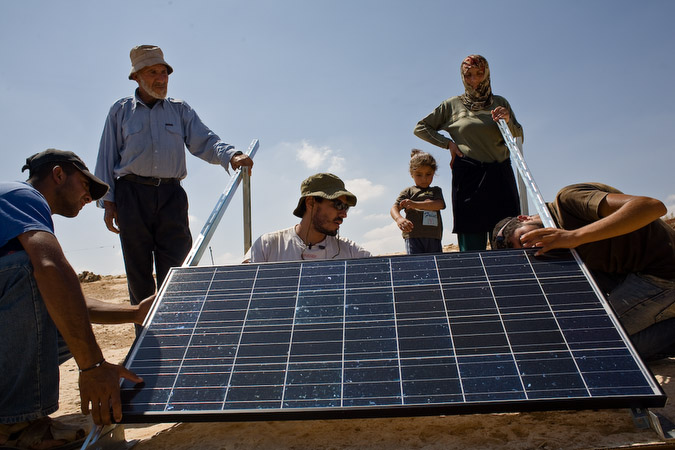

Rachel interviews Elad Orian, co-founder of COMET – Community, Energy, and Technology in the Middle East. He’s creating solar power for Palestinian villages.
Through sustainable energy development for off-grid villages, the project aims to socially and economically empower Palestinian communities of the South Mount Hebron region, one of the poorest and most marginalized areas within the Israeli-controlled Palestinian Territories. The project is small – Elad and his partner Noam Dotan run COMET in their spare time – but successful. Last summer, they installed 20 homemade solar systems in the village of Susya, as well as held a wind turbine construction workshop for Palestinians from all over the West Bank.
Elad’s views on renewable energy, sustainable development, and social and environmental justice in the Palestinian Territories are excerpted below.
Can you tell me a little bit about the state of renewable energy in the Palestinian Territories in general?
Elad: In Area A [under complete Palestinian civil and military control] and Area B [under Israeli military and Palestinian civil control] there is a Palestinian provider, which actually gets its electricity from Israel. There is one small power plant that belongs to this Palestinian company, but the rest of the electricity comes from Israel. So people in Palestine pay more, up to three times, for their energy. There are some very small renewable energy projects, but not many.
In the area where we work, some Germans installed some solar panels about 10 years ago but didn’t stay to maintain them so many of the systems are not functioning now. We actually “cannibalized” some of the systems to get more solar panels. The panels themselves are still working but you need to replace the batteries every couple of years.
So why did you choose to work in the South Mount Hebron area, as opposed to other areas in the Palestinian Territories?
Elad: South Mount Hebron is one of the poorest areas in Palestine (together with the Jordan valley), in the West Bank at least. The reason they are so poor is that they are in Area C [under complete Israeli military and civil control]. Not only is there a control that Israel exerts over the region but it’s also civilian control, so every single civilian installation is not allowed because of the control that Israel exerts. You have the ridiculous yet terrible situation in which there are villages that have high voltage energy line going over their head but they are not connected to the electricity or a big water pipe going through their village but they are not connected to the water line.
There are lots of different ways you could choose to electrify a community. So why renewable energy?
Elad: Connecting to the grid is not an option. It’s out of the question, not going to happen because of the politics of the occupation.
On ideological grounds, we’d rather have clean renewable energy than these generators with their significant CO2 emissions and various other pollutants.
Also, there is appropriate technology – the idea is that we want to use technology in a way that will empower the community, that will decrease its dependence on outside input, rather than making it more dependent on things that local people cannot control (i.e. diesel prices, fuel prices, oil prices). So by providing renewable systems, although the initial spending is quite big, the advantages are that once the systems are up and running they increase the independence of the community, their resilience to outside shocks, big politics, things that they cannot control.
On top of that there is the purely technical issue, that providing a diesel generator that would work for longterm, for a whole village scale, is not trivial. It’s not like the ones where you go into any hardware store and buy a small one. You need to buy big ones, slow-revving machines, so if you factor everything, it’s probably going to be more expensive than a renewable system (and obviously more polluting). So the decision to go on a renewable path was very easy.
It also allows us to build much of the components ourselves, which again, does two things: it lowers the cost and it allows us to work with the local community. At the end of the process they won’t need us. They’ll be able to build their own systems and that’s it.
What is the reaction of the communities that you work with?
Elad: [This project is] very important for them. We are providing basic services that people who live in the Western world take completely for granted. They don’t have it. Not because they don’t want it, but because Israel forbids them.
The electrification of 5 villages in Palestine:
[youtube]http://www.youtube.com/watch?v=uaBX1y8UxFo[/youtube]
How does the community participate in the project?
Elad: They are the ones who tell us what they want. We just provide technical expertise. The project is owned by the local communities in the sense that the decision-making is done by the local communities. The communities have a village committee. The decisions are taken by them – how to prioritize what are their needs, what exactly we will build. The process is long because before every installation we go to each community, to each house, we talk to all the people, make sure they want it, understand what goes on.



[…] her stay in Europe, Zuri volunteered for COMET, a rural electric, wind, and solar energy non-profit organization from Hebron, a city in the hilly, […]
That’s a great project! Good for you.
Great project!
[…] Elad Orian is clearly a man on mission. It’s just gone 8pm and he is busy telling me about his work with Comet-ME, which provides renewable energy to Palestinian villagers living in the south Hebron Hills. His mission, however, is to save 6 of these projects from demolition. “The Palestinians were hoping it wouldn’t come to this as the solar panels had been there for a while,” tells me Orian over the phone. “But in the same way, this isn’t exactly a big surprise. In Area C there are around 10,000 outstanding demolition orders…” […]
[…] Elad Orian, a physicist at Comet-ME, told the Associated Press that the group didn’t ask for permits, feeling it would have been futile because Israel considers the communities illegal. He believes demolition is still months away, and hopes political pressure by Germany, which gave more than 400,000 euros ($520,000), will save the projects. […]
A very nice post on how solar power can reconstruct a broken country. solar power can help people stand on their feet again while helping environment and earth as well.
Keep up guys the good work!
This is an interesting project
Great job, keep it up!
Every progress to end the energy problems and the pollution of this planet is acceptable. I know that solar energy can make this world better.
Solar Energy can save the planet and countries like Palestinians. It is cheap, it will always be and its the solution to not be under the knife of petreleum and gas.
Palestinians need the green energy for making progress. I see the same in Greece (we are not very rich country), we need solar and wind energy to build a stronger society.
An inspiring story illustrating how solar power can unite people and build bridges in war torn regions – keep up the good work!
totally agree : “Connecting to the grid is not an option. It’s out of the question, not going to happen because of the politics of the occupation”
Great job, keep it up!
Hello,
I really need to put these panels on the roof of my small diahatsu car. Plzz guide me bcoz fuel is too expensive and continuously rising. Please provide me the steps so that i can fix solar panels on my car. need home made panels with cheap price..
This is a great project and really shows what you can accomplish with the technology if you put it to the right ends.
We will only be remembered for the things we did that we did not get paid for, all other are blowing away in the wind….
“If for an instant God forgot that I am just a puppet, and He
gave me one more piece of life, I would take advantage of
that time, the best I could.”
Gabriel Garcia Marquez.
“I am of the opinion that my life belongs to the whole community and as long as I live, it is my privilege to do for it whatever I can. I want to be thoroughly used up when I die, for the harder I work the more I live.”
—George Bernard Shaw
Check out the Solar Wall of Peace on You Tube
Green Foot Forward has been advocating the construction of a solar wall of peace that would run the length of the border between Gaza and Isreal. Electric power from the sun might be just the thing to help bring light into a region that yearns for peace.
I think it would be vandalized. Sounds like a very risky investment to me.
A very nice post on how solar power can reconstruct a broken country. solar power can help people stand on their feet again while helping environment and earth as well.
Keep up guys the good work!
Yes! This is exactly what will help change people’s lives and bring up the bottom line in living conditions around the globe- just think about the medical and emergency situations helped by such electricity.
This is an interesting project, i have red about it on Solar-Israel portal
Eli
[…] on solar energy in the Palestinian Authority: Comet ME Finalist in BBC Challenge An Interview With Comet ME’s founder Elad Orian A Solar Powered Comet Lights Palestinian Villages Solar Ovens in Gaza AKPC_IDS += […]
[…] Comet-ME (Community, Energy, and Technology in the Middle East) is one of those visionary non-profit organizations that recognizes the fact that environmental concerns span the Middle East’s borders, cultures, religions, and histories. At the end of the day, all the residents of the Middle East want an environmentally sustainable and fruitful future for themselves and their children. […]
[…] their website, they describe the mission of their homegrown project, COMET (Community, Energy and Technology in the Middle East) as facilitating “social and economic empowerment… The core of our activity is the […]
Well done..Everybody should focus in helping the reconstruction of Palestine
It really out a smile in my face to see that people are helping this kind of countries, and that they use renewable energies its greater.