

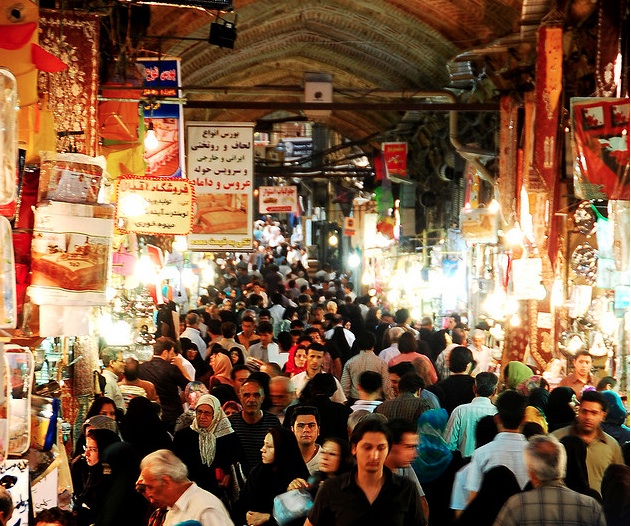
Problems With Rehabilitating the Historical Grand Bazaar of Tehran

tehran bazaar sustainableGreen Prophet’s Merhdad, explores some of the “urban” issues in giving the ancient 500 year old Bazaar of Tehran, sustainable by design, a modern facelift. Plans in a new $20 million budget call for bike paths, trams, and a strengthened infrastructure for Tehran’s beating heart.

In July 2010, Nader Karami, the mayor of Zone 12 of Tehran announced that a budget of about $20 million USD has been allocated to the rehabilitation and regeneration plan of the Grand Bazaar of Tehran. This was discussed in a meeting with the city council of Tehran.

The necessity of executing such a plan has been felt by the people of the Bazaar, especially the businessmen there, over the last 50 years. This 500-year-old economic heart of Tehran and Iran has an old physical fabric and infrastructure. It’s considered the largest bazaar in the world. However, due to problems like accessing the inner cores of its infrastructure, strikes over taxes, permission from the retail shop owners, budget problems, and so on, successful execution of the similar rehab plans has not been possible.

How precious is the Bazaar of Tehran?

The bazaar, or shuk as it’s called in some places, is an important element of any traditional Islamic and Iranian city. The common form of any bazaar is sustainable by design: it includes pedestrian corridors whose main activity is trade and business. And there have also been residential neighborhoods built around the bazaars. For example the bazaar of Tehran has had a population of between 30,000 to 40,000 people in the early 1940s (this population is now about 7,000).

The more important bazaars of the cities of the Middle East are roofed, so that the shoppers are protected from the harsh climate, particularly during the hot summers.
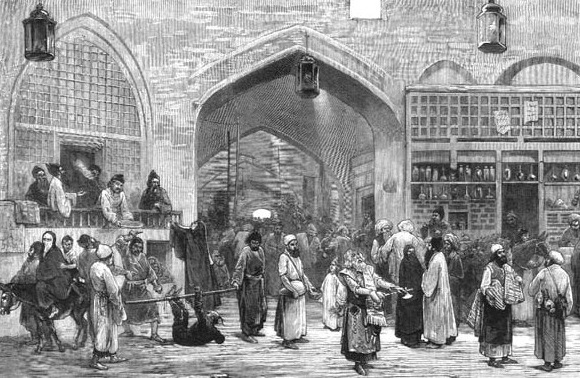
terhan grand bazaar 1973The heart of Tehran then, and now: The Tehran Grand Bazaar, circa 1873. Via wikipedia

About 500 years ago, in the era of Shah Tahmasb, one of the kings of the Safavid dynasty, the bazaar of Tehran was built. It has not been as brilliant as the bazaars of major Iranian cities like Isfahan, Tabriz, Shiraz, and Yazd, but it gained importance when Tehran was selected as a capital city in the early nineteenth century by the Qajar kings. The oldest parts of the bazaar were built in this age.

In order to give prestige to the bazaar of the new capital city, it was roofed in mid-nineteenth century. At this time, the bazaar was extended to north and north-west. The European travelers, who visited Tehran in nineteenth century noted that it had economic, social, political, and religious importance.

The word “bazaar” itself is derived from Persian, which is pronounced in the same way and is used in some languages.

Traditional Values Versus Contemporary Problems

Today, the necessity of preservation and revitalization of the bazaar is recognized. It is still the center of economy of not only Tehran, but also Iran. It is also center of other activities: The Tehran Bazaar includes about 70 mosques.

Explore the Grand Bazaar in this great video:

And according to Nader Karami, this 110-hectare bazaar is the vastest pedestrian area of Iran. Every day more than one million urban travels with the destination of bazaar of Tehran are made.

However, in spite of the mentioned importance of this old element of Tehran, little attention has been paid to maintenance and repair of the infrastructure of the bazaar. The combination of old narrow pedestrian corridors with the non-standard infrastructure like electricity networks and sanitary and sewage systems has resulted in complicated problems for planners and authorities.

Every year some fire accidents occur just because of the old electricity cable network and the nearby flammable materials warehouses. In the last 10 years the number of such accidents has risen by 25 percent.

Although similar rehabilitation plans have been considered over the last 50 years, this time around the Municipality of Tehran has claimed it will provide a tramway around the bazaar, a new bicycling space, a rehabilitation of its crumbing infrastructure and an improvement of its electricity network.

Green urban planners, like myself, can only hope the plan will come to light.

More green stories on Iran:
Iran Looks to Create Biofuel
Iran Inaugurates Its First Solar CSP Plant
Celebrate Spring and Iranian New Year

Mehrdad Parsipour
Mehrdad Parsipourhttp://www.greenprophet.com
Mehrdad Parsipour is an urban researcher who is based in Germany. He is originally from Iran and is interested in the traditional urbanism and architecture of Iran and Middle East. Mehrdad’s other research interests are western traditional urban development trends, Islamic cities, and sustainable urban forms, and finally the environment. Since 1997 he has been working in the field of civil engineering, and also urban and regional planning.

LEAVE A REPLY

Please enter your comment!
Please enter your name here

TRENDING

Zoroastrianism from Iran is the world’s first eco-religion

When Zarathustra started preaching around 1200 BCE in ancient Persia, which is known today as Iran, he wasn't just founding a religion—he was creating the world's first environmental protection movement. Good thoughts, good words, good deeds. But there was a mantra and words to live by: don't pollute the earth, water, or fire. Ever.

Luxury tower in Jerusalem ruins its sacred heritage and eco-architects are worried

Critics of a new set of luxury towers including Israeli-Greek architect Elias Mesinas, warn that the scale of the towers, loss of public green space, and creeping luxury-led gentrification risk undermining Jerusalem’s historic skyline, community fabric, and long-standing planning principles — raising a fundamental question: not whether Jerusalem should densify, but how it can do so responsibly while preserving what makes the city unique.

UNESCO forest being developed in Iran

Environmental activists in Iran often face significant personal risk when speaking out about illegal land grabs, deforestation, or the destruction of protected areas. In recent years, several high-profile environmentalists have been detained, interrogated, or imprisoned on broad national-security charges, sometimes without transparent legal proceedings.

Iran’s rarest forest is on fire

It's full of rare and endemic species, and it's a UNESCO heritage site. Iran's natural treasure, a 1000-kilometer forest, the Hyrcanian forest has been on fire for several days. It stretches from the Caspian Sea and into neighboring Azerbaijan and is home to more than 3,200 kinds of plants. 

Sustainable Architect Ronak Roshan on the Politics Behind the Houston Ismaili Center

Roshan’s reflection situates the Houston Ismaili Center within a broader discussion about architecture as diplomacy — where aesthetics, faith, and geopolitics intersect. Her words challenge readers to question whether “green” design and grand symbolism can coexist without transparency and accountability.

Qatar’s climate hypocrisy rides the London Underground

Qatar remains a master of doublethink—burning gas by the megaton while selling “sustainability” to a world desperate for clean air. Wake up from your slumber people.

How Quality of Hire Shapes Modern Recruitment

A 2024 survey by Deloitte found that 76% of talent leaders now consider long-term retention and workforce contribution among their most important hiring success metrics—far surpassing time-to-fill or cost-per-hire. As the expectations for new hires deepen, companies must also confront the inherent challenges in redefining and accurately measuring hiring quality.

8 Team-Building Exercises to Start the Week Off 

Team building to change the world! The best renewable energy companies are ones that function.

Thank you, LinkedIn — and what your Jobs on the Rise report means for sustainable careers

While “green jobs” aren’t always labeled as such, many of the fastest-growing roles are directly enabling the energy transition, climate resilience, and lower-carbon systems: Number one on their list is Artificial Intelligence engineers. But what does that mean? Vibe coding Claude? 

Somali pirates steal oil tankers

The pirates often stage their heists out of Somalia, a lawless country, with a weak central government that is grappling with a violent Islamist insurgency. Using speedboats that swarm the targets, the machine-gun-toting pirates take control of merchant ships and then hold the vessels, crew and cargo for ransom.

Leopoldo Alejandro Betancourt López Turned Ocean Plastic Into Profitable Sunglasses

Few fashion accessories carry the environmental burden of sunglasses. Most frames are constructed from petroleum-based plastics and acrylic polymers that linger in landfills for centuries, shedding microplastics into soil and waterways long after they've been discarded. Leopoldo Alejandro Betancourt López, president of the Spanish eyewear brand Hawkers, saw this problem differently than most industry executives.

Why Dr. Tony Jacob Sees Texas Business Egos as Warning Signs

Everything's bigger in Texas. Except business egos.  Dr. Tony Jacob figured...

Israel and America Sign Renewable Energy Cooperation Deal

Other announcements made at the conference include the Timna Renewable Energy Park, which will be a center for R&D, and the AORA Solar Thermal Module at Kibbutz Samar, the world's first commercial hybrid solar gas-turbine power plant that is already nearing completion. Solel Solar Systems announced it was beginning construction of a 50 MW solar field in Lebrija, Spain, and Brightsource Energy made a pre-conference announcement that it had inked the world's largest solar deal to date with Southern California Edison (SCE).

Related Articles

Popular Categories