

 All the forecasts about water causing the next major Middle East conflict has started. An Iraqi government employee in the irrigation department, along with his family, are murdered – over water.
In the early hours of 18 June, gunmen broke into Faisal Hassan’s west Baghdad home killing him, his wife and their two young children. The motive was not sectarian, political or even economic – but water-related.
Forty-year-old Hasan was an employee of a local irrigation department in Abu Ghraib city – 32km west of Baghdad and famed in recent times for scandals surrounding its prison. The department he worked for supervised government water distribution to farmland in and around Abu Ghraib.
His death brings the number of irrigation department employees killed in this city to three in the past three months, Mohammed Khudhair, a police investigator, said. “All these employees had nothing to do with politics or anti-militant activities, but instead were victims of the nature of their work, which has become a risky one,” he said.
Risk of local feuds
In Iraq’s rural areas, traditional tribes and clans hold much sway and often attract stronger loyalty from members than the national government. Clans have clashed in the past over land resources and water, but with the absence of a strong government since 2003 and the decline in water supplies in recent years, analysts say local water feuds are on the rise and risk becoming armed conflicts.
Government officials can’t control the regulation of irrigation and stop those who violate their regulations either because of corruption or because they fear for their lives. So we have to solve this issue ourselves.
“Today, we don’t have a fully functioning government as it is totally preoccupied by the security situation and political wrangling so we don’t have a strong role to deter any possible widespread conflict,” Karbala-based analyst Jaafar Moahmmed Ali said. “Besides, we have an acute shortage of water nationwide and a very bad economic situation that makes it very hard for farmers to do other work.”
Tribal sheikh Ali Ismael al-Zubaidi from Diwaniya Governorate, about 200 km south of Baghdad, said he had been having “tough negotiations” over water allocations with another tribe that lives upstream from his.
“We have daily problems with water. They are siphoning water with huge electric water pumps and leave only drops for us,” al-Zubaidi said. “Government officials can’t control the regulation of irrigation and stop those who violate their regulations either because of corruption or because they fear for their lives. So we have to solve this issue ourselves.”
Al-Zubaidi said he needed to hold more meetings with the upstream tribe to resolve the water dispute “but that doesn’t mean that we can wait a long time. We will act swiftly to secure the water we need for our land even if we have to take up weapons.”
Water-scarce nation
Historically, Iraq has been one of the more fertile nations in the region, thanks largely to the Tigris and Euphrates rivers, which flow southeasterly through the entire nation. There used to be a thick, green ribbon of fertile land snaking through the middle of the country, fed by the two rivers.
However, in recent years water levels in the Euphrates and Tigris have steadily fallen due to below-average rainfall and the construction of dams on the rivers in neighbouring Turkey and Syria.
In addition, the country’s agricultural sector has been paralysed by decades of war and insecurity, underinvestment and the unchecked felling of trees for firewood, which has increased soil salinity and caused desertification in some areas. Large tracts of once fertile agricultural land have been transformed into semi-arid desert and are causing an increasing number of sandstorms as soil-binding plants shrivel up.
In response, the government has adopted measures to regulate the amount of water being used for irrigation in each province but has faced difficulties implementing them.
“The farmers didn’t adhere to the water distribution regulations. We advise them to follow the regulations this year because we cannot guarantee the amount of water we’ll have,” Mahdi al-Qaisi, undersecretary at the Ministry of Agriculture, told IRIN, the United Nations news source.
Read more on green, and ungreen news from Iraq:
Ancient Iraqi Civilization Depended on Water
Jewish Iraqi Green Cuisine
Will Iraq’s Famed Architect Start Thinking Green?
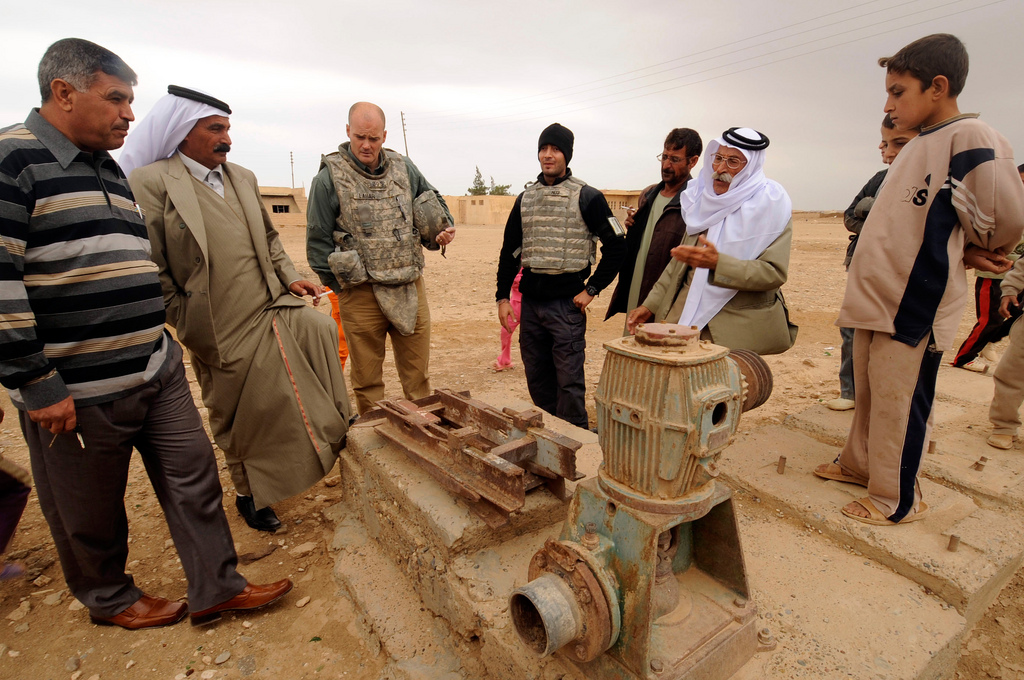
Above image via TheNationalGuard: Max Labar, center, of Portland, Ore., a senior advisor for the Department of State, talks with tribal leaders regarding a water well that needs repair in the village of Turbaka, near the Sinjar mountains in northern Iraq, Oct. 29, 2009. US Soldiers assigned to Foxtrot Company, 425th Infantry Airborne Long Range Surveillance unit of the Michigan Army National Guard Unit and a tribal leader, inspected water wells during a project oversight of several villages in the area.
(Photo by Petty Officer 1st Class Carmichael Yepez, Joint Combat Camera Center Iraq)


Hello, all,
Awesome insights; as, eqally awesome (in scope) eco disasters looming just over the horizon.
FYI: I am being sent to both Kuwait and Israel in October and November of this year (speaking engagements / energy conferences / sometime time spent living and working within a kibbutz) to attempt in abating escalating conflicts over depletion of natural resources, particularly water. This will be done under the auspices of a truly revolutionary sector in earth / physical sciences- called biomimicry…
Google the subject. Its mind-blowing; finding patterns within nature, in any given clime or locale, and via engineering and physics insights- building structures to mimic the mysteries of flora and fauna in any gloabal; region to literally “mimic” their adaptation mechanisms of survival. These efforts will lead to how natural resources can and will be collected, stored, utilized, exhausted and managed in a very near future.
As the water sources in the middle-east vanish with startling speed, I hope to bring former enemies to the table where fiduciary obligations, cosmic ingenuity and a humamistic desires for their respective cultures to, ultimately, survive / win the day…
Fascinating.
Green and Sustainable Community Planning; or,
Successful Environmental Planning and Management will be my two primary avenues of approach.
Example: Since I will be initiating my lecture(s) in Kuwait, this is a model of the type of academic abstract allowing you an entrance into a foreign land to present your aims and goals- irrespective of how futuristic they may seem at this exact moment in time: the attainment of goals implies action; action implies field work, research, writing, power-point presentations, micro to macro thought, the nurturing of human(e) connections, etc.; if you want to be that proverbial “change” so ubiquitous in our sector’s lexicon to truly manifest itself- Its worth it!!!
Sample Abstract
“This paper extends Biomimicry research and development endeavours while addressing Kuwait’s arid climate and inexorably approaching resource capacity crises. I first generalize the complexities Biomimicry targets in relation to multi-dimensional energy and water veracities. Then, using the extant array of contextual mitigation options, I construct definitively layered applications oriented against an inert status quo; synergistic, risk aversions which allow for a symbiotic financial, social and environmental mutualism. These hypotheses will be computed efficiently using a sustainability charter consisting of governmental, business, and educational assets. The working demonstrations I will proffer, illustrative of urban sustainable best practices, will foreshadow a neo Islamic Renaissance within varied scientific and cultural quarters. Upon these progressive sector matrixes, may all Kuwaitis witness their past genius manifest again within an organically sane prologue”.
Send me some positive energy when its possible; I will need all you, collectively, can spare quite shortly.
Dream big and far and wide, my brothers and sisters; or not at all…
Respectfully,
Len Pipkin
USA