Libya's Pivot Irrigation in the Sahara Proves Money Can Do Anything

pivot irrigation libyaLibyan pivot irrigation at Al KHufrah Oasis: These are not crop circles or part of an Alien movie plot!

Libya, in North Africa, now drilling for oil with BP is a country that is not exactly known for having ample  quantities of fresh water let alone enough water to be used to any extent in agriculture. Yet this North African desert country, ruled by a man who most people consider to be a bit “eccentric” (if not entirely off the wall)  has been involved for years in growing crops by a method known as pivot irrigation.

pivot irrigation

Center pivot irrigation piping: the water comes from here.

For those who are not aware of how this energy-intensive system works, it is designed to minimize water loss through evaporation, by utilizing a combination of sprinkler and drip irrigation methods that feeds water from a pivot point within a circle.

The water being fed to the crops is measured and dispersed from a series of circular pipes that are rotated on wheeled platforms the gradually moved out from the center of the circle; the place where the water originated from. By using this circular rotation method, less water is wasted and the crops inside the circular agricultural plot are able to receive the maximum amount of water available.

Although used in a number a number of countries, including India and desert regions of the USA, the use of this method to grow crops is so unique in Libya, that the circular pivot irrigation fields are often photographed by both orbiting satellites and NASA space shuttles passing overhead.

In a country like Libya, where more than 95% of the country consists of the near-waterless Sahara, this type of agriculture is not cheap, and is only possible by being able to tap underground fossil water deposits from a large underground aquifer like they’ve done in the Great Man Made River project. Each circular plot is about 1 km in diameter, and is able to grow a number of different crops include grains, fruits and vegetables, and crops for animal fodder.

Pivot irrigation in Jordan.
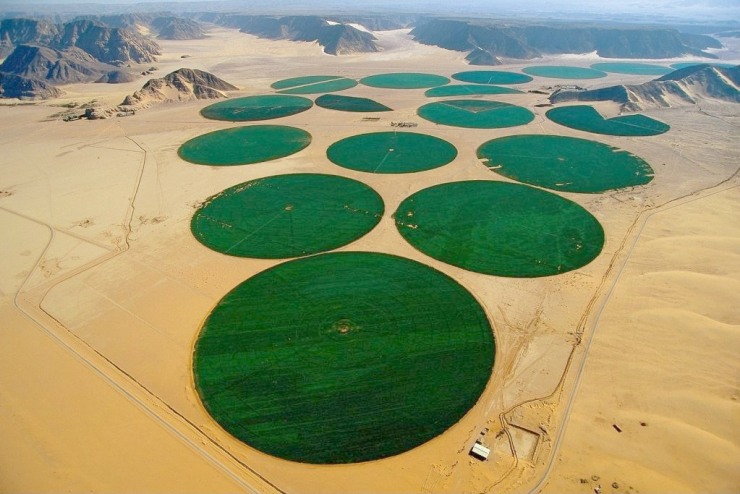
pivot irrigation jordanImage via Manufactured Landscapes blog. A cool site that looks at man-made structures on earth using Google maps.

Libya is not the only Middle Eastern country trying to “green the desert” through the use of irrigation. Jordan is also practicing pivot irrigation (see above image); Israel has been irrigating for years via its patented “drip irrigation” methods through companies like Plastro and Netafim are now being used in arid regions all over the world, even in arch enemy countries like Syria, and other regional countries, including Qatar in the Persian Gulf region which is teaming up with Syria on agriculture projects intended to “green the desert.”

But none of these countries, except for Libya, have these circular pivot irrigated fields which can actually be seen from above by orbiting astronauts. No one really knows how much Libyan President Muammar al-Gaddafi has spent on these projects, which are probably costing a lot more than simply importing the crops his country needs. But when one is sitting on what is still one of the world’s largest oil reserves (at least 10% of the world’s oil)  then anything is possible – as long as the oil holds out.

Photo credit : NASA, US Government, Wikipedia

Read more about efforts to green the deserts:

Doha Bank and UNESCO Join Together to Green the Middle East

DESERTEC Offers Opportunities to Green the Middle East

Drip Irrigation Methods Now Helping Syrian Farmers Grow Crops

Maurice Picow
Maurice Picowhttps://www.greenprophet.com/
Maurice Picow grew up in Oklahoma City, U.S.A., where he received a B.S. Degree in Business Administration. Following graduation, Maurice embarked on a career as a real estate broker before making the decision to move to Israel. After arriving in Israel, he came involved in the insurance agency business and later in the moving and international relocation fields. Maurice became interested in writing news and commentary articles in the late 1990’s, and now writes feature articles for the The Jerusalem Post as well as being a regular contributor to Green Prophet. He has also written a non-fiction study on Islam, a two volume adventure novel, and is completing a romance novel about a forbidden love affair. Writing topics of particular interest for Green Prophet are those dealing with global warming and climate change, as well as clean technology - particularly electric cars.
3 COMMENTS
  1. I think that what you posted was very reasonable. But, what about this?
    what if you typed a catchier post title? I ain’t suggesting your content is not solid., however suppose you added
    a headline that grabbed people’s attention? I mean Libya’s Pivot Irrigation in the Sahara Proves Money Can Do Anything |
    Green Prophet is a little boring. You could peek at Yahoo’s home page and see
    how they write news headlines to grab people interested.
    You might try adding a video or a picture or two to get readers excited about what you’ve written. In my
    opinion, it might make your blog a little livelier.

  2. Qaddafi opted for the Man Made River Project and not De- desalination Plants considerably cheaper because the latter is based on US/Western Technology and he has been wary of their technological support as experienced in the oil sector.
    Yes it has been an expensive project but at least he has not wasted oil money on grand Palaces & other grandiose projects unlike several Arab countries.
    As for pivot irrigation cost, again the idea is to make Libya self sufficient in food. Isn’t Saudi Arabia trying to do the same by growing wheat in the Kingdom?!

    Qaddafi was amongst the few leaders who saw water as a source of next wars and embarked on the GMR project to ensure water supply for his country for decades.

    The West’s ” bogey man ” should be given credit where due!

LEAVE A REPLY

Please enter your comment!
Please enter your name here

TRENDING

Farm To Table Israel Connects People To The Land

Farm To Table Israel is transforming the traditional dining experience into a hands-on journey.

Sink holes from over-watering farmers’ fields

Sinkholes are rapidly appearing in Turkey’s central Anatolian farming region, particularly around Konya and Karapınar. These giant gaping holes in the ground in areas of farmland, known locally as obruk, are not random geological events. They are linked to prolonged drought, climate-driven heat stress, and heavy groundwater extraction for agriculture in one of the country’s most important breadbaskets.

Iran’s holiest city about to run dry as terror chosen over water management

Iran’s second-largest city, Mashhad, is facing an acute water emergency after dam reservoirs feeding the city fell below three percent capacity, according to Iranian state and local media. Officials warn that without rainfall or improved inflows from neighboring Afghanistan, the city’s supply could soon collapse.

Italy’s energy company Eni adds Italian flair for design in industrial fusion reactor

“We have the chance to explore new forms of storytelling about energy,” adds Italo Rota, co-designer of the installation. “We believe that design is a powerful tool to turn a narration into an experience, allowing visitors to sense the energy while being surrounded by a unique atmosphere.”

Ecomondo 2025: Italy’s Green Expo Powers Global Circular Innovation

Each November, a quiet city on Italy’s Adriatic coast becomes the epicenter of the world’s circular economy conversation. What began in 1997 as a local waste management trade show has grown into Ecomondo, a global forum for environmental innovation, resource regeneration, and ecological transition.

Qatar’s climate hypocrisy rides the London Underground

Qatar remains a master of doublethink—burning gas by the megaton while selling “sustainability” to a world desperate for clean air. Wake up from your slumber people.

How Quality of Hire Shapes Modern Recruitment

A 2024 survey by Deloitte found that 76% of talent leaders now consider long-term retention and workforce contribution among their most important hiring success metrics—far surpassing time-to-fill or cost-per-hire. As the expectations for new hires deepen, companies must also confront the inherent challenges in redefining and accurately measuring hiring quality.

8 Team-Building Exercises to Start the Week Off 

Team building to change the world! The best renewable energy companies are ones that function.

Thank you, LinkedIn — and what your Jobs on the Rise report means for sustainable careers

While “green jobs” aren’t always labeled as such, many of the fastest-growing roles are directly enabling the energy transition, climate resilience, and lower-carbon systems: Number one on their list is Artificial Intelligence engineers. But what does that mean? Vibe coding Claude? 

Somali pirates steal oil tankers

The pirates often stage their heists out of Somalia, a lawless country, with a weak central government that is grappling with a violent Islamist insurgency. Using speedboats that swarm the targets, the machine-gun-toting pirates take control of merchant ships and then hold the vessels, crew and cargo for ransom.

Leopoldo Alejandro Betancourt López Turned Ocean Plastic Into Profitable Sunglasses

Few fashion accessories carry the environmental burden of sunglasses. Most frames are constructed from petroleum-based plastics and acrylic polymers that linger in landfills for centuries, shedding microplastics into soil and waterways long after they've been discarded. Leopoldo Alejandro Betancourt López, president of the Spanish eyewear brand Hawkers, saw this problem differently than most industry executives.

Why Dr. Tony Jacob Sees Texas Business Egos as Warning Signs

Everything's bigger in Texas. Except business egos.  Dr. Tony Jacob figured...

Israel and America Sign Renewable Energy Cooperation Deal

Other announcements made at the conference include the Timna Renewable Energy Park, which will be a center for R&D, and the AORA Solar Thermal Module at Kibbutz Samar, the world's first commercial hybrid solar gas-turbine power plant that is already nearing completion. Solel Solar Systems announced it was beginning construction of a 50 MW solar field in Lebrija, Spain, and Brightsource Energy made a pre-conference announcement that it had inked the world's largest solar deal to date with Southern California Edison (SCE).

Related Articles

Popular Categories