The Gulf of Mexico Oil Spill Opens Pandora's Box at Alberta Tar Sands

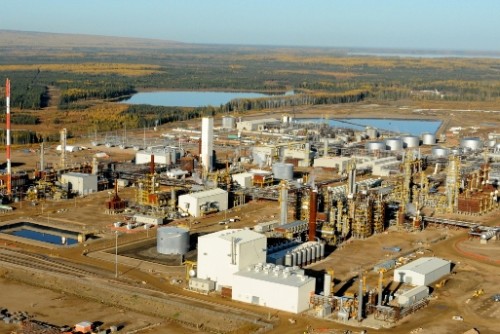
alberta tar sands photoHow can the polluting oil tar sand oil extraction – here Opti Canada’s operations – be better than offshore drilling?

The Gulf of  Mexico oil “leak” is a gusher pouring as much as 3.4 million gallons of oil into the waters every day, scientists estimate in a NY Times story. It’s below the surface what counts. The oil spreading underwater may result in much of this body of water becoming a “dead zone” or void of marine life. This slick could eventually spread into the Caribbean Sea as well as parts of the Atlantic Ocean as well. Government sources and BP have “estimated” something different – some 5,000 – 7,000 barrels of oil per day, that people are being led to believe is escaping in the Gulf.

Could this be one of the planet earth’s worse ecological disasters since creation that rivals the events that spelled the end of the era of the dinosaurs more than 40 million years ago? Finding alternatives, oil purveyors look to Canada’s oil-rich tar sands. But what could be unleashed there in terms of pollution could be worse than the Gulf oil spill.

The Gulf oil event has already made the US and other world governments think seriously about continuing to drill for oil and natural gas under the oceans and seas, which often have to be more than a mile deep before reaching the sea bed, and subject to thousands of tons of underwater pressure.

Finding alternatives to offshore well drilling has already resulted in searching for oil in what are known as oil tar sands, in places like Alberta Canada. These sands, are said to be the “last frontier” for extracting fossil fuels, and despite their own environmental problems are considered as less problematic than offshore oil wells. The environmental issues surrounding the extraction of crude oil from oil tar sands, has already been noted by myself and other Green Prophet writers in which large amounts of steam is sent underground to “free” the trapped oil and bring it to the surface.

The down side of this kind of oil production was also noted in an article in the UK newspaper, The Guardian, that reported on research from the NGO, Friends of the Earth; there are  environmental ramifications of creating synthetic crude oil from bitumen deposits:

“Tar sands – bitumen that is extracted and upgraded to produce synthetic crude – has been heavily criticised for its poor environmental and social outcomes, locally and globally. Canada is currently the only major centre of production but investment is expanding, including by European oil companies such as BP, Shell, Total and ENI.”

What environmentalists are trying to tell people is that the main problem is Mankind’s continued desire to rely on fossil fuels as a major source of our energy needs – instead of trying to put more efforts into developing alternative and renewable energy sources.

Consider the Middle East, where a great deal of the earth’s remaining petroleum reserves are still located; this region also has huge solar energy potential since the sun shines here as much as 340 days a year. Even countries like Saudi Arabia are now beginning to develop solar energy to provide power for desalination plants and other industrial uses.

I shudder to think what could happen if a similar sized well blowout would occur in the eastern Mediterranean or in the Persian Gulf, which is still suffering from the effects of the largest man-made spill that occurred during the 1991 Gulf War.

In the end, the only way to prevent these oil spills, and environmental damage from tar sand oil extraction is to make more concerted efforts to developing alternative and renewable energy. And the sooner, the better.

(Photo above of tar sands via Opti-Canada Inc.)

Read articles dealing with oil tar sands and alternative energy:
Ormat Industries Involved in Alberta Tar Sands Crude Oil Project
Japan and Saudi Arabia Plan Large Plant to Manufacture Desalination Equipment
Ormat Taps into Thermal Volcanic Energy in Indonesia

Maurice Picow
Maurice Picowhttps://www.greenprophet.com/
Maurice Picow grew up in Oklahoma City, U.S.A., where he received a B.S. Degree in Business Administration. Following graduation, Maurice embarked on a career as a real estate broker before making the decision to move to Israel. After arriving in Israel, he came involved in the insurance agency business and later in the moving and international relocation fields. Maurice became interested in writing news and commentary articles in the late 1990’s, and now writes feature articles for the The Jerusalem Post as well as being a regular contributor to Green Prophet. He has also written a non-fiction study on Islam, a two volume adventure novel, and is completing a romance novel about a forbidden love affair. Writing topics of particular interest for Green Prophet are those dealing with global warming and climate change, as well as clean technology - particularly electric cars.
1 COMMENT
  1. I can already see that nobody gives a didly about this subject.
    This is why were are all in the mess we are in now, environmental wise!

LEAVE A REPLY

Please enter your comment!
Please enter your name here

TRENDING

Huge Fish Nursery Discovered Under Freezing Arctic Seas

In 2019, an underwater robot camera exploring the seabed...

Charbone produces first hydrogen at Quebec’s local “model” UHP plant

The Sorel-Tracy site is the first decentralized clean UHP hydrogen production facility in Quebec and is positioned as a model for North America. The plant is part of CHARBONE’s five-phase plan to deploy a network of modular hydrogen production facilities across the continent, supported by the company’s growing specialty-gas distribution platform.

Sex selection kits for embryos available in the US and Canada

We used to be shocked to hear about gender...

Italy’s energy company Eni adds Italian flair for design in industrial fusion reactor

“We have the chance to explore new forms of storytelling about energy,” adds Italo Rota, co-designer of the installation. “We believe that design is a powerful tool to turn a narration into an experience, allowing visitors to sense the energy while being surrounded by a unique atmosphere.”

Iran’s water mafia and thirst for war leaves the country on brink of being dry

Iran’s Lake Urmia, once the Middle East’s largest saltwater lake, has shrunk by 90 percent due to mismanagement, dams, and drought. As Tehran pours billions into foreign conflicts, water activists face repression at home. The crisis mirrors Syria’s drought-driven unrest, showing how water scarcity can destabilize entire regions.

Qatar’s climate hypocrisy rides the London Underground

Qatar remains a master of doublethink—burning gas by the megaton while selling “sustainability” to a world desperate for clean air. Wake up from your slumber people.

How Quality of Hire Shapes Modern Recruitment

A 2024 survey by Deloitte found that 76% of talent leaders now consider long-term retention and workforce contribution among their most important hiring success metrics—far surpassing time-to-fill or cost-per-hire. As the expectations for new hires deepen, companies must also confront the inherent challenges in redefining and accurately measuring hiring quality.

8 Team-Building Exercises to Start the Week Off 

Team building to change the world! The best renewable energy companies are ones that function.

Thank you, LinkedIn — and what your Jobs on the Rise report means for sustainable careers

While “green jobs” aren’t always labeled as such, many of the fastest-growing roles are directly enabling the energy transition, climate resilience, and lower-carbon systems: Number one on their list is Artificial Intelligence engineers. But what does that mean? Vibe coding Claude? 

Somali pirates steal oil tankers

The pirates often stage their heists out of Somalia, a lawless country, with a weak central government that is grappling with a violent Islamist insurgency. Using speedboats that swarm the targets, the machine-gun-toting pirates take control of merchant ships and then hold the vessels, crew and cargo for ransom.

Leopoldo Alejandro Betancourt López Turned Ocean Plastic Into Profitable Sunglasses

Few fashion accessories carry the environmental burden of sunglasses. Most frames are constructed from petroleum-based plastics and acrylic polymers that linger in landfills for centuries, shedding microplastics into soil and waterways long after they've been discarded. Leopoldo Alejandro Betancourt López, president of the Spanish eyewear brand Hawkers, saw this problem differently than most industry executives.

Why Dr. Tony Jacob Sees Texas Business Egos as Warning Signs

Everything's bigger in Texas. Except business egos.  Dr. Tony Jacob figured...

Israel and America Sign Renewable Energy Cooperation Deal

Other announcements made at the conference include the Timna Renewable Energy Park, which will be a center for R&D, and the AORA Solar Thermal Module at Kibbutz Samar, the world's first commercial hybrid solar gas-turbine power plant that is already nearing completion. Solel Solar Systems announced it was beginning construction of a 50 MW solar field in Lebrija, Spain, and Brightsource Energy made a pre-conference announcement that it had inked the world's largest solar deal to date with Southern California Edison (SCE).

Related Articles

Popular Categories