

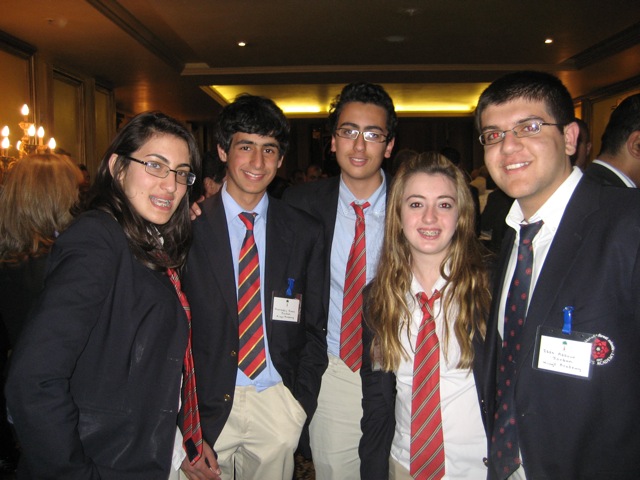
 Jordanian teens work to learn more about Jordan River conservation efforts and practices.
Friends of the Earth Middle East (known as foy-me for its acronym FoEME) have accomplished to develop an unprecedented study of the quality of water in the Jordan River, which they hope will lead to its rehabilitation. Highly polluted from a variety of sources including sewage, and high levels of salinity, FoEME as the only Jordanian, Israel and Palestinian trilateral organization working in partnership for a common goal in the region (theirs is water), plans on taking their study to policy makers to catalyze peace and change.
Presenting their scientific study (links to study) study on what can be done to rehabilitate the lower Jordan River, after a media tour along the Jordan River yesterday with foreign journalists (which I promise to post later), I headed to Jordan to take part in their conference to present the study, which brought out about 200 Jordanian, Israel and Palestinian water experts and government officials from around the world. The atmosphere was positive, the reception very friendly. These are people willing to look forward to the future instead of back to the untold number of Middle East conflicts from the past.
I was hoping to get to meet Princess Sumaya, the daughter of Jordan’s Prince Hassan who was to be a keynote speaker (she cancelled due to illness), but I ended up meeting two princesses and three princes instead. These five teens from the King’s Academy boarding school outside of Amman (pictured above), are working with Friends of the Earth Middle East to study and understand more about the state of the Jordan River.
While most Jordanians and Palestinians shy away from overtly talking about working with Israelis, I asked the teens if it was okay that I mentioned their cooperation with Israeli teens from Beit Shean, Israel, in a story. “That’s the whole point,” they said unanimously in English, thrilled to be recognized for their work with FoEME.
In front of an impressive audience of ambassadors, the region’s water experts, members from the United Nations, EU parliament, USAID and more, these teens bravely stood up on the podium and explained to the group on how they are getting involved to learn more about rehabilitating the Middle East. With video clips that will be put together with movies made by Israeli and Palestinian peers, just getting to the shores of the Jordan River was hard, they told the crowd, talking about how they interviewed locals who lived along the lower Jordan River, which no-one is swimming in, in order to assess the problem with their own eyes.
Today about only 2% of the flow of the Jordan River remains from what it once was in the middle 1800s when it was a mighty river. Today it resembles more of a stream, brook, and trickle in some places; and FoEME working with youth (like these tends), scientists, environmentalists, and economists are putting together local, regional and international plans to clean it up and restore the Jordan River to its former glory.
Today the lower Jordan River below the Sea of Galilee starts with a sewage pipe and ends in a whimper. FoEME, backed by USAID, the Green Environment Fund, the Goldman Fund and the Global Nature Fund are proposing that the countries that border the Jordan River do all in their power to rehabilitate this significant body of water, important for all the monotheistic religions of the world.
While Israel has a “fake” baptismal site at Yardenit, near the Sea of Galilee, it’s really not more than an artificial pond with water pumped to the site from the nearby lake. The real baptismal site is about 100 kilometer downstream At Kaser El Yehud, about 100 km downstream from the source. It’s not accessible from the Israeli side whose military opens it only for popes and media folk, people do risk their lives on the Jordanian side by dunking into the highly polluted river. How can you stop people of faith who’ve come so far for this experience?
Kaser El Yahud in the Israeli-controlled West Bank is believed to be the real baptismal site of Jesus (although whether it was on the east or west bank depends on who you ask). For Jews, the same site is the historical point for Joshua and the Israelites thousands of years ago when they entered the Promised Land leaving Moses behind in Jordan; and in Islam, its shores are believed to contain the burial sites to the Four Companions of the Muslim Prophet Mohammed.
Today the Jordan River is truly a sorry, sorry sight. Land mines, pollution, an overgrowth of non-native reed weeds, political constraints, military presence, and a sheer lack of water in some places, prevent tourists from entering its shores –– and locals from using it. But heroic efforts on behalf of FoEME’s Jordanian, Palestinian, and Israeli staff, plus their volunteers, local networks and youth programs give us all hope that the river will flow once again to its former glory.
To read more about the Jordan River rehabilitation project, please click on the brand new report released today by Friends of the Earth Middle East. It’s long, but worth printing out and reading if you are concerned about this historic river.
::FoEME


Agreed. Maybe some youth from this region could participate somehow in your study and investigation of water for Middle East security. The environmentalists certainly need to be there… FoEME is a great project.
Wonderful to see a coalescing of the young and the old, NGO's and politicians, religion and science. Shows how important the Jordan River is for all these stratas of society and how water can truly be a binding force for cross-border cooperation. Very interesting Karin.