
Tel Aviv Requests Public's Help in Boardwalk Redesign

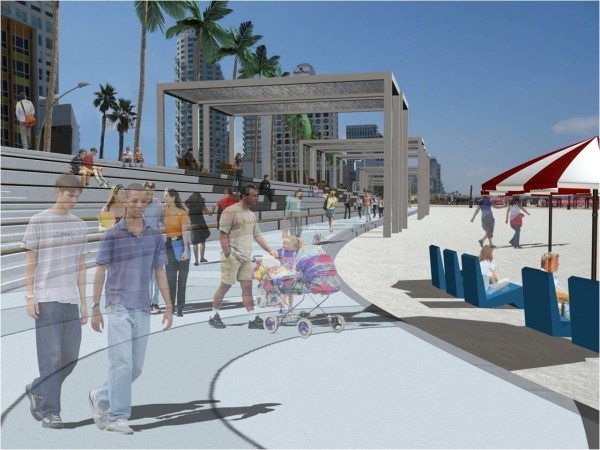
A rendering of Tel Aviv’s new central promenade: stairs leading down to the beach, a paved lower level, shade-providing structures and new sidewalk and beach furniture. (image courtesy of Tel Aviv Municipality)

Two years ago, Tel Aviv presented a plan to redesign its central promenade. The plan – vague, unclear and buried inside another policy proposal – drew plenty of opposition from the public.

Last week, however, an improved version of the plan was presented at a public hearing. Over 100 residents showed up, all eager to make their voices heard. City officials listened to their concerns, and promised to take them into consideration as they draw up the plan’s final version. But neither the process nor the plan itself could please everyone.

Municipal officials and a handful of city council members also attended the meeting, which began with a short presentation by municipal planner Orly Harel, followed by a presentation by Udi Kassif, the architect charged with designing the new boardwalk.

Kassif, of Mayslits Kassif Architects (which was also commissioned to redesign Tel Aviv’s old port), was charged with designing the section of the beach between the Dolphinarium in the south and Gordon Pool in the north. The goal, he said, was to fuse the beach, the boardwalk and the adjacent Herbert Samuel street into a single public space, while connecting the beach to the city.

Among the problems with the current boardwalk, according to the architect, are the many obstacles (including scattered palm trees and benches) to pedestrian traffic, the old fashioned paving stones and street furniture, the wall that exists between the boardwalk and the beach, the haphazard storage spaces along this wall and a large, “unused” strip of sand between the boardwalk and the beach’s main bathing areas.

In order to improve the situation, he proposed removing those obstacles, new paving stones, stairs leading down to the sand instead of the wall that currently exists, new street furniture and shade-providing structures and a paved pedestrian area at the bottom of the stairs that would cover several meters of sand. He also proposed paved handicapped paths to the sea, as well as moving seaside restaurants closer to the boardwalk and away from the beach.

The hundred or so residents in attendance began by listening patiently to the presentation, but soon began losing their patience. The text of Kassif’s presentation, displayed in a small and dense font, was impossible for most to read. A related plan to narrow the adjacent Herbert Samuel Street was not presented at all. And many were outraged at the architects’ claim that parts of the beach were underutilized and could be paved over without inconveniencing anyone.

However, residents were very pleased to hear that the promenade would include a new bike lane (this, in fact, was the only part of the presentation which drew the crowd’s applause).

After the presentations, the audience was divided into small discussion groups, in which everyone was encouraged to contribute their thoughts and ideas, which were duly recorded. City officials promised that some of these suggestions would be integrated into the final designs.

Ira Rozen, a recent graduate of an urban planning program at Tel Aviv University, was disappointed with the event. “The presentation was poor,” he said. “The hall was large and the screen was small and difficult for the crowd to read, even from the front rows.”

Rozen, who wrote his master’s thesis on the privatization of planning in Israel, said the event was typical of participatory planning exercises in Tel Aviv, in which public input is only welcome at the end of the design process.

“It was like: ‘This is what we are going to do, now tell us what you think’,” said Rosen. ” It was clear to everyone that the municipality is not obligated to take anyone’s comments into account, and I think that because of that a lot of people related to the event as a chance to let off steam.”

Jesse Fox
Jesse Fox
Jesse Fox is hoping to complete a graduate degree in urban planning at the Technion sooner rather than later. In the meantime, he is working at green NGO’s,volunteering with African refugees and writing as much as he can to try and get the word out. He is also a regular contributor at TreeHugger.com. Originally from North Carolina, Jesse has lived in Memphis, Boston, Quito and the Arava before finally settling down in Tel Aviv. There he can occasionally be found chilling at the beach. Jesse can be reached at jesse (at) greenprophet (dot) com

LEAVE A REPLY

Please enter your comment!
Please enter your name here

TRENDING

Quintin Tarantino walks on a bike lane in Tel Aviv

Quentin Tarantino lives in Israel now, quietly blending into Tel Aviv life (which is pretty loud and late night!) — until Tel Aviv, of course, notices him.

All 13 Tel Aviv Beaches Reawarded the Prestigious ‘Blue Flag’ for 2025

Reaffirming its leadership in sustainable coastal management, all 13 of Tel Aviv-Yafo’s public beaches have once again earned the prestigious Blue Flag certification for 2025. This honor, awarded by the International Blue Flag Committee and the Foundation for Environmental Education (FEE), recognizes beaches that meet exceptional standards in water quality, safety, accessibility, and environmental education.

Tel Aviv’s mayor Huldai is taking smart phones from schools – his irony in education

Waldorf schools, created by Austria's Rudolph Steiner, are the fastest-growing school system in Israel because of their focus on arts and crafts and their avoidance of technology in the classroom. It’s ironic that Huldai is being praised for pushing a tech-free school environment while his administration shattered a community that has been practicing this philosophy for over a decade.

Tel Aviv is giving away free fruit trees to turn the city into an urban edible forest

Orange trees are everywhere in Jaffa. So are grapes, loquats, and olives. The city is giving away free fruit trees so the entire city will be an edible urban forest

Wave power collector opens at ancient port city on the Mediterranean

Developed by the company Eco Wave Power, the station was built in collaboration with EDF Renewables. The power station is recognized as “pioneering technology” by the Ministry of Energy.  For the first time, electricity generated from sea waves will power the country's national grid—a historic milestone in the country’s renewable energy progress. 

Qatar’s climate hypocrisy rides the London Underground

Qatar remains a master of doublethink—burning gas by the megaton while selling “sustainability” to a world desperate for clean air. Wake up from your slumber people.

How Quality of Hire Shapes Modern Recruitment

A 2024 survey by Deloitte found that 76% of talent leaders now consider long-term retention and workforce contribution among their most important hiring success metrics—far surpassing time-to-fill or cost-per-hire. As the expectations for new hires deepen, companies must also confront the inherent challenges in redefining and accurately measuring hiring quality.

8 Team-Building Exercises to Start the Week Off 

Team building to change the world! The best renewable energy companies are ones that function.

Thank you, LinkedIn — and what your Jobs on the Rise report means for sustainable careers

While “green jobs” aren’t always labeled as such, many of the fastest-growing roles are directly enabling the energy transition, climate resilience, and lower-carbon systems: Number one on their list is Artificial Intelligence engineers. But what does that mean? Vibe coding Claude? 

Somali pirates steal oil tankers

The pirates often stage their heists out of Somalia, a lawless country, with a weak central government that is grappling with a violent Islamist insurgency. Using speedboats that swarm the targets, the machine-gun-toting pirates take control of merchant ships and then hold the vessels, crew and cargo for ransom.

Leopoldo Alejandro Betancourt López Turned Ocean Plastic Into Profitable Sunglasses

Few fashion accessories carry the environmental burden of sunglasses. Most frames are constructed from petroleum-based plastics and acrylic polymers that linger in landfills for centuries, shedding microplastics into soil and waterways long after they've been discarded. Leopoldo Alejandro Betancourt López, president of the Spanish eyewear brand Hawkers, saw this problem differently than most industry executives.

Why Dr. Tony Jacob Sees Texas Business Egos as Warning Signs

Everything's bigger in Texas. Except business egos.  Dr. Tony Jacob figured...

Israel and America Sign Renewable Energy Cooperation Deal

Other announcements made at the conference include the Timna Renewable Energy Park, which will be a center for R&D, and the AORA Solar Thermal Module at Kibbutz Samar, the world's first commercial hybrid solar gas-turbine power plant that is already nearing completion. Solel Solar Systems announced it was beginning construction of a 50 MW solar field in Lebrija, Spain, and Brightsource Energy made a pre-conference announcement that it had inked the world's largest solar deal to date with Southern California Edison (SCE).

Related Articles

Popular Categories