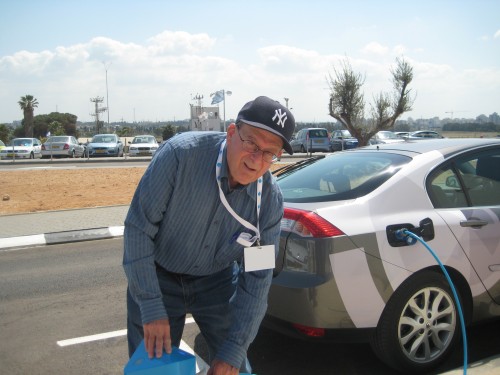

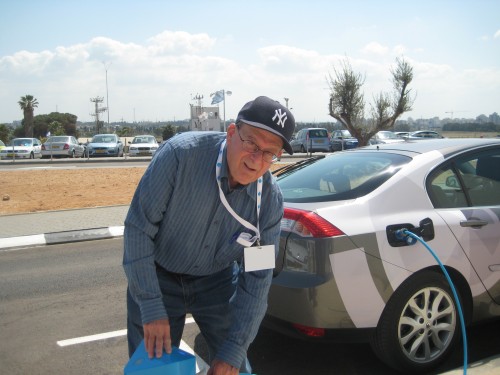
 Maurice charges a Renault Fluence: He’ll have a bit of a wait ’till he owns one.
As a Green Prophet contributer, I decided that it was time to go see Better Place’s educational and test drive electric car center myself. This was important to me, especially since writing several articles dealing with the company’s electric car infrastructure concept – including one where I compared the Better Place Renault-Nissan concept to the one currently being developed by the American General Motors Corporation, and another which provides links with information on how to convert your present gas-eating clunker into an electric powered version.
Getting there:
It’s relatively easy to visit the Better Place Education Center, at Pi Glilot (a junction outside of Tel Aviv, in Israel) as long as one makes a reservation a few days in advance. I decided to go there on a Friday morning where visitors are welcome between 10:00 am and 12:00 pm. Pi Glilot has an “environmental” history of is own ” as the site was formerly a large storage terminal for petroleum, gasoline, and other fossil fuels, most notably LP gas.
It was finally relocated when a terrorist plot to plant a bomb in a fuel delivery truck was almost successful in blowing up the depot which would have resulted in a massive explosion that many experts say would have rivaled a small nuclear bomb.
It’s now used as a storage center for Subaru automobiles, as well as for the Better Place Visitors Center.
The presentation
Upon entering and registering for the 1 1/2 hour presentation, including a photocopy of my driving license being done (required to be able to test drive a car), I was directed with a group of about 25 others to a small auditorium where a personable young man named Roi gave us some background information on the company and its mission to change the way people drive; and as a result, the environment as well.
Sitting on seats recycled from older automobiles (to enhance the philosophy of the Better Place idea, I suppose) we were shown a 20 minute presentation film which began with the history of the automobile, and leading up to the present day with the resulting environmental and economic “costs” of so many fossil fuel powered vehicles in use all over the world.
I was very much impressed by the presentation, which included a hologram image of Better Place founder and CEO Shai Agassi himself (you can see a good article on him at Wired magazine) explaining why it just makes better sense to drive electric powered cars over conventional ones, including hybrid models.
Agassi said that hybrids, which use a combination of both gasoline and electric engines, only save about 20% on fuel costs as well as reduction in air pollution. During the presentation, a Renault-Fluence car that been converted to electric power was “unveiled” to us to emphasize the point that driving such a vehicle need not compromise on personal comfort and practicality; i.e., it’s not a glorified golf cart as many people believe.
The test drive
We were then taken out to where a number of electric cars were sitting, each one attached to its blue “umbilical cord” charging cable that plugs into a charging post. We were explained that on a full charge, a car can travel as much as 160 km (100 miles) before the car’s lithium ion battery pack needs to be either recharged or exchanged at a special battery exchange station, of which at least 100 plan to be located in Israel.
I was then invited to test drive the car, which although was of short duration, was very impressive itself; including electric seats which I haven’t been accustomed to since I owned an extremely gas guzzling Oldsmobile 98 back in the Old Country.
In comparison with a normal gasoline or diesel powered car, the ignition “key” is a rectangular plastic thing that resembles a slim-line cellular phone. Starting up is done by pressing a start button. The pick-up was amazing, and the constant variable transmission moved the car down the test strip like a dragster.
But what was most impressive of all was the near silence, with only a slight whirring sound; sort of like you might hear when riding an electric powered “senior citizen vehicle” or golf cart, which I mentioned to the young guide who went along with me.
“It goes faster than a golf cart, doesn’t it?” he mused, to which I most heartily agreed.
< < Off I Go
Needless to say, everyone who took part in the presentation went away with a very enlightening impression as to what the future of driving may soon be. Roi told us that his company believes that by the year 2030, the majority of cars on the road in Israel, will be electric or powered by some alternative to fossil fuels. Israel is the first country that will have a suitable infrastructure in operation to run these cars, according to Better Place.
The main challenges besides public education towards electric cars will be to have enough electricity available to run them; as well as all the modern appliances that people in Western countries, especially here in Israel, are now using as part of their normal lives.
It was mentioned during the presentation that new power plants will have to be constructed, including ones which will operate on solar energy.
“Cleaner” fuels such as natural gas will also be used for new plants as I noted in my previous article in which new natural gas wells are proposed to be drilled offshore.
While not as environmentally friendly as solar energy, natural gas will provide a much cleaner fuel than using oil or coal. Solar energy will definitely be part of Better Place’s idea for making driving a much more environmentally sound pastime than it is now. As Roi added, “After all, what Israel has plenty of is sunshine.”
More Better Place articles:
Will Better Place Partner With the Chinese to Make the Chery?
Better Place Technology and the New Nissan Leaf
Better Place Receives Investment Fuel from HBSC
Update:
Tel Aviv University MBA students test drive the Renault-Nissan Better Place car (video):
[youtube]http://www.youtube.com/watch?v=9p70ITEDJ3w[/youtube]