
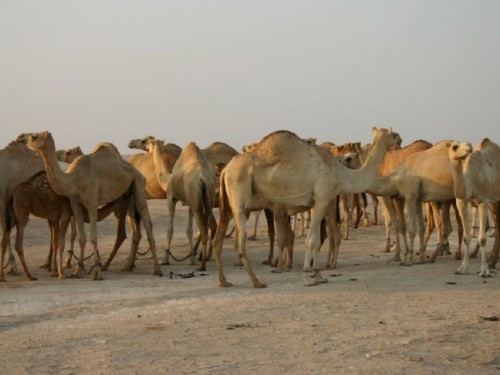
Abu Dhabi Rich Pay Millions For Camels While Arab World Stays Poor

The price a pedigree camel fetches could fuel a small town. Is it moral for camel races to continue, while much of the Arab world lives in poverty?

Walk a mile for a camel? It certainly seems like rich people living in Abu Dhabi and other UAE states are more than willing to do this – especially when the camels in question are pedigree racing dromedaries used for sport in the Sheikdom and other locations in the Middle East.

While possessing and racing these “splendid beasts,” as Lawrence of Arabia once referred them to be, is not really in itself environmentally damaging, spending so much money on them is an issue; especially if this kind of eccentric hobby is at the expense of abuse to the animals themselves and to children who care for and even race these ships of the desert.

The situation regarding children being forced to become “camel jockeys” became so serious that under pressure of international organizations such as the UN ‘s UNICEF children’s relief organization, camel racing by underage riders became illegal in 2005. And less than a year later, a conference was held in Riyadh, Saudi Arabia, to make camel racing using children a criminal act.

So taking all of this into account, you might wonder why camel breeding festivals are still held in Emirate states like Abu Dhabi, where recently a prized breeding camel fetched a hefty price of 10 million dirham ($2.7 million); and the wealthy purchaser of this expensive dromedary bought two more as well, for a combined price of more than $6.5 million?

One might expect this kind of camel trading to take place in Saudi Arabia, where camels are still considered as a symbol of wealth. But this is Abu Dhabi, which like Dubai is now supposed to be more enlightened and thus interested in environmental and clean technology projects such as its well-publicized Masdar City,  whose ecological virtues we have featured in Green Prophet on numerous occasions.

I might add that Abu Dhabi also engineered the Masdar Clean Tech Fund which recently completed it’s first successful investment offering of more than $265 million.

Still, this is the Middle East, where camels are still very much a part of the local scene. And after all, prized race horses, including breeding mares, are sold for similar prices in many parts of the world, and purchased by the wealthy, including Arabs. But even though camel racing with child jockeys is supposedly illegal in places like the UAE and Saudi Arabia, it undoubtedly continues, as does human trafficking of women and children, now considered to be one of the most lucrative financial operations in the world today.

Getting back to the subject of camel trading in Abu Dhabi, this year’s festival even included contests like the most attractive “camel beauty queen,” the winner of which won a prize of $10 million. The camel trading market has even remained stable, despite the disastrous effects of the worldwide recession on the local real estate markets, especially in Dubai.

And what is known as the Al Ain Camel Market, near Dubai is considered to be a national heritage.

There are a lot of good qualities to this animal, besides being used for sport. Camels have been used to both carry loads and for transportation for more than 4,000 years. Their meat and milk are consumed with relish; and their hair and hides used to make clothing and for the walls of Bedouin tents. And last of all, their dung is used to make campfires to keep people warm on cold desert nights, as well as for cooking. But to pay so much money to own them, while many people are going hungry?

It might well be prudent for some of this camel wealth to be spread around to help improve the welfare of the children and their families who were (and maybe still are) involved in being camel jockeys, for the pleasure and enjoyment of the rich.

Images via Fohn; Dreamsofdubai.

More Mid East animal articles worth reading:
Circus Animals Brought to Lebanon Found Abused
Kosher Turkeys “Going to the Wolves” in Tel Aviv
Egypt Culls 300,000 Pigs in Response to Swine Flu Scare

Maurice Picow
Maurice Picowhttps://www.greenprophet.com/
Maurice Picow grew up in Oklahoma City, U.S.A., where he received a B.S. Degree in Business Administration. Following graduation, Maurice embarked on a career as a real estate broker before making the decision to move to Israel. After arriving in Israel, he came involved in the insurance agency business and later in the moving and international relocation fields. Maurice became interested in writing news and commentary articles in the late 1990’s, and now writes feature articles for the The Jerusalem Post as well as being a regular contributor to Green Prophet. He has also written a non-fiction study on Islam, a two volume adventure novel, and is completing a romance novel about a forbidden love affair. Writing topics of particular interest for Green Prophet are those dealing with global warming and climate change, as well as clean technology - particularly electric cars.
24 COMMENTS

LEAVE A REPLY

Please enter your comment!
Please enter your name here

TRENDING

Which Occupational Therapy Activities Are Best for Toddlers’ Development?

There are plenty of art skills from Montessori schooling that are helpful in occupational therapy settings

Microplastics Are Becoming Superbug Highways — New Study Warns Beachgoers to Wear Gloves

Prof. Pennie Lindeque added that microplastics “act as carriers for antimicrobial-resistant bacteria, enhancing their survival and spread… each particle becomes a tiny vehicle capable of transporting pathogens from sewage works to beaches, swimming areas and shellfish-growing sites.”

Who gave the first kiss?

When you experience your first kiss you might feel like you are the first in the world to feel that way. Kissing, scientists say, occurs in a variety of animals (even if today it's not in every culture), and it presents an evolutionary puzzle: kissing, a learned behavior, carries high risks, such as disease transmission like herpes and hepititis, while offering no obvious reproductive or survival advantage.

Biodiversity Blueprint Set for 2026

If we seize this moment, the 2026 review can catalyse a new wave of finance (see Green Finance mechanisms in the UAE), innovation and policy coherence — and move us closer to the vision of a nature-positive world by 2050. If not, the checkpoint risks becoming another missed opportunity while ecosystems, livelihoods and economies continue to degrade.

UAE Green Finance Report 2025

Masdar is the the UAE’s flagship renewable energy company. Compare it to Neom in Saudi Arabia. Masdar has become one of the world’s most active clean energy investors, with projects in more than 40 countries across six continents. Established in 2006 and jointly owned by ADNOC, Mubadala, and TAQA, Masdar operates and develops solar, wind, and green hydrogen projects with a current portfolio exceeding 50 gigawatts of capacity. Masdar also buys companies, and paid $50 million for this US business Terra-Gen last year. 

Qatar’s climate hypocrisy rides the London Underground

Qatar remains a master of doublethink—burning gas by the megaton while selling “sustainability” to a world desperate for clean air. Wake up from your slumber people.

How Quality of Hire Shapes Modern Recruitment

A 2024 survey by Deloitte found that 76% of talent leaders now consider long-term retention and workforce contribution among their most important hiring success metrics—far surpassing time-to-fill or cost-per-hire. As the expectations for new hires deepen, companies must also confront the inherent challenges in redefining and accurately measuring hiring quality.

8 Team-Building Exercises to Start the Week Off 

Team building to change the world! The best renewable energy companies are ones that function.

Thank you, LinkedIn — and what your Jobs on the Rise report means for sustainable careers

While “green jobs” aren’t always labeled as such, many of the fastest-growing roles are directly enabling the energy transition, climate resilience, and lower-carbon systems: Number one on their list is Artificial Intelligence engineers. But what does that mean? Vibe coding Claude? 

Somali pirates steal oil tankers

The pirates often stage their heists out of Somalia, a lawless country, with a weak central government that is grappling with a violent Islamist insurgency. Using speedboats that swarm the targets, the machine-gun-toting pirates take control of merchant ships and then hold the vessels, crew and cargo for ransom.

Leopoldo Alejandro Betancourt López Turned Ocean Plastic Into Profitable Sunglasses

Few fashion accessories carry the environmental burden of sunglasses. Most frames are constructed from petroleum-based plastics and acrylic polymers that linger in landfills for centuries, shedding microplastics into soil and waterways long after they've been discarded. Leopoldo Alejandro Betancourt López, president of the Spanish eyewear brand Hawkers, saw this problem differently than most industry executives.

Why Dr. Tony Jacob Sees Texas Business Egos as Warning Signs

Everything's bigger in Texas. Except business egos.  Dr. Tony Jacob figured...

Israel and America Sign Renewable Energy Cooperation Deal

Other announcements made at the conference include the Timna Renewable Energy Park, which will be a center for R&D, and the AORA Solar Thermal Module at Kibbutz Samar, the world's first commercial hybrid solar gas-turbine power plant that is already nearing completion. Solel Solar Systems announced it was beginning construction of a 50 MW solar field in Lebrija, Spain, and Brightsource Energy made a pre-conference announcement that it had inked the world's largest solar deal to date with Southern California Edison (SCE).

Related Articles

Popular Categories