
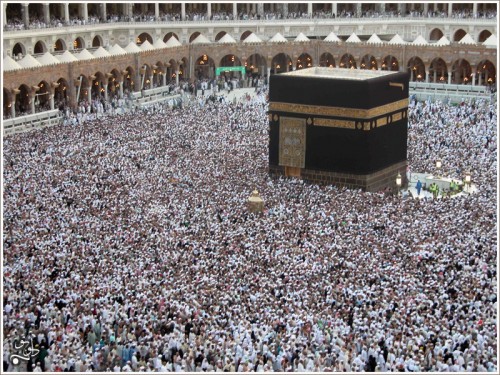

 Muslims succumb to swine flu during annual Hajj pilgrimage.
One of the biggest concerns to Saudi Arabian health authorities has unfortunately become a reality at this year’s Hajj pilgrimage, now underway in Islam’s holiest cities of Mecca and Medina.
This year’s pilgrimage, which began on Saturday, November 21, has already claimed at least four lives to the H1N1 influenza (swine flu) virus, according to an article published in Al Jazeera.
The article , which came out last Saturday, at the beginning of week long event, noted that despite efforts being made by 15,000 Health Ministry workers to screen out persons who might be infected by the H1N1 virus, 4 people have already succumbed to the disease and that another 4 were in hospital in “critical condition.”
Another 20 pilgrims had become infected, but had fully recovered. A Health Ministry spokesman was quick to point out that all four persons who died, 3 in Medina and one in Mecca, all suffered from serious illnesses ranging from cancer to various respiratory illnesses.
None of the four people who died had taken a preventive H1N1 vaccine. But bearing this in mind, it is very likely the vaccine might not have been available to them as they came from countries which included Morocco, Sudan, and Nigeria.
Health workers are now trying to determine whether these individuals already had flu symptoms when they arrived, some of them several days before the formal pilgrimage began.
The deaths were a call for alarm in order to find out whether the various screening methods for finding people with tell-tale symptoms were in place when these people arrived. These include thermal cameras which can detect a person with higher than normal temperatures, which were installed at both airports and seaports, where most of the Hajj pilgrims enter the Kingdom.
These cameras were first used in quantity during the previous SARS disease outbreak that began in China in November, 2002, and spread to a number of countries before dissipating in July, 2003.
Participants have now reached the high point of the pilgrimage, the rite of “witnessing the Prophet” at Mt. Arafat; and most likely a few more participants may have died from complications brought on by the virus by now as well.
For this reason, Saudi health authorities are asking pilgrims not to eat in public places and are making efforts to distribute face masks and disinfectants. Concern among Saudi health officials in regards to the H1N1 virus was noted earlier this month in our Green Prophet article dated November 8 in which Saudi Health Ministry and American Center for Disease Control officials were working together to provide better screening methods for detecting persons who might be infected with the disease.
Still, it must be taken into account that with more than 3 million people participating in this year’s Hajj, it is virtually impossible to check everyone arriving as many come by bus and by private car. Due to so many people being brought together for the week long event, a number of them are killed during stampedes (especially during the rite of Stoning the Devil) and by acts of violence.
The concern by health officials has been made even more trying due to difficult weather conditions during the week that has included moderate to heavy rain showers and lower than average temperatures.
We at Green Prophet wish the pilgrims a healthy conclusion to this very important religious rite that must be undertaken by religious Muslims at least once in a lifetime; as well as a happy Eid al Adha (Feast of the Sacrifice) holiday at the pilgrimage’s conclusion.
More on greening your Hajj:
Swine Flu Concerns for Hajj Pilgrims
Go To Medina and Mecca on Fast Train
Saudi Adds Eco-Guards to Its Police Force
Photo via mo7amaD



[…] Solar panelling and reusable drinking water bottles have already taken a firm role; we expect to hear details on cleaner travel arrangements and health procedures to prevent contagious diseases such as 2009′s Hajj swine flu outbreak. […]
[…] on greening your Hajj: Greening Hajj and Medina for the Muslim World Swine Flu Finds Hajj 2009 Go to Medina and Mecca on Hajj on Fast Sustainable Train Saudi Arabia Adds Eco-Guards to Its Police […]
[…] swine flu is taking its toll in the Middle East, not immune to the deadly virus that tends to attack younger, healthier people, and those who are […]
Swine Flu Finds Hajj 2009 http://www.greenprophet.com/2009/11/27/13848/swine-flu-hajj/
RT @Milieunet: Swine Flu Finds Hajj 2009 http://www.greenprophet.com/2009/11/27/13848/swine-flu-hajj/
#SwineFlu #H1N1 #News Swine Flu Finds Hajj 2009: http://url4.eu/pyUW
Swine Flu Finds Hajj 2009: Green Prophet (blog)
One of the biggest concerns to Saudi Arabian health authorities has… http://bit.ly/6rvgMk
Swine Flu Finds Hajj 2009: Green Prophet (blog)
One of the biggest concerns to Saudi Arabian health authorities has… http://bit.ly/7wvzxw
#SwineFlu Finds Hajj 2009 – Green Prophet (blog) : http://bit.ly/8AfZyE
News:: Swine Flu Finds Hajj 2009 http://bit.ly/6KddCG