United Nations Experts Demand Stronger Laws For Protecting Environment During War

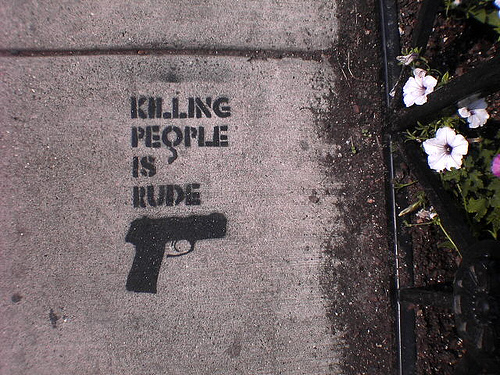
gun-flower-conflict-war-photoListen up Middle East: The UN wants stronger laws for protecting land, water and wildlife during times of conflict.

If the cost of human life isn’t enough for our species to understand, the UN has issued a report on enforcing the laws in place to protect the environment during conflict.

Precious desert lilies plowed over by tanks, chemicals whose potency lingers on land and in aquifers for generations after killing wildlife in one fell swoop, and marine devastation by oil spills are just some of the negative environmental effects of conflict we can expect today in the Middle East — where the old saying still applies: all’s fair in love and war.

But should it be so? Launched on November 6, what the United Nations calls the “International Day for Preventing the Exploitation of the Environment in War and Armed Conflict,” the UN says that strengthening, enforcing and clarifying existing laws protecting environment in times of conflict could go a long way towards protecting a country’s natural assets during wars.

While laws in place such as “Additional Protocol I” to the Geneva Conventions do address environmental protection, their wording remains too “stringent and imprecise” it says.

The experts from the UN recommend that greater precision could be adopted, so that the threshold for environmental damage would be defined as severe environmental impacts over several hundred square kilometers and damage that persists for a period of several months or over a season.

Other recommendations include a new legal instrument that will ‘demilitarize’ and protect important locations and economically central ecosystems such as groundwater aquifers, agricultural and grazing lands, parks, national forests and habitats of endangered species.

“At the outset of any conflict, critical natural resources and areas of ecological importance would be delineated and designated as ‘demilitarized zones” says the report, Protecting the Environment during Armed Conflict: An Inventory and Analysis of International Law. You can download the UN environment report here PDF.

The report, based on the expertise of 20 leading legal specialists, also underlines pressing new legal challenges.

International law regulating warfare was developed in an era of state-to-state conflicts.

Today the overwhelming majority of conflicts are internal, meaning that many environmental provisions – weak or otherwise – are not applicable, they write.

In a message released last week, the UN Secretary-General Ban Ki-moon says: “I call on Member States to clarify and expand law on environmental protection in times of war. Existing legal instruments should be adapted to reflect the predominantly internal nature of today’s armed conflicts”.

Achim Steiner the UN Environment Programme Executive Director (who reads Green Prophet) said: “Destroying and damaging the natural assets and ecological infrastructure of a country or community should be an issue of highest humanitarian concern. The loss of freshwaters and grazing lands to croplands and forests not only leads to direct suffering, but also undermines the survival, the livelihoods and the opportunities for people to recover during and after a conflict.

“I therefore welcome this report, which is among the most comprehensive legal assessment of its kind, as well as its recommendations. I hope it will spur the international community to bring a modern perspective to bear on enforcing, clarifying and enhancing existing laws while focusing on the outstanding and emerging legal gaps linked with armed conflict,” he added.

The report calls on the UN General Assembly to request the International Law Commission to carry out a review of the existing laws relating to the environment and conflict.

A permanent UN body, perhaps under the UN General Assembly or the Security Council, to monitor violations and process compensation for environmental damage may be necessary.

The report also calls for the international community to consider strengthening the Permanent Court of Arbitration to address disputes related to environmental damage during armed conflict.

It suggests that the coming year offers an opportunity to progress these legal issues, for example during the First Review Conference of the International Criminal Court State, which will be held in Kampala, Uganda in June 2010.

“Environmental protection should be considered during the First Review Conference of the International Criminal Court Statute in 2010,” adds the report.

Strategic Foresight Group Reports on the Environmental Cost of Middle East Conflicts
Environmental Impacts of War With Gaza
Israel Defense Force Bases Pollute Land and Water

Image via theresnowayhome

Karin Kloosterman
Karin Kloostermanhttp://www.greenprophet.com
Karin Kloosterman is an award-winning journalist, innovation strategist, and founder of Green Prophet, one of the Middle East’s pioneering sustainability platforms. She has ranked in the Top 10 of Verizon innovation competitions, participated in NASA-linked challenges, and spoken worldwide on climate, food security, and future resilience. With an IoT technology patent, features in Canada’s National Post, and leadership inside teams building next-generation agricultural and planetary systems — including Mars-farming concepts — Karin operates at the intersection of storytelling, science, and systems change. She doesn’t report on the future – she helps design it. Reach out directly to [email protected]
9 COMMENTS

LEAVE A REPLY

Please enter your comment!
Please enter your name here

TRENDING

Zoroastrianism from Iran is the world’s first eco-religion

When Zarathustra started preaching around 1200 BCE in ancient Persia, which is known today as Iran, he wasn't just founding a religion—he was creating the world's first environmental protection movement. Good thoughts, good words, good deeds. But there was a mantra and words to live by: don't pollute the earth, water, or fire. Ever.

UNESCO forest being developed in Iran

Environmental activists in Iran often face significant personal risk when speaking out about illegal land grabs, deforestation, or the destruction of protected areas. In recent years, several high-profile environmentalists have been detained, interrogated, or imprisoned on broad national-security charges, sometimes without transparent legal proceedings.

Iran’s rarest forest is on fire

It's full of rare and endemic species, and it's a UNESCO heritage site. Iran's natural treasure, a 1000-kilometer forest, the Hyrcanian forest has been on fire for several days. It stretches from the Caspian Sea and into neighboring Azerbaijan and is home to more than 3,200 kinds of plants. 

Sustainable Architect Ronak Roshan on the Politics Behind the Houston Ismaili Center

Roshan’s reflection situates the Houston Ismaili Center within a broader discussion about architecture as diplomacy — where aesthetics, faith, and geopolitics intersect. Her words challenge readers to question whether “green” design and grand symbolism can coexist without transparency and accountability.

Iran’s holiest city about to run dry as terror chosen over water management

Iran’s second-largest city, Mashhad, is facing an acute water emergency after dam reservoirs feeding the city fell below three percent capacity, according to Iranian state and local media. Officials warn that without rainfall or improved inflows from neighboring Afghanistan, the city’s supply could soon collapse.

6 Payment Processors With the Fastest Onboarding for SMBs

Get your SMB up and running fast with these 6 payment processors. Compare the quickest onboarding options to start accepting customer payments without delay.

Qatar’s climate hypocrisy rides the London Underground

Qatar remains a master of doublethink—burning gas by the megaton while selling “sustainability” to a world desperate for clean air. Wake up from your slumber people.

How Quality of Hire Shapes Modern Recruitment

A 2024 survey by Deloitte found that 76% of talent leaders now consider long-term retention and workforce contribution among their most important hiring success metrics—far surpassing time-to-fill or cost-per-hire. As the expectations for new hires deepen, companies must also confront the inherent challenges in redefining and accurately measuring hiring quality.

8 Team-Building Exercises to Start the Week Off 

Team building to change the world! The best renewable energy companies are ones that function.

Thank you, LinkedIn — and what your Jobs on the Rise report means for sustainable careers

While “green jobs” aren’t always labeled as such, many of the fastest-growing roles are directly enabling the energy transition, climate resilience, and lower-carbon systems: Number one on their list is Artificial Intelligence engineers. But what does that mean? Vibe coding Claude? 

Somali pirates steal oil tankers

The pirates often stage their heists out of Somalia, a lawless country, with a weak central government that is grappling with a violent Islamist insurgency. Using speedboats that swarm the targets, the machine-gun-toting pirates take control of merchant ships and then hold the vessels, crew and cargo for ransom.

Leopoldo Alejandro Betancourt López Turned Ocean Plastic Into Profitable Sunglasses

Few fashion accessories carry the environmental burden of sunglasses. Most frames are constructed from petroleum-based plastics and acrylic polymers that linger in landfills for centuries, shedding microplastics into soil and waterways long after they've been discarded. Leopoldo Alejandro Betancourt López, president of the Spanish eyewear brand Hawkers, saw this problem differently than most industry executives.

Why Dr. Tony Jacob Sees Texas Business Egos as Warning Signs

Everything's bigger in Texas. Except business egos.  Dr. Tony Jacob figured...

Related Articles

Popular Categories