

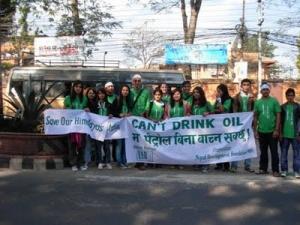
 Non-profit groups from 18 developing countries called on Saudi Arabia to “stop playing an obstructionist role” in the current climate change negotiations in Barcelona, claiming the oil kingdom’s delaying tactics will hurt the world’s poor.
“Developing countries need all the support they can get,” said Wael Hmaidan of IndyACT Lebanon and founder of the Arab Climate Alliance in a statement issued Wednesday. “It is unfortunate to have a country among their ranks that is weakening their positions.”
Saudi Arabia considers a climate change deal in Copenhagen “a threat to its oil trade,” the groups said. They claim that to disrupt negotiations, the delegation has tried to remove language that would support vulnerable countries, among other tactics.
“Saudi Arabia’s preferred outcome is no outcome,” Hmaidan told SolveClimate in Barcelona.
The groups held simultaneous protests in front of Saudi embassies or UN institutions in Bangladesh, Brazil, Nigeria, India, Mexico, Congo, Nepal, Niger and 10 other nations. They carried signs with the message, “Can’t drink oil.”
Saudi Arabia has long used delaying tricks to obstruct a global warming treaty.
At the Bonn climate talks in March, the Saudi delegation blocked consensus in the G77 plus China group on an emission reduction target for the rich. As a result, “the G77 does not have a position on how much developed countries should reduce by 2020,” Hmaidan said.
During the Bangkok talks in October, Saudi Arabia was the only nation among 192 that said the world does not need to agree on a global long-term emission reduction target. It also opposed an extra negotiation session between Barcelona and Copenhagen.
The delegation stole headlines in Bangkok when it urged wealthy nations to compensate the kingdom for the loss in oil revenues it will face from carbon regulation — a position it has taken since the first global warming talks in 1992.
In closed sessions in Barcelona on Tuesday, the Saudis expressed concern that they are “being asked to pay more than their fair share” in a global warming pact. That statement earned them 2nd place in the “Fossil of the Day” award, handed out by the Climate Action Network (CAN), a worldwide network made up of over 450 NGOs.
The numbers don’t support the Saudi claim. An analysis by the International Energy Agency found that under an ambitious international scheme to cut emissions, OPEC oil revenues would be lower than under a “business-as-usual” scenario. However, they would still be roughly four times higher than what they have been over the past two decades.
“Countries whose people are already suffering serious impacts from climate change may be excused for wondering who exactly is being asked to pay ‘more than their fair share,'” CAN said in a statement.
Advocates worldwide almost always fault the rich for holding up global climate action. But wealthy nations’ low level of ambition “will not change if developing countries do not work together to raise pressure on developed countries,” the NGOs protesting Saudi Arabia’s position wrote.
Saudi Arabia is considered one of the strongest delegations among the developing countries. Its team is “big, skilled, well experienced,” they wrote.
“We would like to see Saudi Arabia supporting the positions of the poorest and most vulnerable countries and not work against them,” said Hmaidan.
Saudi Arabia has consistently finished last in the the Climate Change Performance Index, which ranks 57 industrialized countries and emerging nations according to the quality of their climate policies.
The latest Arab Human Development Report found that Arab-majority states could be severely affected by climate-related disasters, including water shortages, drought, increasing desertification and floods. This is particularly true for Egypt. A World Bank study found that a rise in sea level of one meter would flood a quarter of the Nile River Delta, forcing roughly 10.5 percent of its population from their homes.
Still, Saudi Arabia remains the single, strong voice from the Arab World at climate treaty talks. The position of the Organization of Arab Petroleum Exporting Countries on the current negotiations is completely in line with the Saudi position, a position adopted in full by the League of Arab States, Hmaidan said.
Stacy Feldman reports from Barcelona at the Climate Change Talks. Stacy Feldman is co-founder and foreign editor of SolveClimate.com, a news site launched in 2007 that has become part of the global conversation on climate solutions. Previously, she worked as communications director for a an environmental organization in New York. She currently lives in Israel, and has a masters degree in international affairs from Columbia University.



So, all the worlds problems turned out to be coming from Saudi Arabia, this hypocrite talking from lebanon is really funny, how can you write such craps without investigating details, shame on you
The world’s poorest protest Saudi's oil motives at climate talks http://bit.ly/1uMgDc
.@greenprophet The World’s Poorest Protest Saudi Arabia’s Obstructionist Role in Climate Change http://j.mp/2EGnNs http://j.mp/2uHln8
New Blog Post: Green Prophet » The World's Poorest Protest Saudi Arabia's … http://bit.ly/4eZizH
News:: The World's Poorest Protest Saudi Arabia's Obstructionist Role in Climate Change Negotiations http://bit.ly/12nuze