
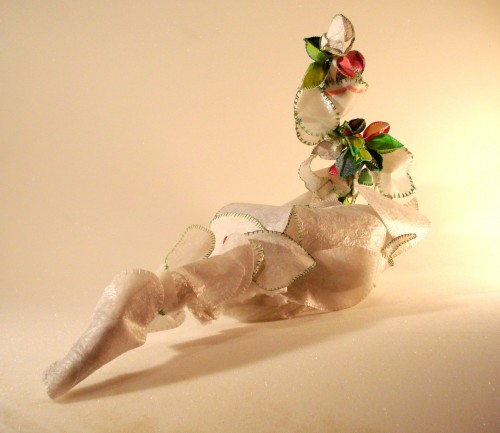

 Think Again is a series that provides fun ideas for how to reuse items in your home that you would normally throw out or recycle. Reusing is higher on the “green” food chain than recycling, because getting another use out of an object is always more effective than spending the energy to recycle it. Plus, trying to reuse can force us to be creative!
Since we’ve featured so many plastic bag upcycling designers here on Green Prophet lately (such as Inbal Limor whose work is shown above, Limor Matityahoo, and Tali Gordon Bleicher), we thought you may be itching to learn this technique yourself.
Of course, having no plastic bags lying around your house is ideal. But even the strictest cloth bag carrying environmentalist probably has a few. By fusing them and making them sturdier, you can extend their life and make sure they stay out of the landfill for a longer period of time.
The technique is surprisingly VERY easy. Fusing the plastic bags doesn’t require any special equipment other than an iron and once you’ve fused the bags you have a cloth-like material that you can do pretty much anything with. If you’re struggling for ideas, you could use the fused plastic to make a drawstring bag such as the one we featured on Think Again last week.
For this project you will need:
1. Plastic bags
2. Scissors
3. Paper that is big enough to cover your plastic bags
4. Iron and ironing board
5. Ventilating fan
Seeing is believing, so the best way to learn this technique is with a video tutorial. Thankfully, Etsy has made a great one. Check out the clip below:
[youtube]http://www.youtube.com/watch?v=PNziDXtm1SA[/youtube]
Got any ideas for what to do with your plastic bags once they’re fused? Please share in the comments section below.
Read about other Think Again projects::
Think Again: Strike Up a Matchbox Inspired Recycled Notebook
Think Again: What to Do With That Old Pair of Jeans
Think Again: Fill All Those Empty Glass Jars with Light


[…] Transform Junk Mail Into Beautiful EnvelopesThink Again: What to Do With That Old Pair of JeansThink Again: How to Fuse Your Plastic Bags So You Can Make… Fill in a BlankThink Again: Strike Up a Matchbox Inspired Recycled Notebook This entry was posted in Environment […]
[…] shopping bags. There does seem to be a common trend among these designers, though, in that they fuse plastic bags together in order to make them more durable, usable, and […]
[…] Design from Israel at Milan Design Week Bag It Up: Inbal Limor Recycles Plastic Bags Into High Art Think Again: How to Fuse Your Plastic Bags so You Can Make… Fill in the Blank AKPC_IDS += […]
RT: recicleideias Mais ideias para fazer com sacolinhas fundidas: http://ow.ly/Nq1y #reciclesuasideias
Mais ideias para fazer com sacolinhas fundidas: http://ow.ly/Nq1y #reciclesuasideias
RT @recicleideias: Mais ideias para fazer com sacolinhas fundidas: http://ow.ly/Nq1y #reciclesuasideias
Think Again: How to Fuse Your Plastic Bags so You Can Make… Fill in the Blank http://ow.ly/15SNyF
.@greenprophet Think Again: How to Fuse Your Plastic Bags so You Can Make… Fill in the Blank. Think Again is a series http://j.mp/lUq6M