
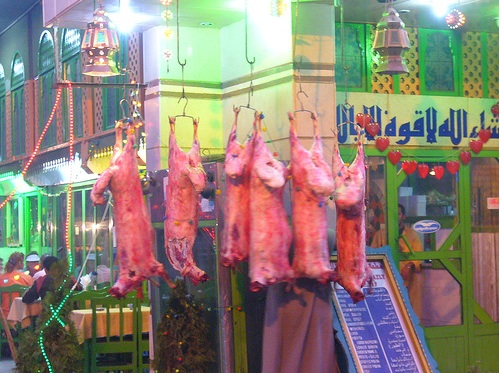

 The massive swine flu cull in Egypt has impacted the city’s garbage collectors, the Zabaleen. Normally they fed organic waste to the pigs. Now what?
Not long ago Green Prophet reported the Egyptian government’s plan to cull the country’s 300,000 pigs as panic of the swine influenza spread across the world.
Now the effects of the massive cull, which was criticised by international agencies and within Egypt itself, are being felt – by both Egyptians who rely on pigs for their livelihoods, and the environment which has been burdened with thousand of extra tons of rotting organic waste that was previously fed to the pigs.
According to a report in the International Herald Tribune, the government said that the cull was not just to prevent swine flu (which had not been detected in Egypt), but also to clean up the zabaleen, Christian Egyptians who make a living from the unenviable task of sorting and collecting Cairo’s garbage, including feeding food waste to their pigs.
The authorities say it’s an attempt to allow the zabaleen (a word that shares the same root as the Hebrew for garbage, zevel) to live in more sanitary conditions, a claim rejected by the zabaleen and their supporters.
“They [the government] don’t have a good understanding of what this means to the livelihood of the rubbish collectors,” says Syada Greiss, a member of Parliament and chairwoman of the Association for the Protection of the Environment.
But killing the swine also means killing off a system for recycling organic waste which dates back to the 1940s. Associations representing the zabaleen estimate that they collect 6,000 of trash a day, 60% of which is food waste.
So where will all the rotting fruit and veg go? “They expect me to pay to have a carter take this away,” says Faris Samir, 22, whose extended family of 33 lost their income when the police took away their pigs.
“Forget it. I will throw it anywhere.”
Egypt’s short-sightedness and paucity of recycling infrastructure reminds me of Israel’s long-forgotten national composting system (see Alon Tal’s seminal Pollution in a promised land). The scheme once transformed food waste into agricultural fertiliser until it was scrapped decades ago when polluting synthetic nitrogen fertiliser was considered “cheaper” than the organic option.
The only option for dedicated Israeli composters is to seek out one of the handful of community-run compost sites – an irony when the skyrocketing price of artificial fertiliser (linked to fossil fuels) is putting to rest the myth of “cheap” industrial farming.




[…] relied on pigs to handle it, until 2009, when the Swine Flue held the world in its grip, and the Egyptian government decided to eliminate all pigs overnight. This suddenly confronted the Zabaleen (and the rest of Cairo) with a new problem, there was no […]
[…] have tried to fix the Zabaleen, whose pigs used to sort Cairo’s organic waste before the city culled all 200,000 of them in 2009, as though the system needs […]
[…] problems are numerous. Everything from agricultural waste, which contributes to the Black Cloud, to organic waste once managed by the Zabaleen’s pigs, overflows in rural areas and city […]
[…] The carcasses should have been disposed of by shipping them to government approved burial sites, which were far away from the poultry farms. In light of the adverse publicity caused by animal diseases like Avian Flu, and the H1N1 or “swine flu” virus that resulted in more than 300,000 swine being slaughtered in Egypt. […]
[…] that tends to attack younger, healthier people, and those who are pregnant. (For other reasons, it’s also decimated the pig population in Cairo, which had been composting the city’s organic […]
[…] For a neat read on how some of Cairo’s 18 million people are making the most out of garbage (film review for Garbage Dreams on Grist). We’d like to follow up to know more how globalization, and waste management firms are affecting the life and trade of the Zabaleen, who were deeply affected by the swine flu cull, we reported earlier. […]
| H1N1 or Swine Flu is a bit scary but it a good thing to note that this virus is not that very deadly
I have a relative who got the Swine Flu in Mexico. It is a good thing that he already recovered from this disease.
the spread of AH1N1 or Swine Flu is really scary. It is a good thing that this virus is not very deadly. We are advised to take Vitamin-C and to wear face masks.
Swine-flu cull in Egypt harms people & environment: pigs were imp. part of recycling infrastructure http://bit.ly/iRawZ
Swine flu cull harms people and the environment in Egypt http://ow.ly/9A7h
Swine flu cull harms people and the environment in Egypt | Green … http://bit.ly/gagU5
Swine flu cull harms people and the environment in Egypt | Green … http://tinyurl.com/r2wmq7
#swineflu Swine flu cull harms people and the environment in Egypt | Green …: Not long ago Green Prop.. http://tinyurl.com/r2wmq7
#swineflu Swine flu cull harms people and the environment in Egypt | Green …: Not long ago Green Prop.. http://tinyurl.com/r2wmq7
Excellent find Michael, and sad story for the Egyptians. I hope some sort of international outcry will let these people return to their livelihood.
My father makes a living off garbage. But more than that it is something he loves to do. It also keeps him young. To see that taken away from him, would leave my dad lost.