

A friend of mine recently asked me with great concern about the water supply from his tap – is it going to disappear tomorrow? Next week?
We hear reports about all of the contamination of our water supplies, and we see the public service announcements in which the lovely model’s skin turns to bark before our eyes, because the water is RUNNING OUT!!
We also know that rainfall is diminishing (also due to global climate change) and the level of water in the Kinneret has been dropped from red to black.
On top of all this, the marketing divisions of some bottled-water companies and water filtration systems are working full time to convince us that the tap water is bad-tasting, harmful, infectious, hazardous, poisonous, and otherwise a tool of the devil.
So does this all mean that we might wake up one morning/afternoon, open the faucet and discover that there is no water??
The answer: a resounding no. The drinking water supply in Israel is one of the most regulated and monitored public services. Recently, a 550 million shekel filtration plant was installed in the Mekorot water supply network, backed by analyses in 6 advanced in-house laboratories. According to the National Bureau of Statistics, over 83,000 microbial tests were conducted on the national drinking water supply system during 2007, with approximately 0.25% of them testing positive for the presence of bacteria. A similar number of chemical tests is conducted, and when the water is unfit for drinking, the residents are warned against use of the water until the problem is solved.
There are three major sources of renewable drinking water in Israel. The first is Lake Kinneret, the second is the Coastal Aquifer, and the third is the Mountain Aquifer (also called Yarkon-Taninim after the two largest streams flowing out of it). A renewable water source is one that is recharged by rainfall. There are additional “fossil” supplies of water in the deep groundwater, which are not recharged over time, and cannot be replaced.
One of the issues of concern is the infiltration of sea water into the coastal aquifer due to over-pumping – that is, taking more water out than is recharged by rainfall. The historical tracking (1960-2007) of chloride (representing salt) in the water sources reveals a steady doubling in the salinity of the Coastal Aquifer (110 to 210 mg/liter), and a rise in the salinity of the Kinneret from 200 to 250 mg/liter since the 1990’s. The Mountain Aquifer does not show an increase in chlorides. The Israel standard for (maximum) chlorides is set at 600 mg/L, while the World Health Organization (WHO) has set it at 250, so although we are close to the WHO limits, the situation is still manageable.

The issue of pollution contaminating our drinking water resources is real and imminent, but that does not mean that our tap water is loaded with poisons and dangerous chemicals. The Coastal Aquifer is especially vulnerable to the long history of industrial and military activity atop it, where pollution has been seeping into the soil and into the groundwater for decades. Even so, it is extremely unlikely that the public water supplies will become contaminated to such a degree that polluted drinking water will reach our faucets. Due to the extensive testing of water resources and the supervision of their quality, the major problem we face is that these wells will be closed down and less water will be available to us.
The Israel Water Authority of Israel is working on a number of parallel initiatives to address the problem, through increasing the amount of water available on one hand, and reducing the consumption on the other. Israel produces and consumes about 2,000 million cubic meters (2 million million liters) of water every year, almost 20% of that is reclaimed from effluent (polite technical term for sewage). The measures for increasing supplies include:
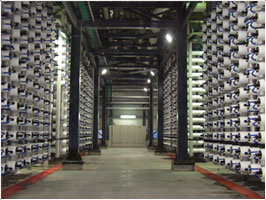
- desalination of sea water (currently 140 million cubic meters, or 7% of the total. Another 100 million due to go online by the end of 2009). This method requires significant amounts of electricity to operate the reverse-osmosis.
- improved water management of existing resources (which often means reducing the safety margin for the production wells).
- treating contaminated water to bring it to drinking water quality.
- repairing the aging, leaky distribution system.
The measures for decreasing consumption include:
- public education campaigns to reduce water use
- regulations reducing the amount of water available for agriculture, public and private gardens, and increasing the cost of this water, encouraging the production of water saving crops instead of oranges, cotton and bananas – at least we don’t grow rice!
- setting pricing structures to increase water savings: basic amount of water for less money, and high fees for anything above that.
- some of our very own prophetic tips for saving water.
In a future post, a comprehensive list of tips how you, too, can help prevent waste of water resources.
Links:
Israel Water Authority (Hebrew)
Israel Water Authority water saving campaign
Other countries dealing with drought issues
California: http://www.water.ca.gov/drought/
Australia: http://www.nwc.gov.au/
Australia: http://www.water.gov.au/
Spain: http://www.mma.es/portal/secciones/





water4gas review…
great post and nice site 🙂 Glad I found it….
Yes, Jared’s point is excellent – spring water is a public resource that adds to the water available to us and to nature. If it is pumped out of the ground and bottled, the companies profit at the expense of the common good. The most extreme example is the Ein Gedi bottled water which comes from the desert, and takes priority over the needs of the nature reserve – when there is a water shortage, the bottling plant gets its full share, while the nature reserves get less.
Even so, some of the bottled water comes from municipal water supplies, and is sold in bottles (at 1000 times the price) after treatment and filtration.
Daniel, thank you so much for this wonderfully clear and concise explanation of the dire, yet survivable, crisis we find ourselves in. I definitely plan to forward this link! It might also be worth emphasizing that the mineral water bottling plants in Israel which you mentioned are drawing water from the same natural sources that supply our tap water, so if we are at all concerned about the rising salinity of our precious lake and aquifers, we must convince folks to think twice about their drinking habits.
Daniel, I think this is something that everyone who lives in Israel or is concerned about Israel should read. Bravo.